He missed the penalty first.
In the ninth minute against Austria, Lautaro Martínez was fouled, the referee pointed to the spot, and the record everyone in Dallas Stadium had come to witness was sitting there waiting for Lionel Messi to claim it. He stuttered in his run-up — the move that has frozen goalkeepers for two decades — and pulled the shot wide of the bottom-right corner. Deathly silence. The record would have to wait.
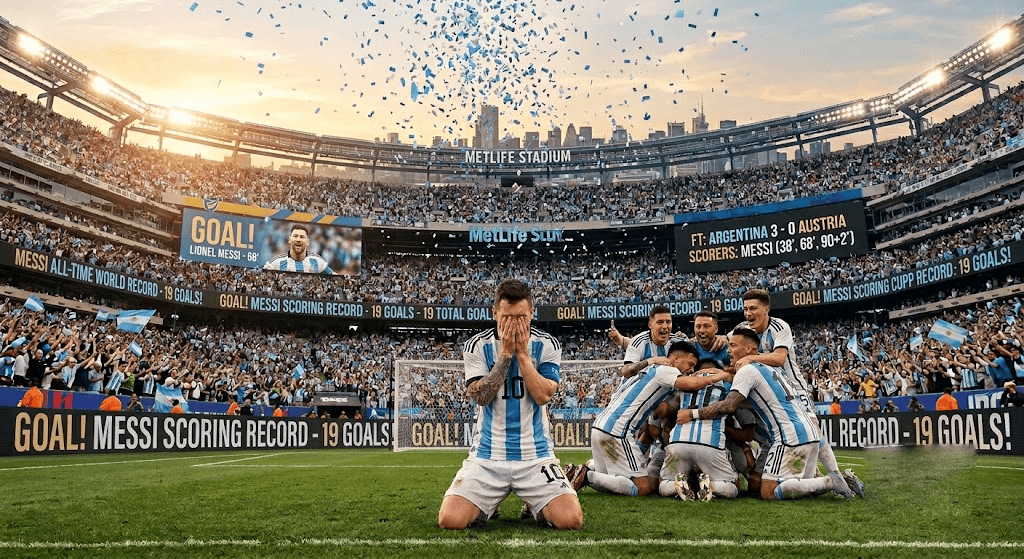
It waited twenty-nine minutes. In the 38th, Messi found space at the top of the box, took a low pull-back, and stroked it first-time into the bottom-left corner. Goal seventeen. Klose's record, which had stood since 2014, was gone. And because Messi has never been a man to stop at enough, he added an eighteenth deep into the match to seal a 2-0 win and push the record two clear.
Eighteen World Cup goals. More than any man who has ever played the tournament. More than any player in either World Cup — the strike moved him past Marta's 17 to make him the highest scorer across the men's and women's tournaments combined.
The numbers around it are almost difficult to hold. Messi scored his first World Cup goal on June 16, 2006, against Serbia and Montenegro, an eighteen-year-old off the bench. Twenty years later, almost to the day, he opened this tournament with a hat-trick against Algeria — his first World Cup hat-trick, the eleventh of his international career, and at 38 years and 357 days, the oldest hat-trick in World Cup history. The previous holder of that particular record was Cristiano Ronaldo. Of course it was.
He is now the first man to play in six World Cups. He has scored in six consecutive World Cup matches, a streak only Just Fontaine in 1958 and Jairzinho in 1970 had managed before him. He has scored all five of Argentina's goals at this tournament. He turns 39 on Wednesday.
And the record may not survive the tournament.
Kylian Mbappé is 27 years old and sitting on fifteen World Cup goals after a brace against Senegal. He plays Iraq as Messi celebrates in Dallas. The arithmetic is simple and a little cruel: the man who inherited the mantle of the world's best player from Messi may also inherit the record, possibly before this World Cup is over, almost certainly before his career is. Messi holds the summit today. He does not necessarily hold it for long. There is something fitting about that — a record claimed and contested in the same fortnight, the past and the future scoring at opposite ends of the same country.
But that is tomorrow's argument. Today, the record is his. And the tournament around him has been busy rearranging itself.
The shape of the thing
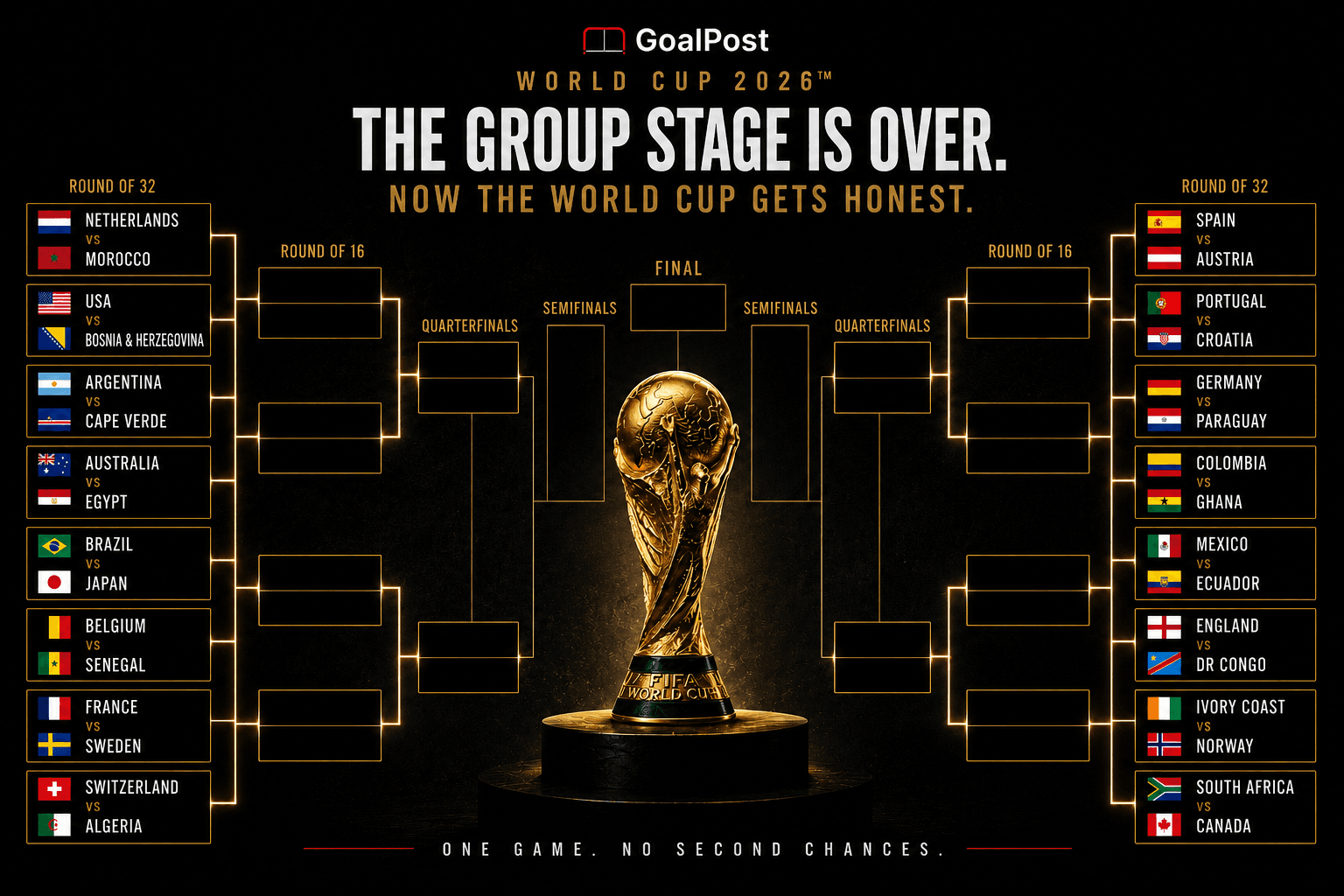
Eleven days in, the World Cup has done what World Cups do: confirmed some things, demolished others, and produced at least three results that nobody had any business predicting. The expanded format — 48 teams, twelve groups, the eight best third-placed sides advancing — was supposed to dilute the drama. It has done the opposite. With more teams chasing fewer certainties, almost every group has gone to the final matchday with something still alive.
Here is where the tournament stands, and what it has told us.
The favorites who look like favorites
Argentina are through, top of Group J, and carried by a 38-year-old playing the best tournament football of anyone in North America. The defending champions have now won eight consecutive World Cup matches since the Saudi Arabia defeat that opened Qatar 2022. That loss feels like it belongs to a different team. This one simply does not lose.
Germany have rediscovered something. After a generation of group-stage humiliations — out in 2018, out in 2022 — they opened with a seven-goal demolition of Curaçao and then came from behind to beat Ivory Coast, sealing their first World Cup knockout appearance in twelve years. Deniz Undav, a substitute, has been the tournament's most effective super-sub. The football has not always been beautiful. The results have been emphatic.
France arrived with the deepest squad in the tournament and have played like it. Mbappé scored twice against Senegal and chases Messi's record with every passing match. The co-favorites look the part.
Spain, the European champions, continue to reload rather than rebuild. And Portugal's midfield — Vitinha, João Neves, Bruno Fernandes — remains, on paper and increasingly on grass, the most complete unit at the tournament.
The surprises
This is where the World Cup earns its name.
Australia beat Turkey 2-0 in Vancouver with 28% of the ball, 30 shots conceded, and a goalkeeper named Patrick Beach playing the match of his life. Tony Popovic named seventeen debutants in his squad. They have a win. Turkey, one of the tournament's fashionable dark horses, have a mountain to climb.
Canada announced themselves not with their opening draw against Bosnia but with what followed: a 6-0 dismantling of Qatar in front of a home crowd that had waited a generation for this. The co-hosts are not here to make up the numbers.
Sweden lived an entire tournament's worth of emotion in eight days. They opened by putting five past Tunisia — a statement, a vindication of every dark-horse whisper — and then were themselves put to the sword by the Netherlands, 5-1. The team that looked like a knockout threat on Matchday 1 looked ordinary on Matchday 2. Both things were true. Both things may stay true.
Japan continue to do the thing they have made their signature: refusing to lose to teams who are supposed to beat them. A 2-2 draw with the Netherlands, salvaged by a Kamada equalizer in the 88th minute, was followed by a 4-0 demolition of Tunisia. They did this to Germany and Spain in 2022. It was not a fluke then. It is not a fluke now.
The returns
Some of the tournament's best stories have nothing to do with the table.
Curaçao, population 150,000, the smallest nation ever to play at a World Cup, lost 7-1 to Germany. They also scored — Leandro Comenencia, in the 21st minute, briefly level with one of football's giants. For a country that size, that goal is a monument. They followed it with a goalless draw against Ecuador and are not yet eliminated, which is its own small miracle.
Scotland ended a 28-year World Cup absence and beat Haiti 1-0 to make the long wait feel worthwhile, before Morocco brought them back to earth. Haiti, back after 52 years, have found the gap between 1974 and 2026 to be every bit as wide as the calendar suggested. But they are here, and for a generation of Haitians who had never seen their country at a World Cup, here is enough.
And Morocco — the 2022 semifinalists, the team that proved Africa's best can beat Europe's best — have quietly gone about confirming that 2022 was not an accident. A draw with Brazil, a win over Scotland. The Atlas Lions are not finished surprising people.
What the football has shown
If there is a single lesson from the first round of group games, it is that the expanded World Cup has not produced the procession of mismatches its critics feared. Yes, Germany beat Curaçao 7-1. But Australia beat Turkey with a quarter of the ball. Japan keep refusing to lose. Canada keep scoring. The smaller nations have, for the most part, arrived not to participate but to compete.
The knockout rounds will tell us whether the giants reassert themselves — whether France and Argentina and Spain and Portugal turn the tournament back into the story everyone expected. Perhaps they will. The favorites usually do.
But for eleven days, the World Cup has belonged to everyone. To Australia's debutants and Canada's home crowd and Curaçao's one shining goal. And, above all of it, to a 38-year-old man in Dallas who has spent twenty years turning waits like that one — the missed penalty, the silence, the twenty-nine minutes — into the moments nobody forgets.
Messi stands alone. The rest of the tournament is still being written.