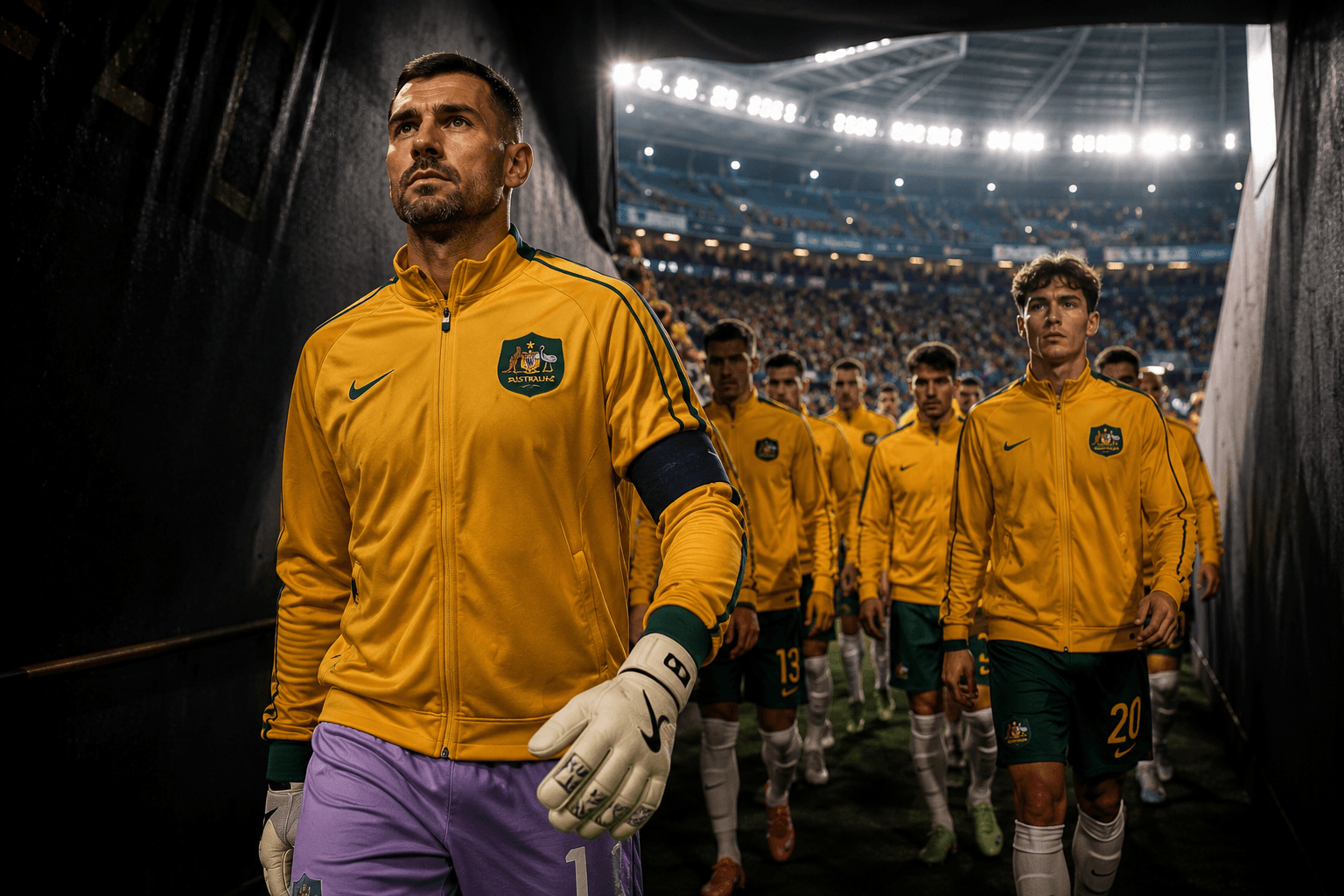
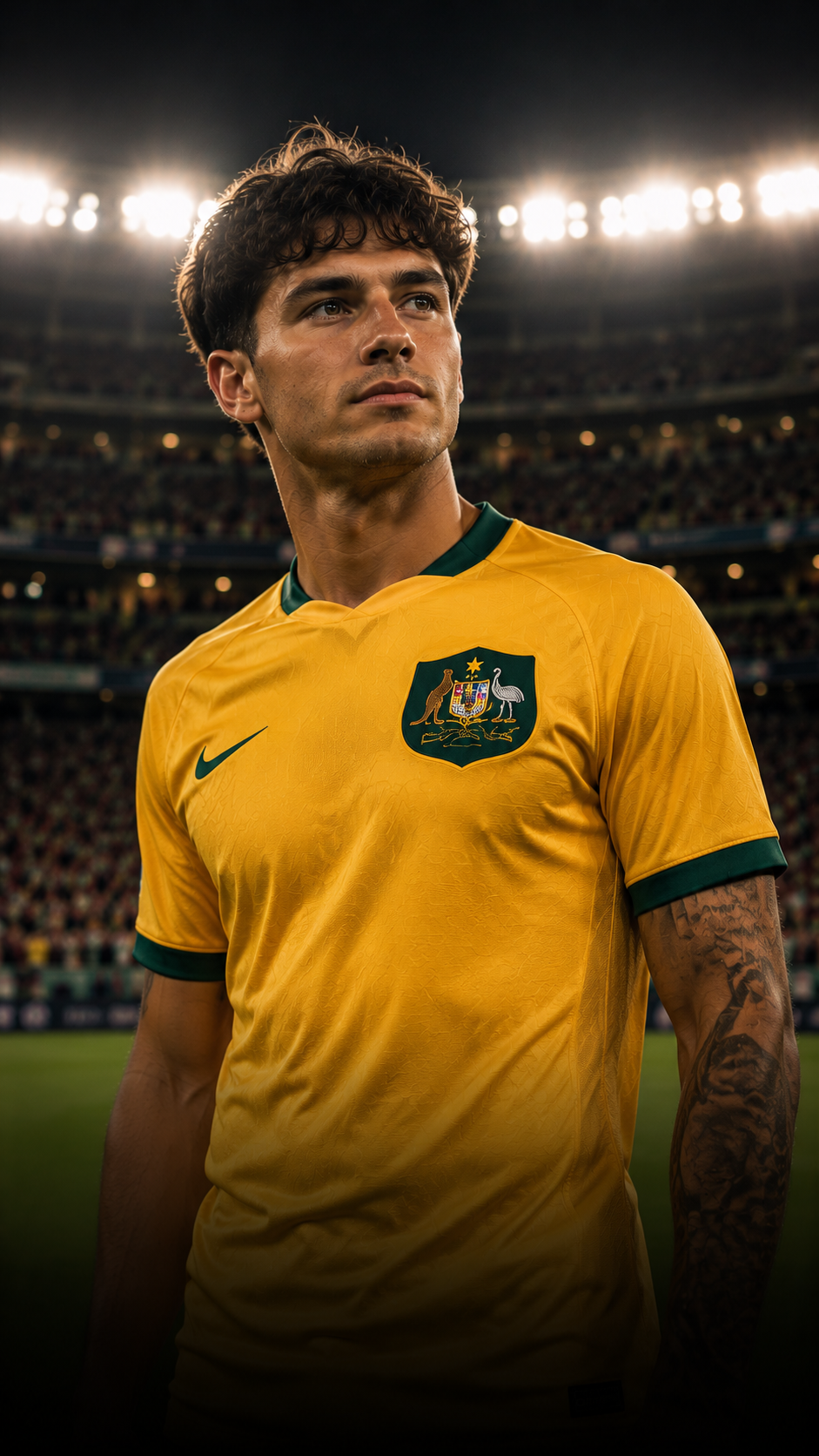
Volpato
Cristian Volpato has never played a senior match for Australia. He grew up in Sydney, moved to Italy as a teenager, played for Roma's academy, represented Italy at under-21 level, and now plays for Sassuolo. He turned down the chance to represent Australia at the 2022 World Cup — as recently as March, he was still reiterating his desire to play for Italy. Then, on the eve of this tournament, he switched. The paperwork went through. Tony Popovic picked him for the squad.
He is 22. He will make his international debut at the biggest tournament in the sport's history. So will Tete Yengi of Machida Zelvia in Japan, the younger brother of existing Socceroo Kusini Yengi. Two uncapped players out of 26. Seventeen World Cup debutants in all. By Australia's standards it is an inexperienced squad — and perhaps the most naturally talented attacking group they have ever brought.
The record chasers
At the other end of the squad, Mathew Ryan and Mathew Leckie are going to their fourth World Cup. They join Tim Cahill and Mark Milligan as the only Socceroos to go to four World Cups. Ryan — captain, 103 caps, now at Levante after a dramatic final-day survival in La Liga — has been the starting goalkeeper at every World Cup since 2014. Leckie, back in the A-League with Melbourne City at 35, has scored World Cup goals and survived every generational shift Australian football has produced in the past decade.
Between Volpato — uncapped, 22, switching countries — and Ryan — 103 caps, four tournaments, the institutional memory of a national team — this squad contains something close to the full span of what international football means. One chose Australia. The other has been Australia.
Aziz Behich, Milos Degenek, and Jackson Irvine are each at their third World Cup. Cameron Devlin, Ajdin Hrustic, Awer Mabil, and Harry Souttar are at their second. This is Australia's seventh World Cup and sixth consecutive — a streak that began in 2006, when Tony Popovic was still playing for the Socceroos.
Popovic's selections
Tony Popovic was part of the Socceroos squad that reached the round of 16 at the 2006 World Cup in Germany. He came close as a player. Now, as coach, he wants to take Australia further than they have ever been.
Popovic's omissions reveal his priorities. Martin Boyle, a fixture of recent Socceroos squads, was left out. Kye Rowles, a starter at the 2022 World Cup, was omitted as well. Even Joe Gauci, widely expected to be Mathew Ryan's deputy, lost out to Paul Izzo of Randers. Experience was available. Popovic chose renewal instead.
Harry Souttar's inclusion is significant. The Leicester City center-back was a key figure in 2022 but has been in and out of squads since, battling injuries. His return gives the defense a physical anchor. Alessandro Circati of Parma provides an alternative, while Jordon Bos of Feyenoord — one of the squad's standout performers in pre-camp — offers a left-footed option from a Europa League side.
The midfield runs through Jackson Irvine and Connor Metcalfe, both at St. Pauli in the Bundesliga. In attack, Nestory Irankunda of Watford is the most exciting prospect — a 20-year-old who left Bayern Munich because he needed game time before the World Cup. His story mirrors Mabil's in one respect: Irankunda was born in a Tanzanian refugee camp to Burundian parents and moved to Australia as an infant. Mabil, born to South Sudanese parents in Kenya's Kakuma refugee camp, is also in the squad, now playing for Castellón in Spain. Two players shaped by displacement, both representing the country that took them in, at football's biggest stage.
The group
Australia are in Group D alongside Turkey, the United States, and Paraguay. The opener is against Türkiye in Vancouver on June 13 — a difficult start against a side with real quality. The second match, against co-hosts USA in Seattle on June 19, is the toughest assignment. The third, against Paraguay in Santa Clara on June 25, may decide everything.
In 2022, Australia reached the round of 16 for the first time since 2006. They beat Tunisia and Denmark in the group stage and lost 2-1 to Argentina in a match that was closer than the eventual winners expected. The ambition now is to go further. Whether a squad with 17 debutants and two uncapped players can do that depends on how quickly Popovic's young core adapts to the speed of tournament football. At one end of the squad stands Mathew Ryan, chasing Australian history at a fourth World Cup. At the other stands Cristian Volpato, making his international debut. One chose Australia. The other has been Australia. The next chapter belongs to both of them.
The squad
Goalkeepers: Patrick Beach (Melbourne City), Paul Izzo (Randers), Mathew Ryan (Levante)
Defenders: Aziz Behich (Melbourne City), Jordon Bos (Feyenoord), Cameron Burgess (Swansea City), Alessandro Circati (Parma), Milos Degenek (APOEL), Jason Geria (Albirex Niigata), Lucas Herrington (Colorado Rapids), Jacob Italiano (Grazer AK), Harry Souttar (Leicester City), Kai Trewin (New York City FC)
Midfielders: Cameron Devlin (Hearts), Ajdin Hrustic (Heracles Almelo), Jackson Irvine (St. Pauli), Connor Metcalfe (St. Pauli), Paul Okon-Engstler (Sydney FC), Aiden O'Neill (New York City FC)
Forwards: Nestory Irankunda (Watford), Mathew Leckie (Melbourne City), Awer Mabil (Castellón), Mohamed Toure (Norwich City), Nishan Velupillay (Melbourne Victory), Cristian Volpato (Sassuolo), Tete Yengi (Machida Zelvia)
Coach: Tony Popovic | Group D: Türkiye · United States · Paraguay
Fixtures: Jun 13 v Türkiye — Vancouver · Jun 19 v United States — Seattle · Jun 25 v Paraguay — Santa Clara
Also in this series: every qualified nation's squad, indexed in 48 Teams, 48 Stories.
Correction, October 5, 2026: this piece was first dated June 18, after Australia's opening match; it was published on June 3. It also said Australia reached the round of 16 for the first time in 2022 (they also did in 2006), that Mathew Ryan and Mathew Leckie would equal a caps record (the record they join is four World Cups), that Feyenoord were a Champions League club this season (they played the Europa League), that Awer Mabil fled South Sudan (he was born in a Kenyan refugee camp), and gave the Türkiye match as June 14 (it kicked off at 9 p.m. on June 13 in Vancouver).