Mexico City has the Azteca. Monterrey has the mountains. Guadalajara has the football.
The distinction matters. Guadalajara is the home of Chivas — Club Deportivo Guadalajara, the only team in Liga MX that has never fielded a non-Mexican player. It is also the home of Atlas, the club that waited 70 years for a league title and then won two in a row. The Clásico Tapatío between them is not the biggest derby in Mexican football (that belongs to América vs Chivas) but it may be the most emotional. Two clubs, one city, and the kind of rivalry that turns neighborhoods into territories.
The Estadio Akron sits in Zapopan, on the northwestern edge of the metropolitan area, and will host four group-stage matches. The city itself, however, is the reason this guide exists. Guadalajara does not need a World Cup to talk about football. It has been doing that for a century. The World Cup merely gives the conversation an international audience.
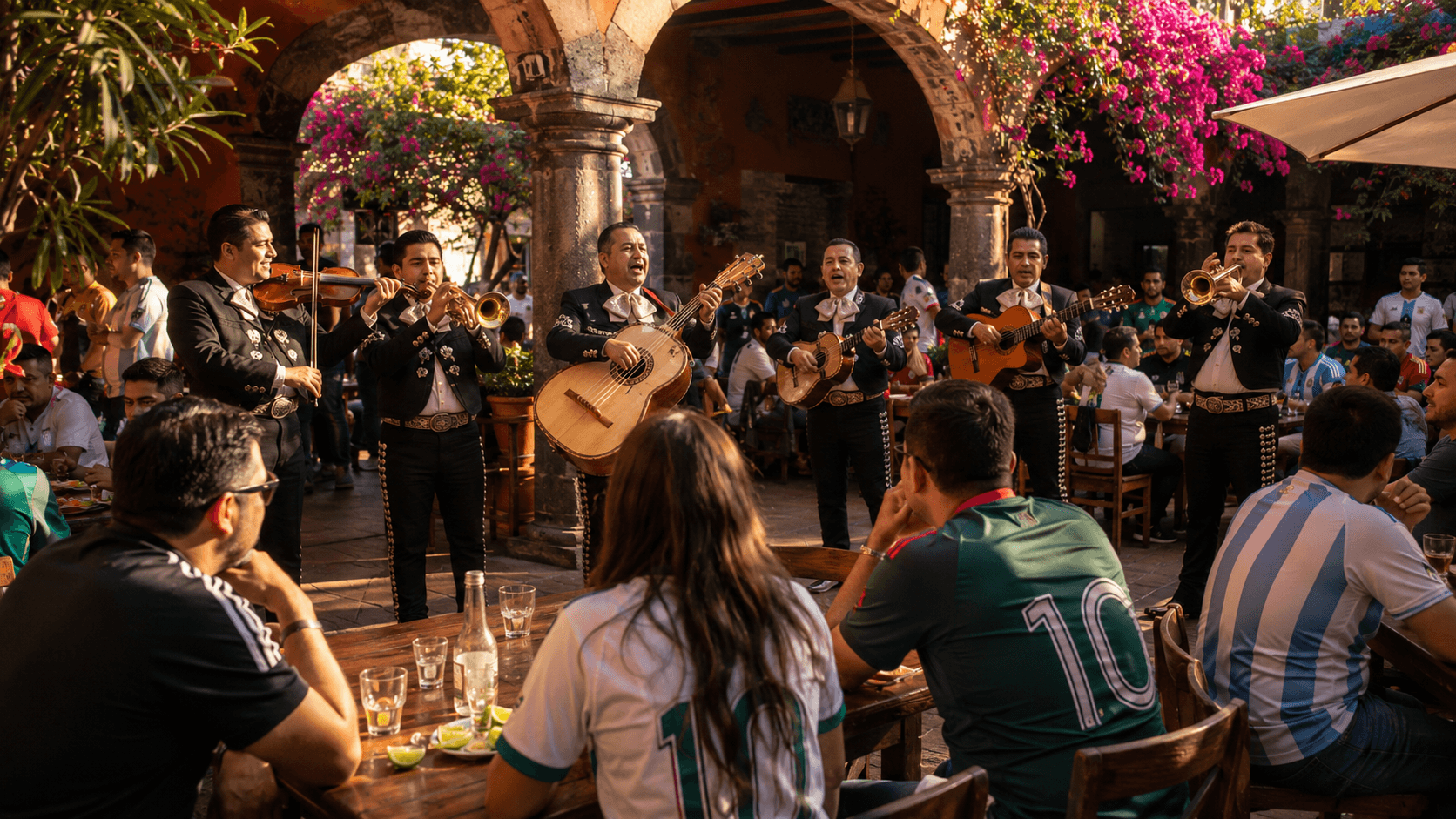
FIFA calls Guadalajara the "world capital of tequila and mariachi." Both are true, and both are relevant — the bars in this city do not separate football from culture. They are the same thing. A match at a Guadalajara cantina is not a quiet affair with craft beer and a mounted television. It is tequila, noise, mariachi between halves, and the absolute certainty that everyone in the room has an opinion about the formation.
The football geography
Guadalajara's football culture lives on one avenue: Chapultepec.
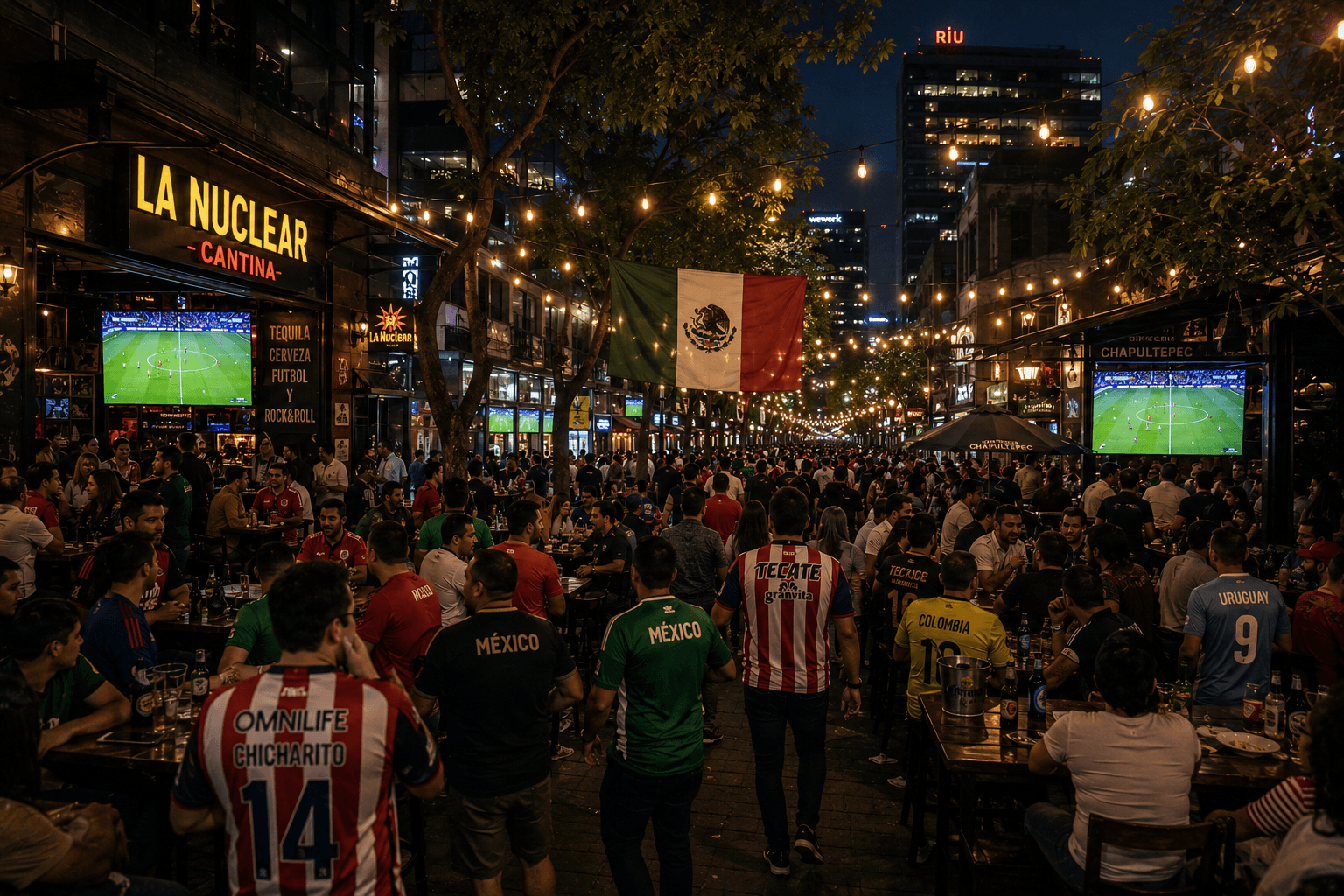
Avenida Chapultepec runs through Colonia Americana, the neighborhood that contains the highest concentration of bars, restaurants, and nightlife in the city. During the World Cup, this strip will function as an open-air football corridor — every bar with a screen will have a crowd, and the streets between them will fill with people moving from venue to venue between matches. If you are watching the World Cup in Guadalajara and you do not know where to go, walk to Chapultepec. You will find the match.
Beyond Chapultepec, the Centro Histórico holds the city's traditional cantinas — older, louder, and less polished than the bars in Colonia Americana. These are the places where football has always been watched: on a television behind the bar, with a cold beer and a plate of botanas, surrounded by men who have been arguing about Chivas since before the current squad was born.
Providencia, to the northwest, offers a quieter alternative — more upscale, more international, and more likely to have English-speaking staff. It is not where the atmosphere is best. It is where the comfort is best.
Where to watch
Guadalajara does not really have a single World Cup bar. It has a World Cup district. Most visitors will end up somewhere along Chapultepec, moving between patios, cantinas, sports bars, and crowded sidewalks as matches begin and end. The best venues reflect different versions of the city.
The stadium
Estadio Akron sits in Zapopan, about 30 minutes from the city center by car, longer by public transit. The BRT line Mi Macro Periferico has a stop at the stadium. The venue opened in 2010, replaced Estadio Jalisco as Chivas' home ground, and was built to FIFA World Cup standards from the outset. Its bowl design creates steep sightlines and traps noise inside the stadium. When the crowd is full, the sound seems to collapse onto the pitch.
Estadio Jalisco, the older stadium across the city, hosted matches at both the 1970 and 1986 World Cups. It is worth visiting even without a ticket — a walk around the exterior is a walk through Guadalajara's football history.
The matches
Four group-stage matches at Estadio Akron:
- June 11: South Korea vs Czechia — 8 PM local (10 PM ET). Opening night. The second match of the entire tournament, played the same evening Mexico face South Africa at the Azteca.
- June 18: Mexico vs South Korea — 7 PM local (9 PM ET). Mexico's second group match, on Guadalajaran soil. The city will be unrecognizable.
- June 23: Colombia vs DR Congo — 8 PM local (10 PM ET). Colombia's attacking talent against one of the tournament's great return stories. Expect a large Colombian presence.
- June 26: Uruguay vs Spain — 6 PM local (8 PM ET). The strongest fixture in Guadalajara's schedule. Two former World Cup winners. A match that could easily belong in the knockout rounds.
The city
Guadalajara is Mexico's second city and, depending on who you ask, its first football city. The tequila is real — the agave fields of Jalisco surround the metropolitan area, and the bars pour it accordingly. The mariachi is real — Plaza de los Mariachis in the Centro Histórico is not a tourist invention but a living tradition. And the football is real — not imported, not aspirational, but embedded in the identity of a city that has produced two of Mexico's most important clubs and watched World Cup matches at Estadio Jalisco in 1970 and 1986.
Guadalajara hosted four matches during the 1986 World Cup at Estadio Jalisco, including Brazil's famous 1-0 victory over Northern Ireland and the round-of-16 match between the Soviet Union and Belgium that remains one of the greatest matches in World Cup history. For older supporters, the 2026 tournament is not a first experience. It is a return.
The World Cup returns to Guadalajara for the first time in 40 years. The city never stopped talking about football. In June, the conversation goes global.
Also in this series: The Best Bars in Mexico City to Watch the World Cup — the Azteca city, five matches, and a cantina tradition that predates television. The Best Bars in Monterrey to Watch the World Cup — the Steel Giant, the Sierra Madre, and the only Mexican venue hosting a knockout match. The Best Bars in Atlanta to Watch the World Cup — the city that built a soccer culture from scratch, now hosting a semifinal. The Best Bars in Boston to Watch the World Cup — Irish pubs, the Tartan Army, and a train to Foxborough. The Best Bars in Kansas City to Watch the World Cup — the Soccer Capital of America, barbecue tailgates, and the loudest stadium on earth.
Correction, October 5, 2026: this guide first recommended La Nuclear Sports Cantina and The Beer Garden. We could not find either in Guadalajara (the La Nuclear we found is a pulquería in Mexico City), so they are no longer listed. It also placed Taberna de Mou in the Chapultepec area; it is in Santa Teresita.