The 2026 World Cup opens at the Estadio Azteca on June 11. It is the third time the stadium has hosted a World Cup opener — 1970 and 1986 were the first two — and its renovation is nearly complete. Mexico's national team is expected to play that night.
The city will be ungovernable.
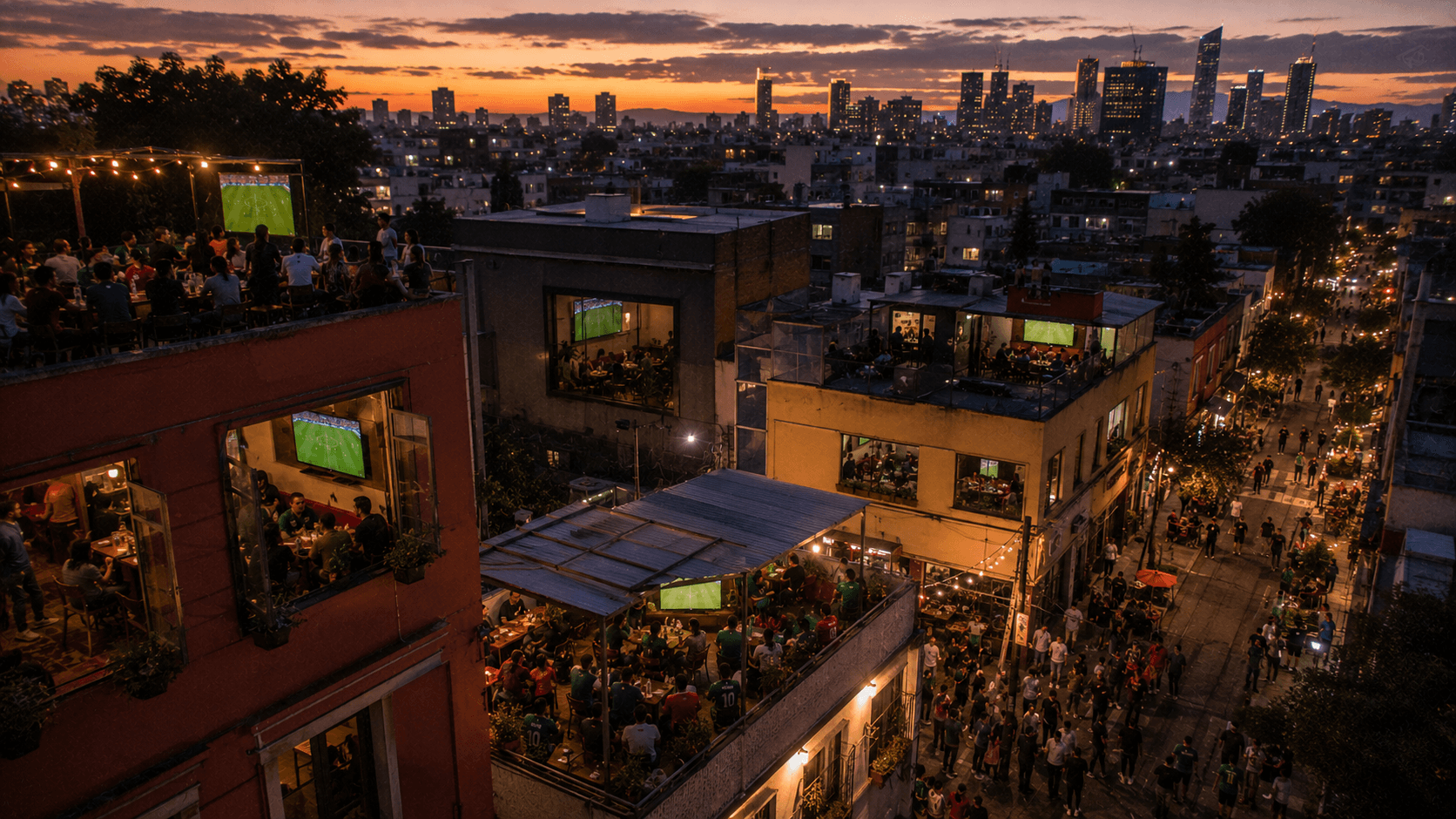
And yet the opening match is only part of the story. The Azteca hosts only five of the 104 World Cup matches. The other 99 will be watched from bars, cantinas, taquerias, rooftops, living rooms, and plazas across a city of 22 million that does not need an excuse to stop for football. Mexico City during a World Cup is not a city with watch parties. It is a watch party that happens to contain a city.
This guide is for the days when the match is not at the Azteca. For the matches on screens rather than in seats. For the bars, cantinas, and cervecerías where Mexico City does what it has always done: gather around the game.
Mexico City's football territories
Mexico City's World Cup experience divides along neighborhood lines. Coyoacán and the southern colonias orbit the Azteca — on match days, the restaurants and bars south of Insurgentes fill with fans walking to and from the stadium. Roma Norte and Condesa become street-party territory — sidewalk bars, open doors, commentary audible from every corner. Centro Histórico offers the cantina tradition: hundred-year-old bars where football is watched the way it has been watched since screens first appeared. Polanco provides the upscale option — polished cervecerías and restaurants that cater to tourists and the international business crowd.
The World Cup will be watched differently in each of these neighborhoods. The same goal will produce different volumes in Roma, Polanco, and Coyoacán. That is Mexico City — one city, many registers.
Torito Sports Bar — Insurgentes
Av. Insurgentes Sur 1020, Insurgentes San Borja, Benito Juárez, 03100
If you want to watch football the way Mexico City watches football — not in an expat pub, not in a polished Polanco restaurant, but in a proper cantina deportiva — Torito is the answer. The bar's own line is "todos los eventos deportivos," every sporting event, and the atmosphere during Liga MX matches and national team fixtures makes it clear that the line is not aspirational. It is descriptive.
Multiple screens ensure every seat has a view. The crowd is overwhelmingly local — after-work regulars, weekend football devotees, neighborhood families who treat matchday as a communal event. The food and drinks are priced for return visitors, not tourists. Torito sits about three miles south of Reforma, a few hundred yards from the Estadio Ciudad de los Deportes, far enough from the hotel district to feel like a different city. Of all the venues on this list, Torito is the one that most embodies the article's thesis: football in Mexico City is not an event you attend. It is a rhythm you join.
La Cervecería de Barrio — Polanco
Euler 145, Polanco V Secc, Miguel Hidalgo, 11560
Cervecería de Barrio is a chain with locations throughout the city, but the Polanco outpost is the one that matters for the World Cup. The bar fills early, gets rowdy regardless of who is playing, and serves the kind of flowing cerveza and seafood botanas that turn a Tuesday group-stage match into an event. During matches involving Mexico, the United States, or any major European team, the atmosphere crosses from energetic into ecstatic.
Polanco is the neighborhood most international visitors will be staying in. Cervecería de Barrio provides exactly what they will be looking for: screens, beer, food, and a crowd that treats football as a matter of national importance. Arrive an hour before kickoff for Mexico matches. Ninety minutes for the opener.
Colonia Juárez — the expat corridor
C. Londres & surrounding streets, Juárez, Cuauhtémoc, 06600
Juárez is where Mexico City's expat and international communities overlap most visibly — and during the World Cup, that overlap becomes the neighborhood's defining feature. Within a few blocks of Reforma, you can find The Dog House (a British football pub lined with memorabilia, loud on European match days), BeerGarden Roma (craft beer, screens, a younger crowd), and half a dozen sidewalk bars where the commentary spills onto the pavement.
The neighborhood's value during the World Cup is not any single bar. It is the density. Walk along Calle Londres or Calle Hamburgo during a match and the options reveal themselves — one bar showing the Mexico fixture, another showing a European group-stage match, a third where the crowd has already moved on to the second fixture of the evening. Juárez is the Mexico City version of London's Soho or San Francisco's Haight: a football corridor rather than a football destination.
Salón Corona — Centro Histórico
Bolívar 24, Centro Histórico de la Cdad. de México, Cuauhtémoc, 06000
One of the oldest cantinas in Mexico City and one of the most beautiful. Salón Corona has been serving beer and tortas since 1928. The space is vast, tiled, and filled with the kind of light that makes everything inside look like a photograph from another era. During the World Cup, the cantina will show matches on screens installed for the tournament — the juxtaposition of a 98-year-old bar and a high-definition football broadcast is part of the charm.
Salón Corona is not a sports bar. It is a cantina that happens to be showing the World Cup, the way generations of Mexico City football fans have watched World Cups in cantinas like this. The tortas are legendary. The beer is cold. The crowd is Centro Histórico — workers, tourists, locals who have been coming here since before the current World Cup cycle began.
Sport and Chips — Coyoacán
Coyoacán is one of Mexico City's most beloved neighborhoods — Frida Kahlo's house is here, the streets are tree-lined and colonial, and the plazas fill with families on weekends. Sport and Chips is the neighborhood's go-to sports bar: a jumbotron-style screen in the center of the room, tapas plates, a steady flow of beer, and a crowd that mixes locals with visiting fans.
The Coyoacán location provides an alternative to the Polanco-Juárez-Roma corridor where most tourist-facing bars are concentrated. For visitors who want to see a different Mexico City — quieter, more residential, more distinctly Mexican — Sport and Chips is the bar that delivers football in a setting that feels like the neighborhood rather than the nightlife district.
Roma Norte — the neighborhood
Roma Norte is not one bar. It is a neighborhood that becomes a single venue during the World Cup. Walk along Álvaro Obregón or Orizaba during a Mexico match and the scene is the same in every direction: TVs visible through open doors, crowds gathered on sidewalks, cheering audible from blocks away. Cervecería de Barrio on Álvaro Obregón is the loudest. Beyond the neighborhood proper, two nearby detours reward the walk: La Bipolar in Coyoacán draws a younger crowd, and Salón Ríos in Cuauhtémoc offers micheladas and atmosphere.
What makes Roma Norte distinct from the other neighborhoods on this list is density. The bars are close enough together that you can walk between three of them during halftime. On Mexico's opening night — if El Tri plays at the Azteca on June 11, as expected — Roma Norte will be the neighborhood where the people who could not get tickets watch the match. The energy will not be lesser. It will simply be different: outdoor, communal, uncontained.
The match schedule
Estadio Azteca hosts three group-stage matches, with two knockout rounds to follow once the bracket is set:
- June 11 — Mexico vs South Africa (the tournament opener)
- June 17 — Uzbekistan vs Colombia
- June 24 — Czech Republic vs Mexico
The tournament opens here on June 11. Mexico City runs two hours behind the US East Coast in June (the city no longer observes daylight saving), which means most group-stage matches across the tournament land between early afternoon and 8 PM local time — perfect cantina hours.
For matches not at the Azteca, the bars on this list will show every fixture. But the truth is that this guide is almost unnecessary. During the World Cup, Mexico City does not need a list of bars showing football. It needs a list of bars that are not.
Mexico City has hosted more World Cup matches than any city on earth. The Azteca held Pelé's coronation in 1970 and Maradona's in 1986. The city knows what a World Cup feels like — not as an event that arrives, but as a rhythm that returns. The cantinas have been here for a century. The football has been here for longer. The World Cup simply gives both a reason to stay open a little later and pour a little more.
Also in this series: The Best Bars in Guadalajara to Watch the World Cup — Mexico's football city, four matches at Estadio Akron, and Avenida Chapultepec as a World Cup corridor. The Best Bars in Monterrey to Watch the World Cup — the Steel Giant, the Sierra Madre, and the only Mexican venue hosting a knockout match. The Best Bars in Atlanta to Watch the World Cup — the city that built a soccer culture from scratch, now hosting a semifinal. The Best Bars in Boston to Watch the World Cup — Irish pubs, the Tartan Army, and a train to Foxborough. The Best Bars in Kansas City to Watch the World Cup — the Soccer Capital of America, barbecue tailgates, and the loudest stadium on earth.
Correction, October 5, 2026: this guide first placed Torito Sports Bar at Av. Insurgentes Centro 1020, within walking distance of Reforma, and quoted a slogan the bar does not use. Torito is at Av. Insurgentes Sur 1020, by the Estadio Ciudad de los Deportes, and its own line is "todos los eventos deportivos."