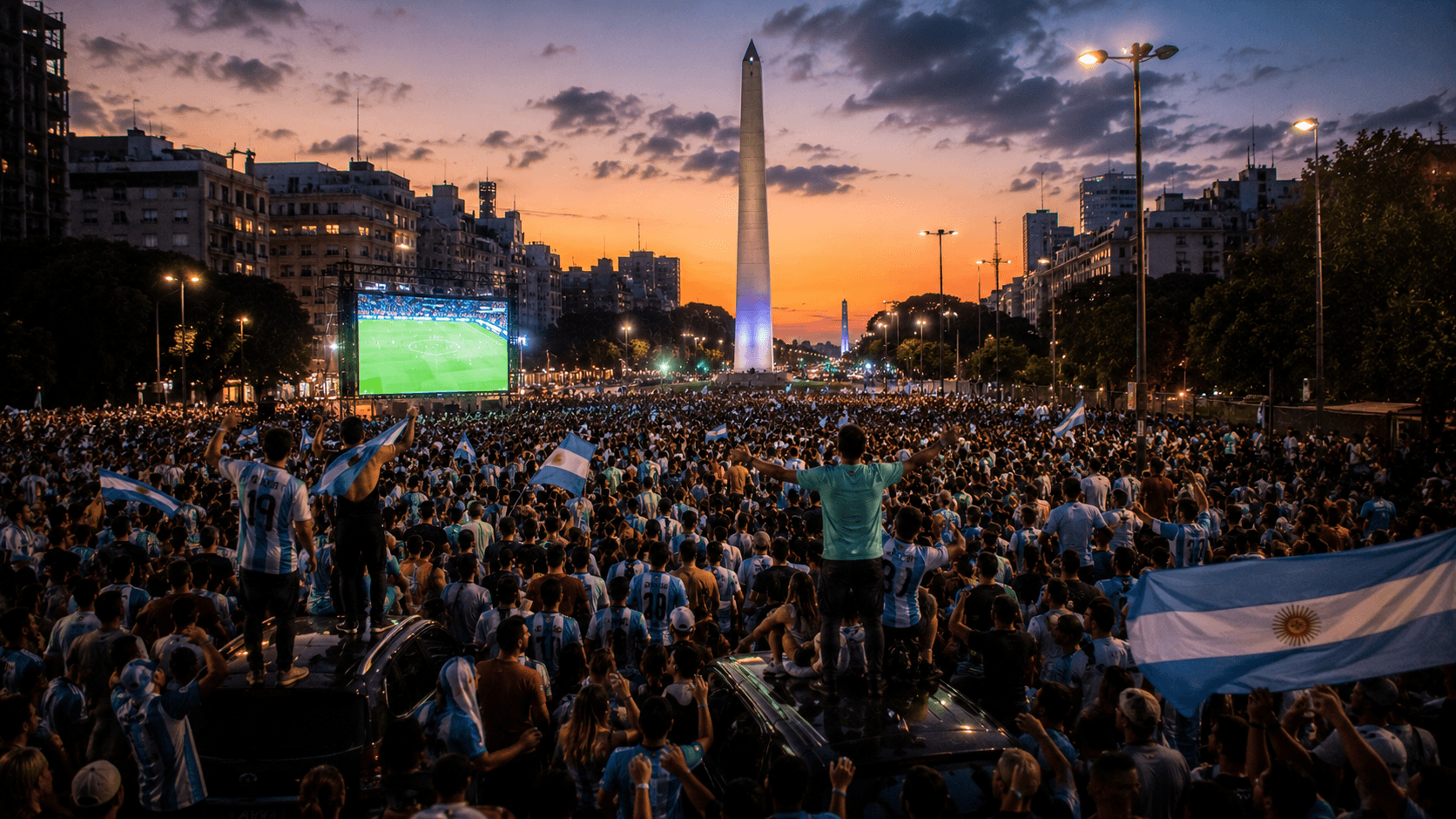
When Argentina play at a World Cup, Buenos Aires stops. Not metaphorically. The city stops. Shops close. Buses empty. Streets fill with people who have no intention of going anywhere until the match is over. Projectors appear on building walls. Screens emerge in plazas. Apartment windows open and the commentary drifts down to the sidewalk, where people who have never met each other stand together and watch.
This is not a city that needs a guide to find the World Cup. The World Cup finds it.
What Buenos Aires does need — and what this guide provides — is a list of bars for the matches that are not Argentina's. For the group-stage fixtures between two European teams at 4 PM on a Wednesday. For the round of 32 match between an African team and a South American rival that the city will not shut down for but will absolutely care about. Buenos Aires doesn't have the sports-bar culture of North America or Britain. Watching football in a pub is not a porteño tradition — watching football is the tradition, and it happens everywhere. But a handful of bars in Palermo, San Telmo, and Almagro have earned reputations as the places to go when the match matters and your apartment is too quiet.
Buenos Aires football geography
The city experiences football differently by barrio. La Boca is where football and identity are inseparable — the Bombonera sits in the middle of a neighborhood painted in Boca Juniors' blue and gold, and on match days the streets feel closer to a pilgrimage than a commute. Almagro is old-club territory — Boedo, San Lorenzo, the cafés notables where football has been watched since the 1920s. San Telmo offers the historic bar culture: tiled floors, pressed-tin ceilings, and a crowd that has been coming to the same spot for decades. Palermo is younger, more international, more craft beer than litro — the bars here cater to expats and tourists alongside porteños. And the Microcentro — specifically the Obelisco on Avenida 9 de Julio — is where the entire city converges after an Argentina victory. Every other neighborhood divides. The Obelisco unites.
El Banderín — Almagro
Guardia Vieja 3601, Almagro
Opened in 1923. More than a century old. El Banderín is a bar notable — a protected heritage café — in the heart of Almagro, one of Buenos Aires' most football-dense neighborhoods. The walls are covered with more than 500 pennants from football clubs around the world, collected over decades and displayed like a museum of the sport's global reach. Teams from Argentina, Brazil, England, Spain, Japan, and countries most porteños have never visited are all represented.
El Banderín shows every match. The atmosphere during a Superclásico or a World Cup fixture is the atmosphere of a bar that has been doing this since before television — cold litro beers, peanuts, sandwiches de miga, and a crowd that understands that watching football in a bar this old is an act of civic participation. For the World Cup, El Banderín is not the loudest option. It is the most authentic.
Locos por el Fútbol — Recoleta
Village Recoleta, Junín 1930, Recoleta
If El Banderín is the museum, Locos por el Fútbol is the stadium. Giant screens, football-themed décor from floor to ceiling, and the kind of atmosphere that during a Superclásico or an Argentina World Cup match borders on the physical — the room shakes, the tables rattle, the person next to you becomes your closest friend or your worst enemy depending on who scores. The bar's name translates to "Crazy About Football," and nobody who has been inside during a knockout match would argue with the description.
Locos has contracted since a shopping-center renovation reduced its footprint, but it remains the reference point for concentrated matchday energy in Buenos Aires. During Argentina fixtures, arrive an hour early or do not arrive at all. During non-Argentina matches, it is the best place in the city to find porteños who care about someone else's result — which, in a country that claims the rest of the world's football as its own, is more people than you might expect.
La Puerta Roja — San Telmo
Chacabuco 733, San Telmo
Behind a red door on a quiet San Telmo street, up a flight of stairs, is one of the most energetic sports-watching experiences in Buenos Aires. La Puerta Roja is not visible from the street. You have to know it is there. Behind the door is a pub with a huge screen, a bar that serves something called the Chilli Bomb (vodka, Red Bull, Tabasco), and a crowd that mixes backpackers, expats, and porteños in roughly equal proportions.
The atmosphere during a World Cup match is closer to a hostel common room than a traditional bar — people from different countries, supporting different teams, bonding and arguing in multiple languages. San Telmo is Buenos Aires' bohemian quarter, and La Puerta Roja is the bar that captures that identity most precisely. For a neutral match where the entertainment is the company as much as the football, there is nowhere better.
Sullivan's — Palermo
El Salvador 4919, Palermo Soho
An Irish pub a block from Plaza Serrano that has been operating in Palermo for more than 20 years. Sullivan's has eight TVs, Guinness on tap, and a crowd that draws from the neighborhood's international population — Palermo Soho is where most of Buenos Aires' expat community lives, and Sullivan's is where they watch football.
The bar is not going to win any awards for its food (fish and chips, hamburgers, shepherd's pie — functional rather than inspired), but the atmosphere during a Premier League morning or a World Cup evening is genuine. Sullivan's is the bar for the person who misses watching football in an English or Irish pub and wants to find the closest approximation in South America.
Desarmadero Bar — Palermo
Gorriti 4295, Palermo Soho
Two locations on the same corner — Desarmadero Bar and Desarmadero Session — with more than 40 taps of Argentine craft beer between them. The TVs will be active during the World Cup, but the real draw is the beer. Argentina's craft brewing scene has exploded over the past decade, and Desarmadero is one of the bars that started it.
For the World Cup, Desarmadero offers something the traditional pubs cannot: the chance to watch football while drinking beer that is genuinely worth paying attention to. IPAs, stouts, sours, red ales — the tap list rotates and rewards exploration. The crowd is Palermo — young, international, more interested in what is in their glass than what is on the screen, until a goal is scored.
Bar Federal — San Telmo
Carlos Calvo 599, San Telmo
One of the most distinguished bars in Buenos Aires. Bar Federal is a San Telmo institution — tiled floors, dark wood, a pressed-tin ceiling, and the kind of timeless interior that makes every drink feel like it is being consumed in a photograph from the 1940s. The bar shows football on a screen that feels almost apologetic in its presence, as if the television knows it is the newest object in a room full of antiques.
Bar Federal is the World Cup bar for people who want refined surroundings rather than raucous energy. The drinks are proper — vermut, fernet, cold beer — and the food is classic Buenos Aires café fare. For a visitor who wants to experience Argentine football culture in a setting that is distinctly, unapologetically porteño, Bar Federal is the answer.
The streets
This is the entry that does not have an address. During Argentina matches, the streets of Buenos Aires become the venue. The Obelisco on Avenida 9 de Julio is the gathering point after victories — tens of thousands of people, flags, flares, songs that continue until dawn. Plazas in every barrio set up screens. Restaurants and cafés wheel TVs onto sidewalks. The boundary between indoor and outdoor disappears.
If Argentina reach the knockout rounds — and as defending champions, they are expected to — the city will escalate with each match. The round of 16 will be loud. The quarterfinal will be louder. The semifinal will be a public holiday in everything but name. And if Argentina reach the final, Buenos Aires will do what it did in December 2022: stop entirely, hold its breath, and erupt.
No bar can replicate that. No guide can prepare you for it. It simply happens.
Buenos Aires does not have a sports bar culture. It has a football culture. The difference is that a sports bar requires a television. Buenos Aires requires only a ball, or a rumor that a match is happening, or — during a World Cup — absolutely nothing at all. The city will find the game. It always does.