Kansas City holds a Guinness World Record for noise.
Arrowhead Stadium was once measured at 142.2 decibels — louder than a jet engine at takeoff — and certified by Guinness as the loudest in the world. That record belongs to the Kansas City Chiefs and their famously relentless home crowd, but it tells you everything about the city that will host six World Cup matches this summer, including the only quarterfinal in the central United States. Kansas City does loud. It does passionate. It does the kind of full-day, full-throated sporting devotion the World Cup was built for.
It also calls itself the Soccer Capital of America, and the claim has evidence behind it. The late Lamar Hunt, the Chiefs' founder, was a driving force behind Major League Soccer after the 1994 World Cup, and the franchise he started became Sporting Kansas City. The city understands the game. When the World Cup arrives, it will not be learning football. It will be hosting it the way it hosts everything: with smoke in the air and noise in the streets.
The football geography
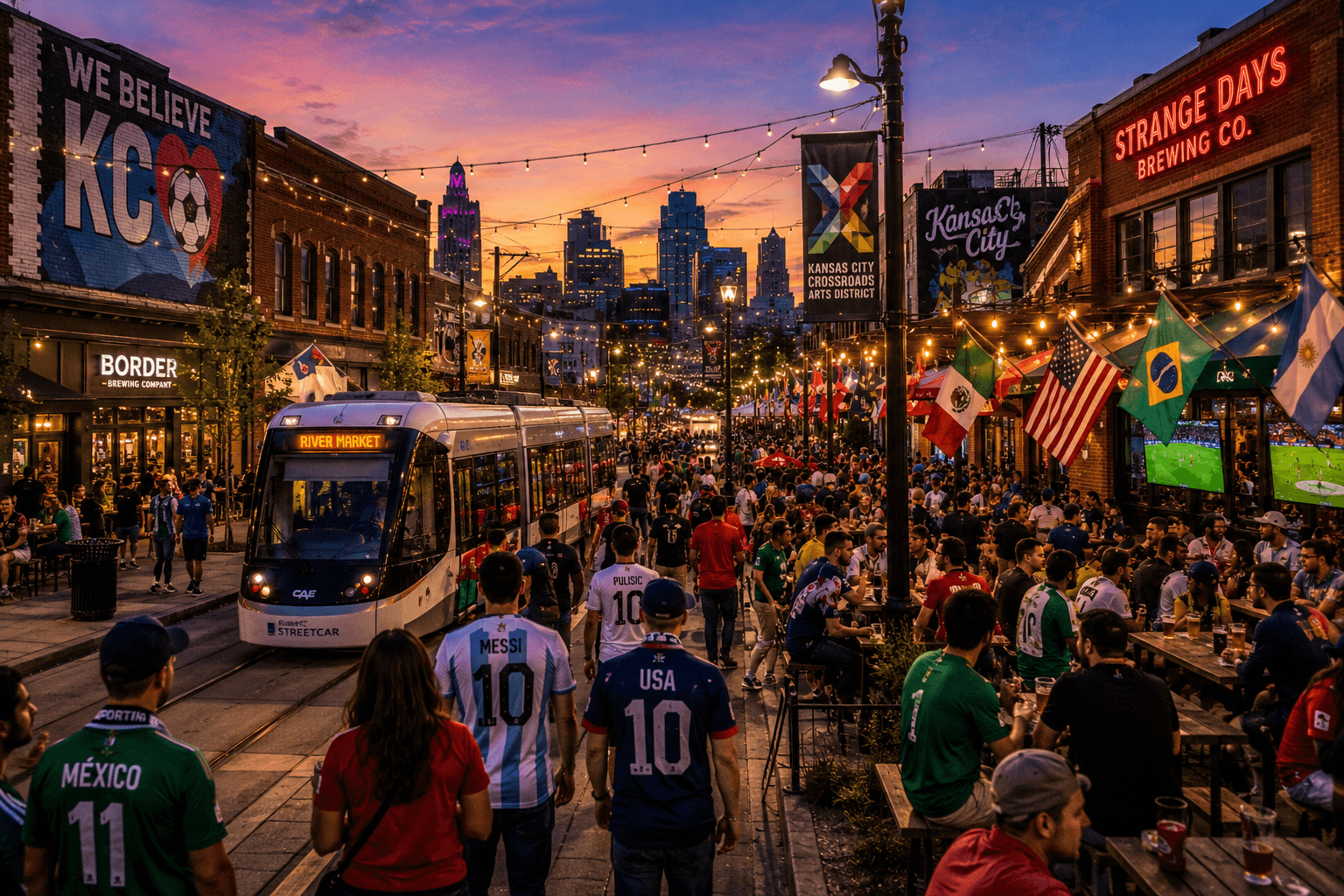
That identity shapes the way you experience a World Cup here. First: the stadium is not downtown. Arrowhead sits in the Truman Sports Complex, east of the city center off I-70, and public transit does not reach it — on match days the ConnectKC26 shuttle service runs from downtown, the Fan Festival, and park-and-ride lots, and if you drive, you tailgate, because tailgating at Arrowhead is less an option than a cultural requirement. Second: the watching, drinking, and gathering happen downtown, in a few districts close enough to move between on foot or on the free streetcar.
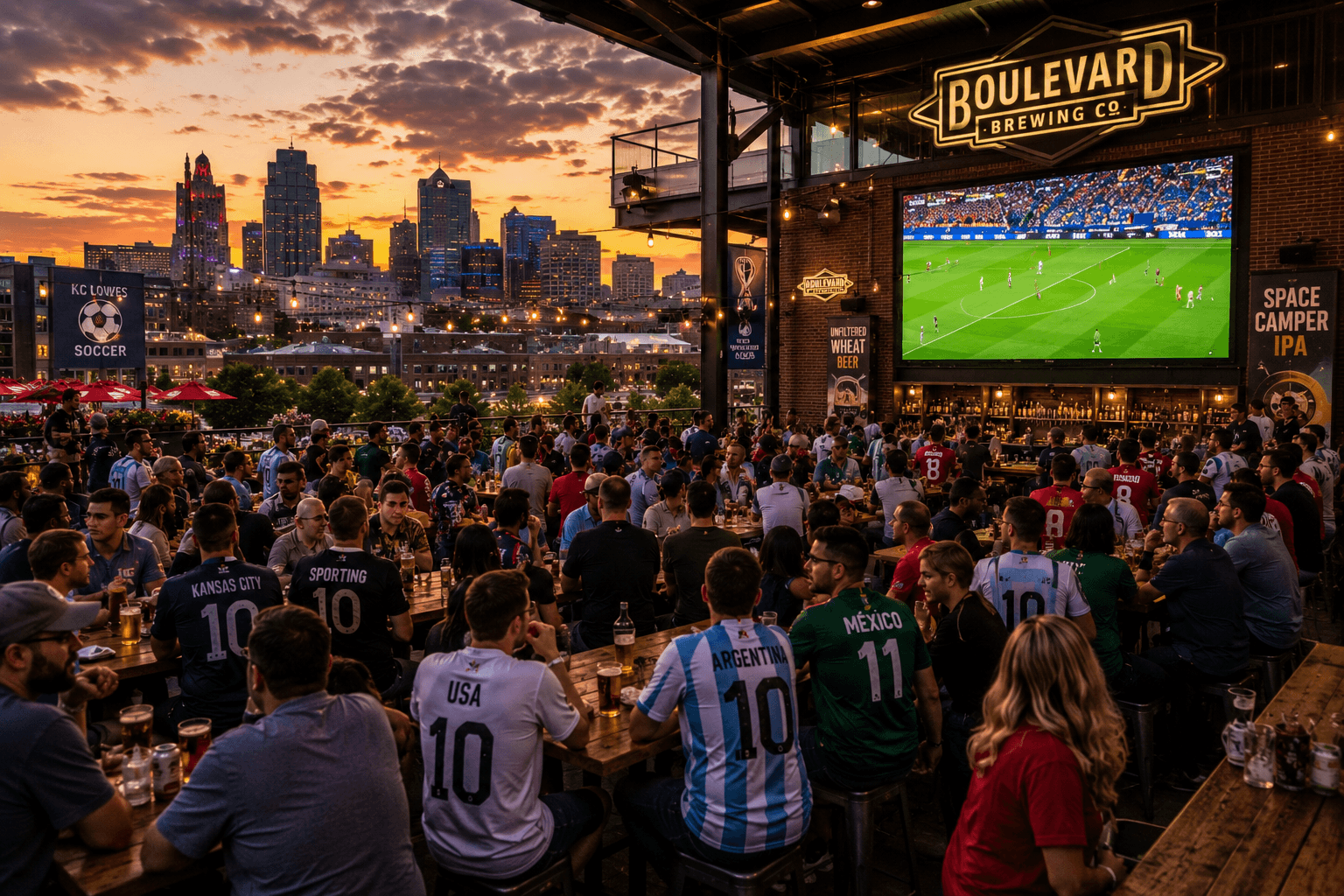
The Power & Light District is the beating heart — an open-air entertainment block downtown, anchored by the KC Live! stage, built for exactly the kind of mass public viewing the World Cup demands. Just south, the Crossroads Arts District is the hip, walkable version: breweries and bars in former warehouses, food trucks, a more local crowd. North, on the free streetcar line, the River Market holds a soccer-first brewery and an easy ride from downtown hotels. Each district has its own accent, and the streetcar threads them together.
The official FIFA Fan Festival sits on the south lawn of the National WWI Museum and Memorial, beneath the Liberty Memorial tower, overlooking the downtown skyline — one of the most spectacular fan-zone settings of the entire tournament, running 18 days from June 11 with free admission and a concert lineup to match the football.
Where to watch
The stadium
Arrowhead Stadium — Kansas City Stadium for the tournament — is the home of the Chiefs and part of the Truman Sports Complex, and it opened in 1972. The Guinness record was set here, at 142.2 decibels. To meet FIFA standards, the field was widened from its NFL dimensions to roughly 116 by 68 yards. The defining local experience remains the tailgate: arrive hours early, walk the lots, and you will find the great American pre-match ritual in full smoke — grills, coolers, and the kind of hospitality the city is built on. It is worth doing even if you have never tailgated in your life. The stadium holds 76,416 for the tournament.
The matches
Kansas City drew one of the tournament's marquee group-stage fixtures and built from there:
- June 16: Argentina vs Algeria — the defending champions, with Messi, opening their campaign. He scored a hat-trick that night, the first of his World Cup record chase. Kansas City saw the opening act.
- June 20: Ecuador vs Curaçao — South America's strongest emerging side against the smallest nation ever to reach a World Cup.
- June 25: Tunisia vs Netherlands — the Dutch and their traveling Oranje support in full voice.
- June 27: Algeria vs Austria — a Group J meeting with knockout places at stake.
Then the knockouts: a Round of 32 match on July 3 and a quarterfinal on July 11 — the only quarterfinal in the central United States, and the biggest match Kansas City has ever hosted.
The city
Kansas City is barbecue and jazz, and it does not let you forget either. This is the city of Arthur Bryant's and Gates, of burnt ends and KC-style sauce, of the 18th and Vine jazz district where the music was born and the Negro Leagues Baseball Museum that tells one of the most important stories in American sport. It has always been more culturally significant than its size suggests, and recent years — the Chiefs' dynasty, the World Cup bid — have made sure the rest of the country knows it.
For the World Cup, Kansas City offers the most authentically American experience on the calendar: the tailgate, the barbecue, the loudest stadium on earth, the open-air watch parties in a district built for celebration. Kansas City has spent thirty years calling itself the Soccer Capital of America. This is the month it gets to prove it.
If you leave having watched a World Cup match, eaten burnt ends in a parking lot before kickoff, and gone home smelling faintly of smoke, you have probably done it correctly.
Also in this series: The Best Bars in New York · The Best Bars in Atlanta · The Best Bars in Boston · The Best Bars in Los Angeles · The Best Bars in Dallas · The Best Bars in Houston · The Best Bars in Miami · The Best Bars in Philadelphia · The Best Bars in San Francisco · The Best Bars in Seattle · The Best Bars in Toronto · The Best Bars in Vancouver · The Best Bars in Mexico City · The Best Bars in Guadalajara · The Best Bars in Monterrey