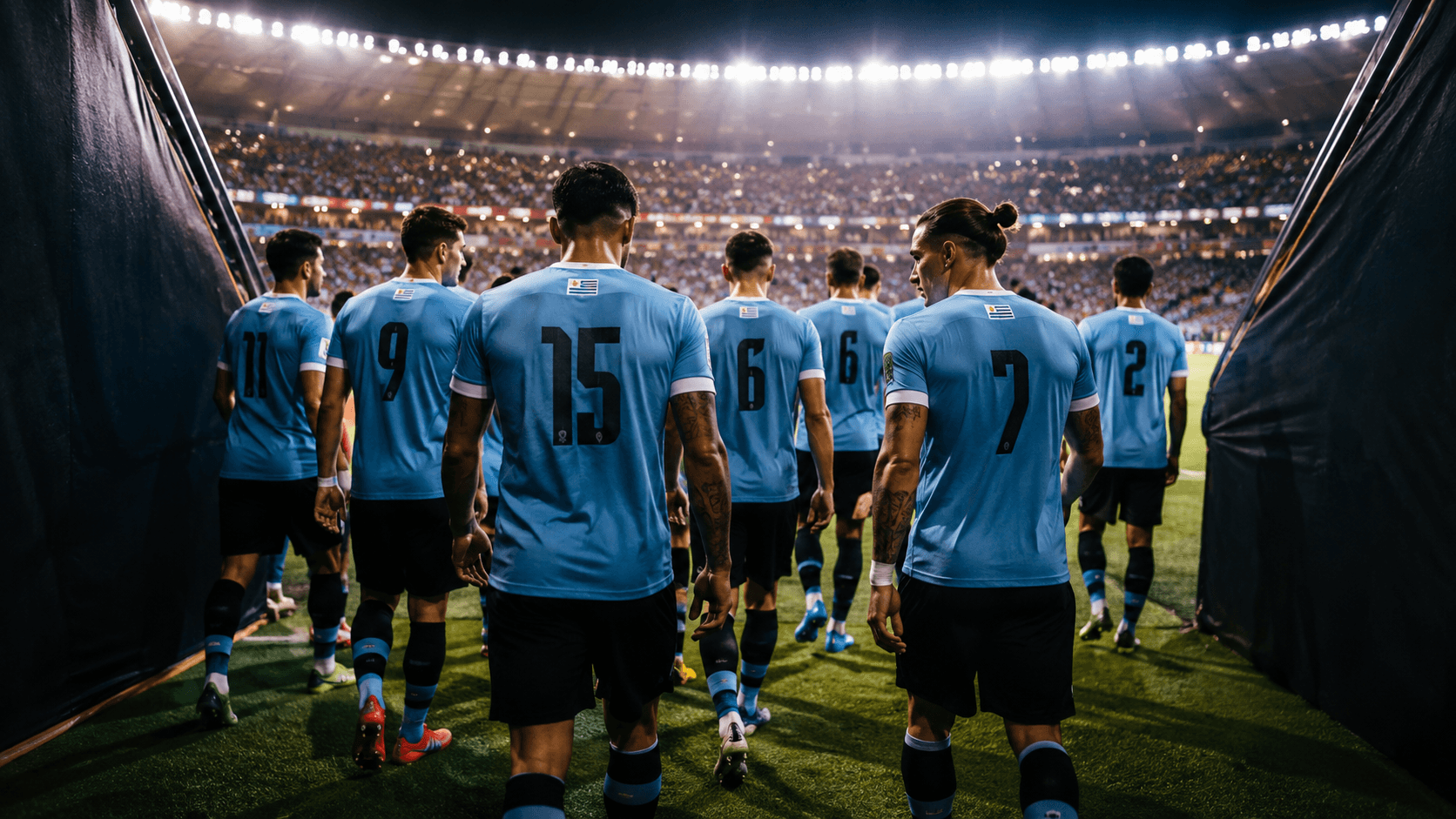
Uruguay have won the World Cup twice. Both times in the first twenty years of the tournament. The most recent was 1950, in Brazil, in a final that was not called a final — a match against the hosts that Uruguay won 2-1 to claim a trophy that Uruguayan football has been explaining ever since. Seventy-six years is a long time to carry a legend. The squad Marcelo Bielsa named on Sunday will carry it into Group H, against Spain, Cape Verde, and Saudi Arabia, without the two players who defined Uruguayan football for a generation.
Luis Suárez retired. Edinson Cavani retired. The era is over.
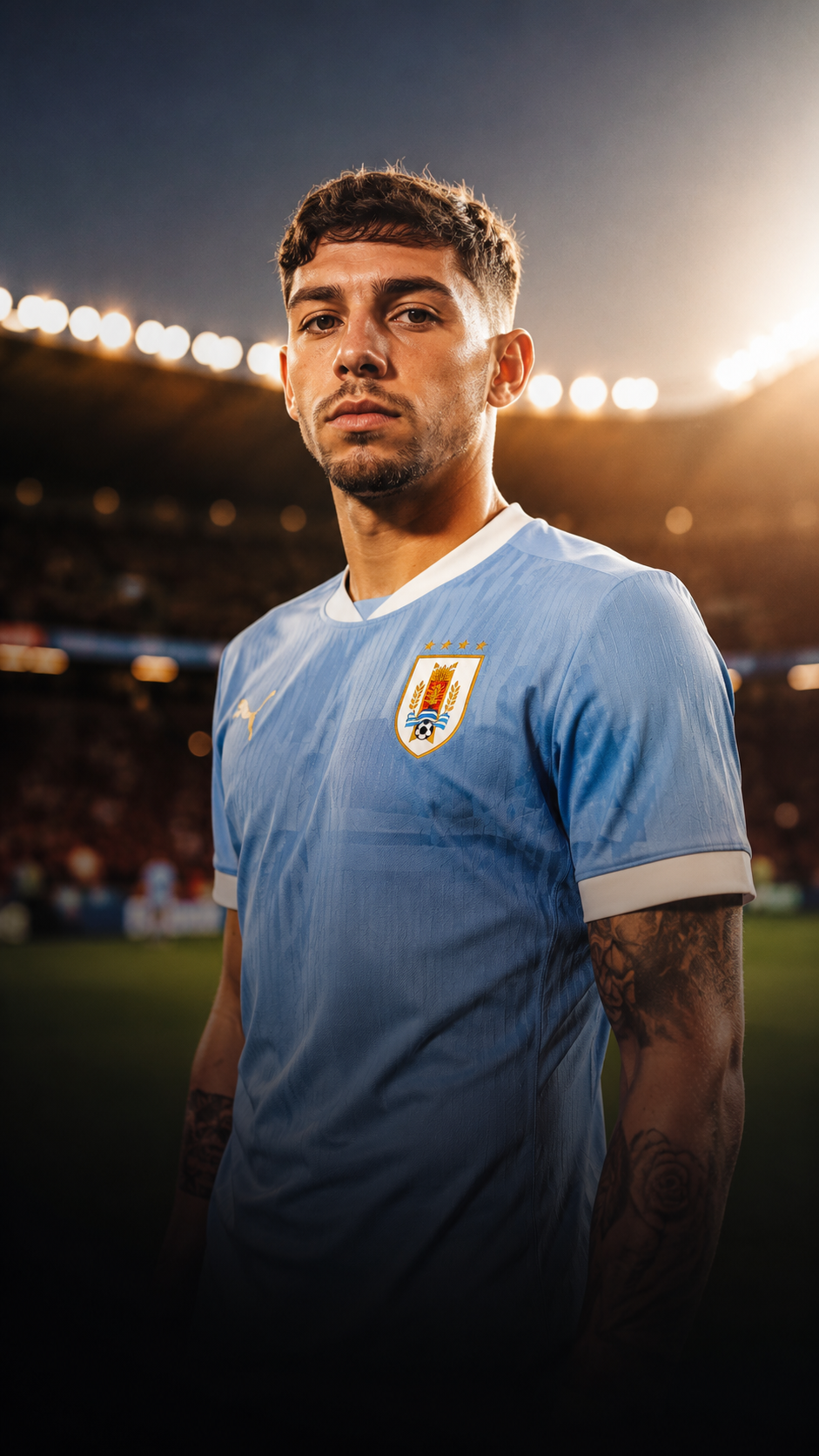
Valverde
The Absence That Defines the Squad
For fifteen years, Uruguay's attacking question answered itself. You built the team around two strikers and organized the rest. Their goals, their physicality, their willingness to make themselves inconvenient for ninety minutes were the arithmetic on which every Uruguayan World Cup campaign was built.
Darwin Núñez has thirteen goals in 36 international appearances. He is quick, powerful, and capable of the kind of finish that changes a match. He is not Suárez. He is not Cavani. He is not supposed to be. The gap between what those two provided and what Uruguay now have in the attacking third is the defining uncertainty in Bielsa's squad.
Bielsa's most notable omission was Nahitan Nández, a regular during qualification whose absence suggests the manager is prioritizing future balance over past service.
Valverde Carries the Weight
Federico Valverde had 20 goal involvements in 42 appearances for Real Madrid this season. He is the finest midfielder in the squad and, by most reasonable measures, the finest Uruguayan footballer of his generation.
Every great Uruguayan side eventually gets measured against 1950. Valverde is now the player expected to narrow that impossible comparison.
In a team that no longer has Suárez to absorb the expectations of a football-obsessed nation, those expectations have migrated to Valverde. He carries them so lightly that they sometimes appear not to exist. He plays as though the size of the occasion is irrelevant, which is the most valuable quality a player can have at a World Cup.
The midfield Bielsa has assembled around him is the most interesting section of the squad. Manuel Ugarte, at Manchester United, has had a difficult club season but played with far more authority in a Uruguay shirt. Rodrigo Bentancur makes the squad on the strength of what Bielsa believes he can contribute if fit, and at his best he remains one of the most complete central midfielders in international football. Giorgian de Arrascaeta and Nicolás de la Cruz bring the Flamengo fluency — both were central to Uruguay's qualifying campaign.
Muslera's Fifth
Fernando Muslera is 39. His first World Cup was South Africa 2010, where Uruguay finished fourth. He went to every tournament through 2022. He is, in any objective assessment, no longer the best goalkeeper in Uruguay. Sergio Rochet is. But Bielsa included Muslera, and Bielsa does not make decisions without reasons.
Muslera has lived through more failed attempts to recreate 1950 than anyone else in this squad. He has stood in goal through the quarterfinals of 2010 and 2018. He carries that history in a way that no other player here does.
A goalkeeper who has been to five World Cups is worth something that does not appear in statistics. What it is worth in Miami or Guadalajara — if Uruguay reach the knockout rounds — remains to be seen. Forty minutes into a World Cup quarterfinal, you do not want the person standing in goal to be experiencing any of it for the first time.
Bielsa's Third World Cup
For all the influence Bielsa has exerted on modern football, World Cups remain the one stage that has consistently resisted him. Argentina 2002 — group stage exit. Chile 2010 — round of 16. Uruguay 2026 is his third attempt. He is 70 years old and has never reached a World Cup quarterfinal. His deepest runs with a senior national team have come at the Copa América: the final with Argentina in 2004, and the semifinals with Uruguay in 2024.
The Captain and the Defense
José María Giménez captains this squad. He is 31, has been at Atlético Madrid for over a decade, and has developed into one of the most commanding center-backs in European football. His partnership with Ronald Araújo — the Barcelona defender who has managed injury concerns throughout this season but remains in the squad — gives Uruguay a defensive foundation that can compete with most of what Group H offers.
If Valverde is the player carrying Uruguay's hopes, Giménez and Araújo are the players protecting them. Few teams in the tournament will enter with a more established central defensive partnership.
Mathías Olivera at Napoli occupies the left back position he has made his own. Guillermo Varela, the veteran right back now at Flamengo, provides experience at 33. The goalkeeper position is clearer in its hierarchy than in its sentiment: Sergio Rochet of Internacional has been the first choice in qualifying, but Muslera takes his place in the squad for reasons outlined above.
The Group
Spain will control the ball. Cape Verde will make every match physical. Saudi Arabia arrive with growing confidence and resources. None of the three present the same challenge, but all demand different answers.
Uruguay have spent three years learning Bielsa's methods. The group stage is where those lessons become measurable.
What 1950 Requires
Uruguay do not arrive at tournaments as underdogs in their own self-image. The history is too heavy for that. But the squad Bielsa has named is a squad without Suárez and Cavani, without a clear answer to the question of who scores the goals when Núñez does not. It is a squad with Valverde, with a midfield that can match almost any opponent for organization and intensity, and with a captain in Giménez who has been one of the best defenders in Europe for a decade.
Nineteen fifty was seventy-six years ago. Every Uruguayan football player knows what happened. Every squad since has been measured against it.
This one will be too. History does not become lighter simply because the players change.
Uruguay World Cup 2026 Squad
Goalkeepers: Sergio Rochet (Internacional), Fernando Muslera (Estudiantes), Santiago Mele (Monterrey)
Defenders: Guillermo Varela (Flamengo), Ronald Araújo (Barcelona), José María Giménez (Atlético Madrid, captain), Santiago Bueno (Wolverhampton Wanderers), Sebastián Cáceres (América), Mathías Olivera (Napoli), Joaquín Piquerez (Palmeiras), Matías Viña (River Plate), Juan Manuel Sanabria (Real Salt Lake)
Midfielders: Manuel Ugarte (Manchester United), Emiliano Martínez (Palmeiras), Rodrigo Bentancur (Tottenham Hotspur), Federico Valverde (Real Madrid), Agustín Canobbio (Fluminense), Giorgian de Arrascaeta (Flamengo), Nicolás de la Cruz (Flamengo), Rodrigo Zalazar (Braga), Facundo Pellistri (Panathinaikos), Maximiliano Araújo (Sporting CP), Brian Rodríguez (América)
Forwards: Darwin Núñez (Al-Hilal), Federico Viñas (Real Oviedo), Rodrigo Aguirre (Tigres)
Coach: Marcelo Bielsa | Group H: Spain · Cape Verde · Saudi Arabia
Fixtures: Jun 15 v Saudi Arabia — Miami · Jun 21 v Cape Verde — Miami · Jun 26 v Spain — Guadalajara
Correction, October 5, 2026: this piece first said the squad was named on Friday (it was Sunday, May 31), that Fernando Muslera kept goal at the 2022 World Cup (Sergio Rochet played all three games; Muslera was the backup), that Uruguay had spent two years under Bielsa (three), and that Bielsa had never reached a quarterfinal as an international manager (he has never reached a World Cup quarterfinal; at the Copa América he reached the 2004 final with Argentina and the 2024 semifinals with Uruguay).