At their last World Cup, in Qatar in November 2022, Alphonso Davies scored Canada's first men's World Cup goal — a header against Croatia in the second minute. They lost that match 4-1. They lost all three group games. They came home without a point and with the sense that something had been started rather than finished.
Four years later the tournament has come to them.
Toronto will host. Vancouver will host. The CN Tower carried giant banners of the squad down its side on Friday evening.
In 2022 Canada arrived. In 2026 Canada hosts.
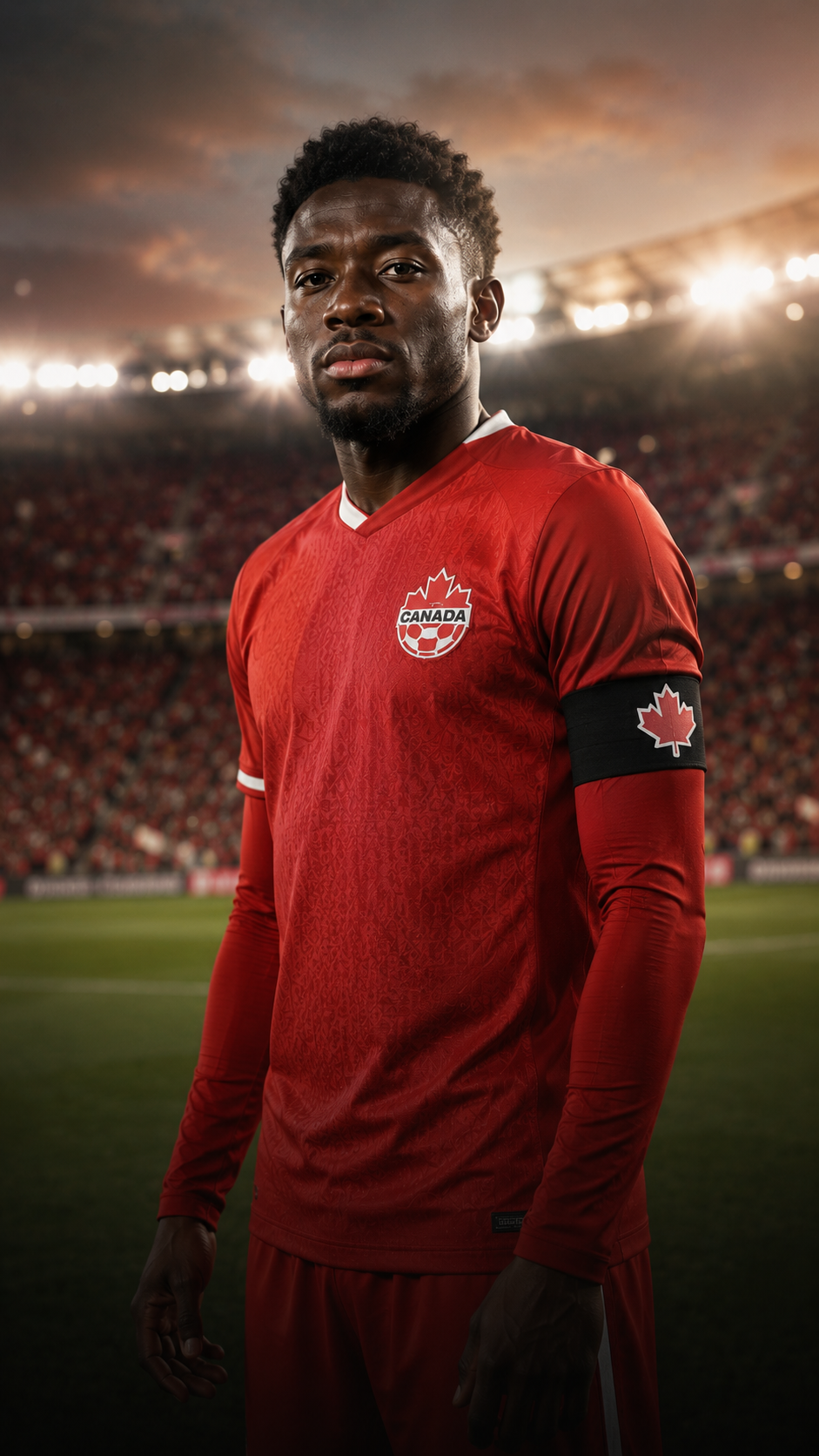
Davies
Davies: The Question Everything Depends On
This is the most talented Canadian men's squad ever assembled.
It is also the most injured.
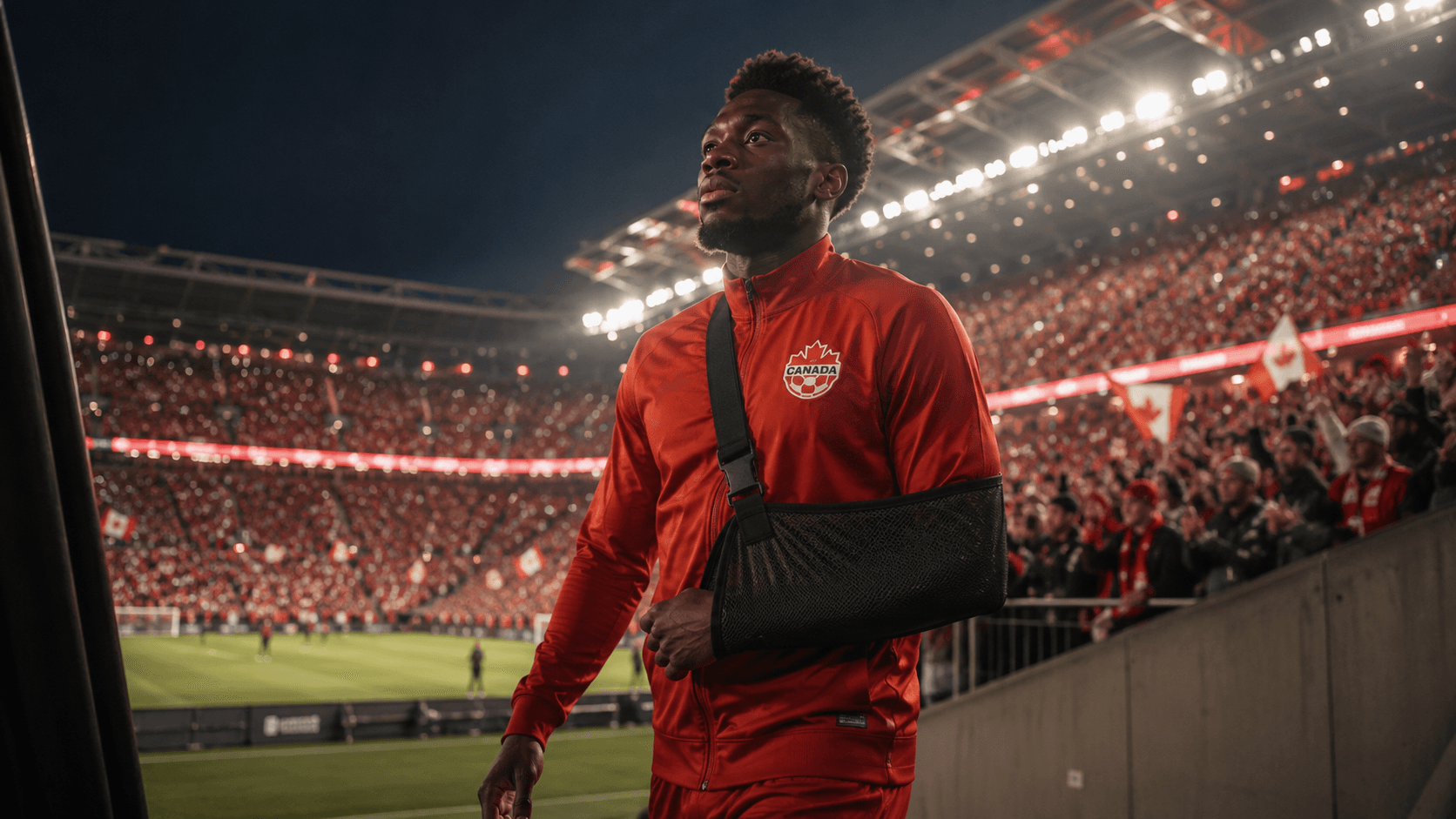
Alphonso Davies is in the squad. He is unlikely to play in the opening game. His availability for subsequent group matches is not guaranteed.
Davies tore his ACL in March 2025 and missed 262 days before returning to action at Bayern Munich. He returned, played his way back to form, and then picked up a hamstring injury in Bayern's Champions League semifinal loss to PSG in May. He did not travel to Charlotte for the training camp, remaining in Germany to continue his recovery. He was due to join the squad on May 31.
He is the captain. He is the best player Canada has ever produced. The entire tactical shape of Canada's best version runs through his ability to bomb forward from left back.
Every version of Canada's best team begins in the same place. With Alphonso Davies healthy.
David: The Player Who Has to Score
Canada used to hope for players like Jonathan David. Now they build squads around them. That sentence alone explains how far Canadian football has traveled.
His move to Juventus last summer punctuated a Lille career that produced goals at a rate that makes him the most dangerous Canadian forward in the history of the program. He and Cyle Larin are the two most prolific scorers in Canadian men's football history, and both are here.
David's goalscoring record for Canada is the argument for optimism that does not depend on anyone's fitness. Even without Davies operating at full capacity, even with the injury cloud over half the defensive unit, Canada with David and a functional midfield can threaten teams at this level. He is the player who can turn a single moment into a result.
Larin, now at Southampton on loan from Mallorca, provides the physical alternative. Promise David (Union SG) and Tani Oluwaseyi complete the forward options — depth that would have been unimaginable for a Canadian squad a decade ago.
The Injury List
Marsch did not select this squad so much as negotiate with it. Every important decision came attached to a medical report.
Moïse Bombito broke his leg in a 2-2 draw with Monaco in October and has not played for the national team since. Alistair Johnston has been recovering from a hamstring injury. Davies, as established, is in Germany rather than Charlotte. Shaffelburg — the surprise selection over Jebbison — arrived at camp carrying his own hamstring injury. Promise David had hip surgery for a ruptured tendon in February; Marsch called him personally to say they would give him whatever time he needed. He is in the squad.
Marsch spent the week in Charlotte assessing timelines, talking to medical staff, weighing risk against potential. The decisions he made reflect a coaching staff that believes the players' peaks will arrive by the knockout stages — if Canada can get there.
The defensive unit is the specific concern. Bombito and Johnston are the first-choice partnership; with both managing injuries, the combination of Cornelius, de Fougerolles, Alfie Jones, and Joel Waterman gives Marsch cover but not certainty.
The Surprise: Shaffelburg Over Jebbison
The selection that generated the most debate in the hours after the announcement was Jacob Shaffelburg over Daniel Jebbison. Jebbison, the Preston North End forward, had been considered a near-certain inclusion after a productive season. Shaffelburg, a winger at Los Angeles FC, injured his hamstring in May and arrives in the squad carrying that concern — making his selection not merely surprising but a genuine fitness gamble alongside all the others Marsch has made in assembling this group.
Marsch's description of the decision: "These players reflect the many communities, cultures, and journeys that make up this country." That is the press conference answer. The squad answer is that Shaffelburg, even managing a hamstring, offers width and directness that a striker who would need to start to justify inclusion cannot provide from the bench.
Jebbison goes home.
Shaffelburg goes to a home World Cup.
Every squad announcement contains one dream and one funeral.
The Midfield: Canada's Strength
Marsch's Canada presses so aggressively that the players gave the system a name. Maplepressing. National identity turned into a tactical instruction. In a narrow 4-4-2 or 4-2-2-2, Canada defend on the front foot with a high line and minimal space between units — designed to force opponents wide, trap them on the touchline, and win the ball early.
The one area where Canada arrive without meaningful fitness concerns and with genuine quality is central midfield. Stephen Eustáquio is the orchestrator — the vice-captain, the player described by everyone who watches Canada regularly as the glue. He is on loan at LAFC from Porto.
Ismaël Koné (Sassuolo), Nathan Saliba (Anderlecht), Jonathan Osorio (Toronto FC), and Mathieu Choinière (LAFC) provide depth. In the wider areas, Buchanan, Ali Ahmed (Norwich), and Liam Millar (Hull City) give Marsch options for different opponent profiles. This is a midfield group that has grown considerably since 2022 — Koné and Saliba in particular are playing at a level that would not have been predicted four years ago.
Group B
For a host nation carrying this many fitness concerns, the draw could have been less forgiving. It also could have been much worse.
Bosnia and Herzegovina first, June 12 in Toronto. Qatar on June 18 in Vancouver. Switzerland on June 24 in Vancouver.
Bosnia are physically capable and have Džeko — 40 years old and still here — to threaten from set pieces. Qatar are the 2022 hosts competing as participants for the first time; they will be organized and defensively structured. Switzerland are the opponent Canada should be most worried about, arriving in Vancouver with a settled, experienced squad and the kind of European tournament pedigree that neither Bosnia nor Qatar carry.
Two of Canada's three group matches will be played in Vancouver. The crowd will not win tackles or score goals, but it may buy something more valuable: belief. Home advantage is rarely decisive. It is almost never irrelevant.
The goalkeeper decision is also unresolved. Crépeau and St. Clair will both play in the pre-tournament friendlies before Marsch makes his choice. Crépeau, for whom this would be a first World Cup after he broke his leg just before Qatar 2022 and missed the tournament entirely, said: "Whatever the decision is, we will be here for one another and for the team on and off the field." It is the right thing to say. Both mean it. Only one will start on June 12.
What This Moment Is
Four years ago Canada arrived at a World Cup and discovered that arrival and belonging are not the same thing.
This squad is more talented than that one. It is deeper than that one. It is also far less healthy.
The tournament is at home. The opportunity may never be larger.
The banners hanging from the CN Tower are not there because Canada qualified.
They are there because Canada believes something is possible.
The problem is that possibility, like Alphonso Davies' hamstring, remains day-to-day.
Canada World Cup 2026 Squad
Goalkeepers: Maxime Crépeau (Orlando City), Owen Goodman (Barnsley, on loan from Crystal Palace), Dayne St. Clair (Inter Miami)
Defenders: Moïse Bombito (Nice), Derek Cornelius (Rangers, on loan from Marseille), Alphonso Davies (Bayern Munich, captain), Luc de Fougerolles (Dender, on loan from Fulham), Alistair Johnston (Celtic), Alfie Jones (Middlesbrough), Richie Laryea (Toronto FC), Niko Sigur (Hajduk Split), Joel Waterman (Chicago Fire)
Midfielders: Ali Ahmed (Norwich City), Tajon Buchanan (Villarreal), Mathieu Choinière (LAFC), Stephen Eustáquio (LAFC, on loan from Porto), Ismaël Koné (Sassuolo), Liam Millar (Hull City), Jonathan Osorio (Toronto FC), Nathan Saliba (Anderlecht), Jacob Shaffelburg (LAFC)
Forwards: Jonathan David (Juventus), Jayden Nelson (Austin FC), Promise David (Union SG), Cyle Larin (Southampton, on loan from Mallorca), Tani Oluwaseyi (Villarreal)
Coach: Jesse Marsch | Group B: Bosnia & Herzegovina · Qatar · Switzerland
Updated June 9: Marcelo Flores (Tigres) withdrew injured on May 31, before this piece was published; Jayden Nelson (Austin FC) replaced him.
Correction, October 5, 2026: this piece first said Canada's last World Cup match was the Croatia game in June 2022 (it was the 2-1 loss to Morocco on December 1, 2022; Croatia was on November 27), that Davies headed in a corner (it was a cross in open play) for Canada's first men's World Cup goal in 36 years (it was their first ever), gave Jonathan David's club as Lille in its FAQ and dated his Juventus move to this year (it was July 2025), and named Marcelo Flores among the options after he had withdrawn.