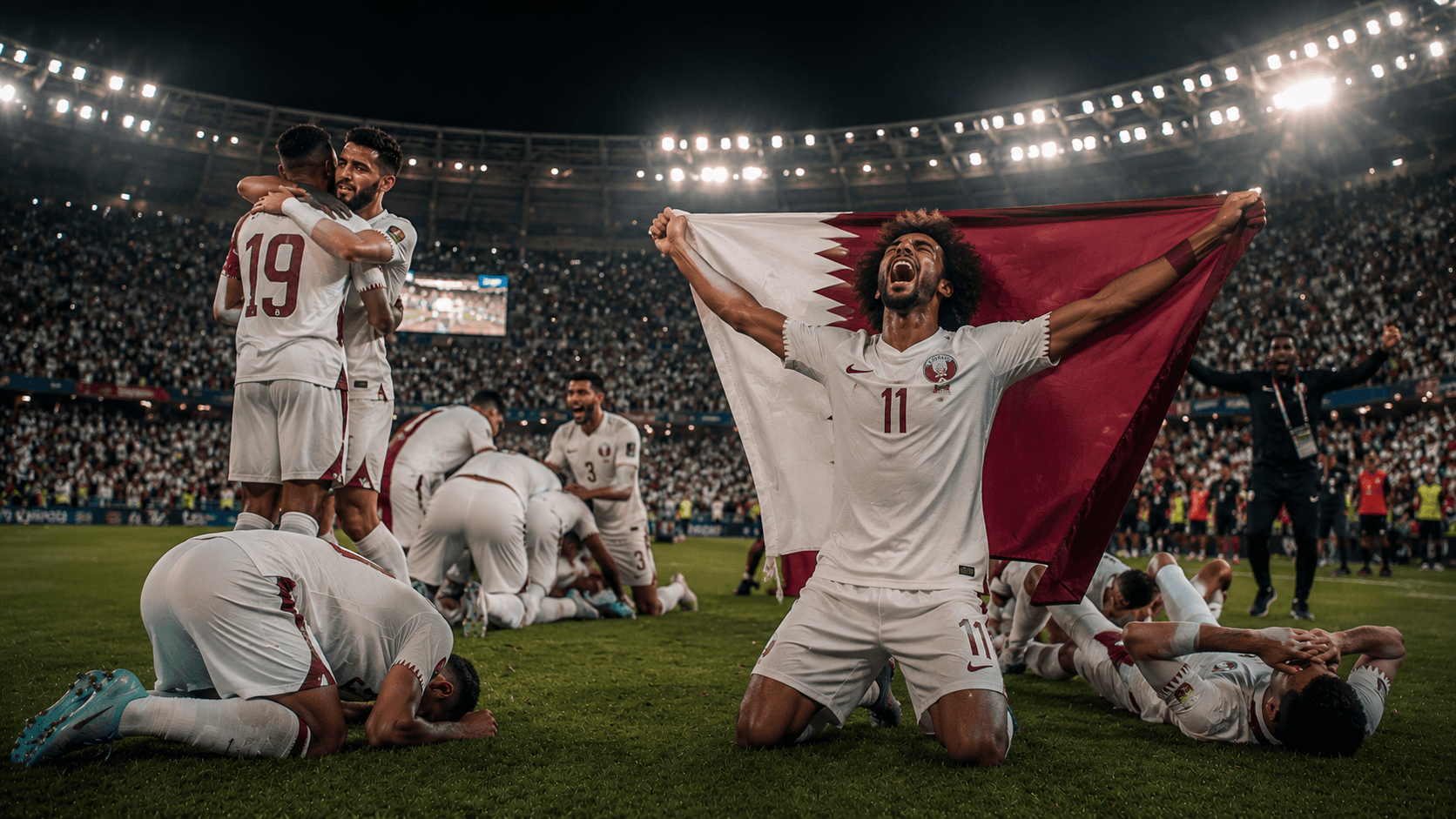
In November 2022, Qatar played three matches at the World Cup they hosted and lost all of them. Ecuador 2-0. Senegal 3-1. Netherlands 2-0. One goal scored. Seven conceded. The worst performance by a host nation in the tournament's history. The critics who said Qatar had no business hosting a World Cup felt confirmed. The critics who said Qatar's football team had no business being at a World Cup felt even more confirmed.
Qatar's response was to win the Asian Cup again, at home, fourteen months later.
They had won the 2019 edition in the UAE — beating Japan 3-1 in the final, Almoez Ali scoring a record nine goals. At the 2023 edition, played at home in early 2024, they defended the title, beating Jordan 3-1 in another final. Two continental championships in five years. The football was real. The question was whether it could travel from Asia to the World Cup stage.
Now they are back, and this time they qualified through the AFC's standard route — no hosting privileges, no automatic berth.
The team that was given a World Cup in 2022 has earned one in 2026.
Afif
Lopetegui's parallel
The coach is Julen Lopetegui, and the symmetry is difficult to ignore. In June 2018, Lopetegui was the head coach of Spain. Three days before their World Cup opener against Portugal, Real Madrid announced he would join them after the tournament. The Spanish federation sacked him the next day. Spain went on without him, lost to Russia on penalties in the round of 16, and Lopetegui watched from outside the tent.
He coached Real Madrid for 14 games before being fired. He won the Europa League with Sevilla in 2020. He was sacked by West Ham in 2025. Now he is at the World Cup again — but on the other side of the bracket, with a team built from a single domestic league rather than from Barcelona and Real Madrid.
Twenty-five from home
The most striking feature of Qatar's squad is its composition. Twenty-five of the 26 players are based in Qatar. The sole exception is Homam Al-Amin, a defender at Cultural Leonesa in Spain. Every other player — from Al-Sadd, Al-Duhail, Al-Rayyan, Al-Gharafa, Al-Wakrah, Al-Arabi, Al-Shamal — plays in the Qatar Stars League. Alongside Saudi Arabia, Qatar have the most domestically concentrated squad in the entire tournament.
The advantage is familiarity. These players train together, play against one another every week, and arrive with a shared understanding that most national teams spend years trying to build. Lopetegui has been able to install a tactical system without the disruption of club-versus-country scheduling conflicts. The question is whether familiarity can compensate for a lack of exposure to elite opposition.
Afif and Ali
Hassan Al-Haydos captains the squad at 35 with 186 caps — one of the most capped active players in world football. Almoez Ali, the all-time leading scorer with 55 goals, leads the attack. Ali scored 12 goals in AFC qualifying — more than any other player on the continent — and holds the record for most goals in a single Asian Cup tournament, nine in 2019.
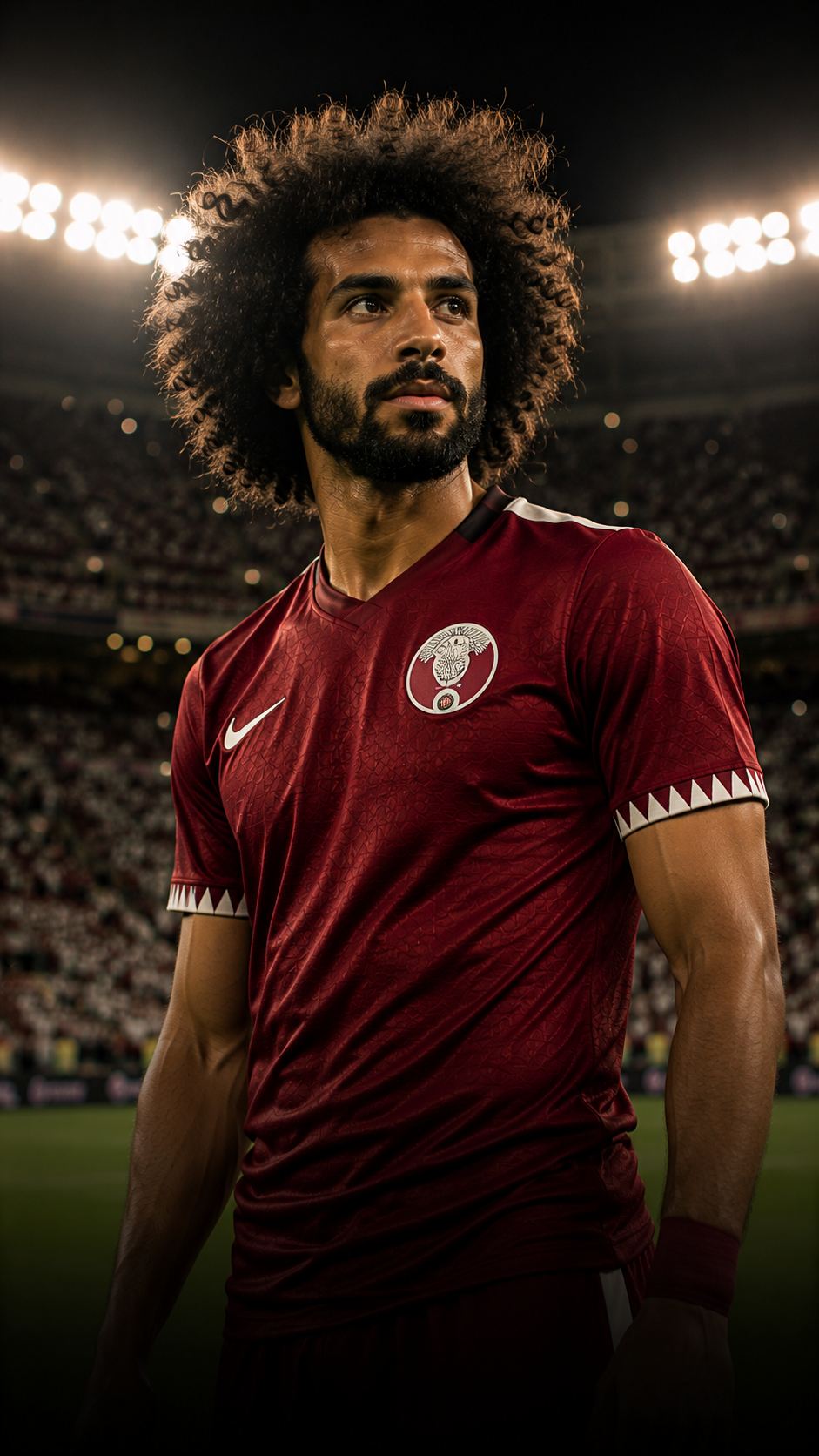
If Ali is the scorer, Akram Afif is the reason the chances exist. The 2023 Asian Player of the Year remains the most gifted footballer Qatar have ever produced — a playmaker capable of deciding matches through invention rather than structure. The Asian Cups were built on organization. The moments people remember usually belonged to Afif. Edmílson Junior, a Belgian-born naturalized Qatari of Brazilian descent, adds versatility in the forward line.
The midfield is built around experience rather than flair. Karim Boudiaf of Al-Duhail and Abdulaziz Hatem of Al-Rayyan provide the structure. Assim Madibo offers the defensive discipline. This is a team that defends collectively and counters through Afif and Ali — a system that won two Asian Cups but leaked 24 goals in the third qualifying round, the worst defensive record of any Asian nation. The counter-attacking threat is proven. The defensive solidity is not.
Sebastián Soria, the 42-year-old Uruguay-born forward who would have become the oldest outfield player in World Cup history, was in the preliminary squad of 34. He did not make the final 26.
The group
Qatar are in Group B alongside Switzerland, Canada, and Bosnia and Herzegovina. The opener against Switzerland on June 13 at Levi's Stadium in Santa Clara is the immediate test — a European side with Champions League-level players across the pitch. Canada follow on June 18 in Vancouver, where the co-hosts will bring the crowd. Bosnia and Herzegovina close the group on June 24 in Seattle — Edin Džeko, dangerous and physical, leading a side that qualified through the UEFA playoffs.
The 2022 World Cup gave Qatar three defeats and a reputation. The two Asian Cups that followed gave them two trophies and a squad that believes it belongs. Lopetegui, who once lost a World Cup before it began, now has the chance to win matches at one. The squad is domestic, the ambition is continental, and the point — above all — is that this time they qualified.
The squad
Goalkeepers: Mahmoud Abunada (Al-Rayyan), Meshaal Barsham (Al-Sadd), Salah Zakaria (Al-Duhail)
Defenders: Ayoub Al-Alawi (Al-Gharafa), Boualem Khoukhi (Al-Sadd), Homam Al-Amin (Cultural Leonesa), Lucas Mendes (Al-Wakrah), Issa Laye (Al-Arabi), Pedro Miguel (Al-Sadd), Al-Hashmi Al-Hussain (Al-Arabi), Sultan Al Brake (Al-Duhail)
Midfielders: Assim Madibo (Al-Wakrah), Abdulaziz Hatem (Al-Rayyan), Ahmed Fathi (Al-Arabi), Karim Boudiaf (Al-Duhail), Jassim Gaber (Al-Rayyan), Mohammed Mannai (Al-Shamal)
Forwards: Ahmed Al-Ganehi (Al-Gharafa), Ahmed Alaa (Al-Rayyan), Akram Afif (Al-Sadd), Almoez Ali (Al-Duhail), Edmílson Junior (Al-Duhail), Hassan Al-Haydos (Al-Sadd), Mohammed Muntari (Al-Gharafa), Tahsin Mohammed (Al-Duhail), Yusuf Abdurisag (Al-Wakrah)
Coach: Julen Lopetegui | Group B: Canada · Switzerland · Bosnia & Herzegovina
Fixtures: Jun 13 v Switzerland — Levi's Stadium, Santa Clara · Jun 18 v Canada — BC Place, Vancouver · Jun 24 v Bosnia & Herzegovina — Lumen Field, Seattle
Correction, October 5, 2026: this piece first said Qatar won two Asian Cups after the 2022 World Cup (the 2019 title came before it), that Almoez Ali scored in every 2019 knockout round (he scored in the semifinal and final), that Spain's federation announced Lopetegui's move to Real Madrid two days before the 2018 opener (Real announced it three days before; Spain sacked him the next day), gave Almoez Ali 60 goals (55) and Hassan Al-Haydos 188 caps (186), and called Edmílson Junior Brazilian-born (he was born in Belgium).