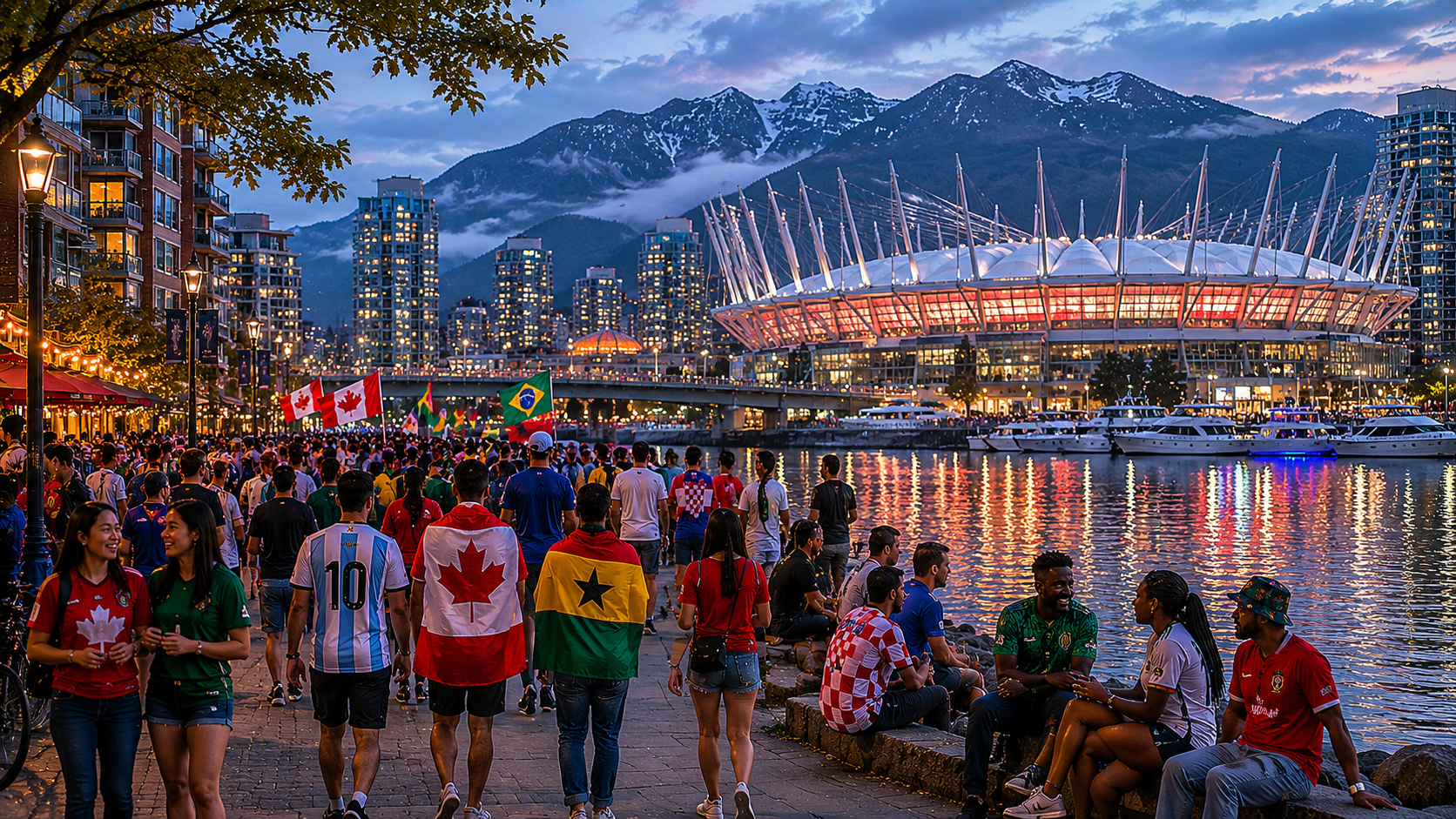
The North Shore Mountains rise directly behind the city. Burrard Inlet separates Vancouver from them, and on clear mornings the snow on the upper peaks is visible from the windows of downtown hotels. False Creek runs inland from English Bay, separating the downtown peninsula from the neighborhoods to the south, and BC Place sits on its northern bank, adjacent to Rogers Arena, a short walk from Gastown's cobblestones and a shorter one from Yaletown's waterfront. Of all the host venues in this tournament, Vancouver Stadium is the most dramatically located — the only stadium sitting directly in a city's downtown core, with the Pacific Ranges as its backdrop and the Pacific Ocean a few kilometers west.
Seven matches. Canada plays twice here — June 18 against Qatar, June 24 against Switzerland. Australia opens the Vancouver program on June 13. New Zealand's group stage fixtures against Belgium and Egypt are both here. The tournament runs in this city from June 13 through the Round of 16 in early July, and Granville Street between Georgia and Davie becomes a pedestrian zone for the full duration — the city reorganizing itself around the event in a way that most host cities manage only in theory.
The Stadium
Vancouver Stadium — BC Place in everyday use — holds 54,500 under an air-supported retractable roof, which gives organizers flexibility for Vancouver's famously changeable June weather. The roof's condition on any given match day will be decided by the morning forecast. The stadium sits adjacent to False Creek, Rogers Arena, and the SkyTrain network, and is genuinely walkable from Gastown, Yaletown, and the West End. It hosted the 2010 Winter Olympics closing ceremony and the 2015 FIFA Women's World Cup Final. The building understands occasions.
One practical warning that supersedes everything else in this section: the Stadium-Chinatown SkyTrain station is closed for the duration of the tournament. Do not plan to arrive there. Use Main Street–Science World Station on the Expo Line instead — approximately a ten-minute walk to the stadium — or the Canada Line to Yaletown-Roundhouse, also a ten-minute walk. This is the single most important piece of transit information for any Vancouver World Cup visitor.
Getting There
The SkyTrain is the correct answer for all match days. From Vancouver International Airport (YVR), the Canada Line runs directly to Waterfront Station, where you transfer to the Expo Line eastbound to Main Street–Science World. The full journey costs approximately C$3.25–$6.50 depending on zone, takes around 35 minutes, and requires a Compass Card — buy one at the airport on arrival for C$6 (C$1 deposit plus C$5 loaded value). The card works across all SkyTrain lines, buses, and the SeaBus.
Granville Street is a pedestrian zone from Georgia to Davie for the tournament's duration — good for walking between Yaletown, the entertainment district, and the stadium. Cycling along the protected lanes on Expo Boulevard and across the Cambie Bridge is a genuine option for fans staying south of False Creek. Mobi by Shaw Go bikeshare has docking stations on Expo Boulevard near the stadium. Do not drive on match days.
🏨Find Hotels
Book on Hotels.com
Hotel links are affiliate links. We earn a commission on completed stays at no extra cost to you.
The Fan Festival
The main FIFA Fan Festival operates at Hastings Park — the PNE grounds in East Vancouver — with live match broadcasts, cultural programming, and food throughout the tournament. From downtown, the SkyTrain Expo Line to Commercial-Broadway, then Bus 9 east, reaches Hastings Park in around 30 minutes.
The secondary fan hub is Canada House at The Shipyards District in North Vancouver — a short SeaBus ride from Waterfront Station to Lonsdale Quay, then a walk to The Shipyards. The SeaBus crossing takes 12 minutes and provides one of the more extraordinary transit views available at any World Cup — Burrard Inlet, the downtown skyline, the mountains above it. The crossing costs a standard TransLink fare. On a clear evening, the return crossing after a match, with the city lit up across the water, is worth planning around.
Granville Island, in False Creek, hosts additional fan zone programming — accessible by Aquabus or False Creek Ferry from downtown docks, or by foot across the Granville Bridge.
The Neighborhoods
Gastown
Gastown is Vancouver's oldest neighborhood — cobblestones, brick facades, the steam clock at the corner of Water and Cambie that draws its own modest crowd, and a restaurant and bar scene that has been building since before the neighborhood was fashionable. L'Abattoir, in a converted slaughterhouse on Blood Alley, holds a Michelin star for French-influenced Pacific Northwest cooking. PiDGiN, on Carrall Street, has been doing Asian-French fusion since 2013 — Foie Gras Rice Bowl, Lobster Dan Dan Noodles — and carries a Michelin recommendation. Rodney's Oyster House on Hamilton is the right place for wild Pacific oysters before a match, at a marble bar that has been doing this since 1987. The Mackenzie Room, just east of Gastown, does a tasting menu that the city's food community currently considers one of the best tables in town.
The Diamond cocktail bar upstairs on Powell Street, and Pourhouse and Steamworks Brewpub for something less elaborate. Gastown's side streets carry the hidden bars and laneway murals that the steam clock does not.
Chinatown
Vancouver's Chinatown on Pender Street is the oldest in Canada and one of the largest in North America. The Dr. Sun Yat-Sen Classical Chinese Garden, built by craftspeople from Suzhou and considered the most authentic classical Chinese garden outside China, is two minutes' walk from the main street and charges admission for a reason — the design is irreproducible outside its cultural context, and the garden is genuinely quiet in ways downtown Vancouver is not. The Chinatown Night Market runs Friday and Saturday evenings on Keefer Street through the summer. Kissa Tanto, on Main Street at the edge of Chinatown, holds a Michelin star for its Japanese-Italian fusion — the wine list is serious and the room is small enough that booking is essential.
Commercial Drive
Commercial Drive — known as The Drive — runs north-south through East Vancouver and carries decades of Italian-Canadian history alongside more recent Greek, Latin American, East African, and South Asian layers. It is the neighborhood that resisted gentrification longest and most successfully of any in the city, and the bar and café culture on The Drive reflects that: owner-operated, price-conscious, politically opinionated in the manner of neighborhoods that have been paying attention for a long time. For fans seeking the version of Vancouver that the tourism board underweights, The Drive is the answer.
Yaletown
Yaletown, immediately south of BC Place, is the neighborhood that converted its Victorian warehouses into the city's upscale hospitality district. The proximity to the stadium makes it the match-day hub — restaurants and bars filling hours before kickoff — and the seawall running along False Creek from Yaletown to Granville Island is the most pleasant walk available in the downtown core between matches.
Richmond
Richmond, south of Vancouver across the Fraser River, contains one of the largest Chinese communities in North America — the "Golden Village" along Alexandra Road and No. 3 Road has been described as a larger and more comprehensive Chinatown than Vancouver's own. Hong Kong-style BBQ, Cantonese dim sum, Taiwanese bubble tea, Sichuan hot pot. The Canada Line runs directly from downtown Vancouver to Aberdeen Station in the heart of the Richmond restaurant corridor. For South Korean and East Asian fan bases attending New Zealand vs Belgium or Australia matches, Richmond is the full expression of what the region's Asian food culture looks like at its most concentrated.
The Natural Setting
Stanley Park's seawall — 22 kilometres around the perimeter of the park, through old-growth forest and along the waterfront — is free and requires only time. Rent a bike from the concession at Denman Street; the full loop takes around two hours. The views across Burrard Inlet to the North Shore Mountains are the reward.
Capilano Suspension Bridge, 15 minutes north by bus or car, crosses a 70-metre gorge in the forest above the Capilano River. It is a tourist attraction and is not trying to pretend otherwise, but the forest it sits inside — towering Douglas firs, the suspension bridge swaying slightly above the river — does not require any particular framing to be impressive.
Whistler is two hours north on the Sea to Sky Highway, one of the more dramatic road drives in North America. The highway climbs from sea level through Squamish and up into the Coast Mountains — Whistler Blackcomb in summer offers gondola rides, hiking, and mountain biking. A long day between matches, with an early start.
What It Costs
Vancouver is expensive — among the most expensive cities in Canada — though the USD/CAD exchange rate (approximately 0.73) reduces the impact for American visitors.
| SkyTrain, airport to downtown | C$3.25–$6.50 |
| Compass Card (one-time) | C$6 |
| SeaBus, Waterfront to North Van | C$3.25 |
| Wild Pacific salmon, restaurant | C$30–$45 |
| Oysters, Rodney's | C$4–$6 each |
| Hotel, Yaletown/Downtown (mid-range) | C$250–$450/night |
| Group stage ticket, mid-tier | C$85–$700 |
Find Hotels
Book on Hotels.com
Hotel links are affiliate links. We earn a commission on completed stays at no extra cost to you.
Essential Information
Stadium Vancouver Stadium (BC Place), downtown. 54,500 capacity, retractable roof. 7 matches: Australia June 13, Canada vs Qatar June 18, Canada vs Switzerland June 24, New Zealand vs Belgium, New Zealand vs Egypt, Round of 32, Round of 16.
CRITICAL TRANSIT NOTE Stadium-Chinatown SkyTrain Station is CLOSED for the tournament. Use Main Street–Science World Station (Expo Line, 10-min walk) or Yaletown-Roundhouse (Canada Line, 10-min walk). Do not plan to arrive at Stadium-Chinatown.
Transport SkyTrain Expo Line to Main Street–Science World. Canada Line to Yaletown-Roundhouse. Compass Card (C$6) at YVR on arrival. YVR → Canada Line → Waterfront → Expo Line eastbound → Main Street–Science World, ~35 mins. SeaBus from Waterfront to North Vancouver (12 mins, C$3.25) for Canada House fan zone.
Fan Festival Hastings Park/PNE grounds, East Vancouver (main). Canada House at The Shipyards, North Vancouver (SeaBus from Waterfront). Granville Island (False Creek Ferries or Aquabus from downtown).
Canadian entry eTA (C$7, canada.ca/eta) for eligible nationalities. Not a US visa — separate requirement for multi-city fans.
Neighborhoods Gastown (L'Abattoir, PiDGiN, Rodney's Oyster House, cobblestones). Chinatown (Dr. Sun Yat-Sen Garden, Kissa Tanto, Night Market). Commercial Drive (Italian-Canadian roots, diverse, owner-operated). Yaletown (stadium-adjacent, waterfront, seawall). Richmond (Canada Line, Asian food corridor, Hong Kong BBQ, dim sum).
Food L'Abattoir, Gastown (Michelin-starred, book ahead). Kissa Tanto, Chinatown (Michelin-starred Japanese-Italian, small room, book ahead). PiDGiN, Gastown (Michelin-recommended, Asian-French fusion). Rodney's Oyster House, Gastown (wild Pacific oysters since 1987). Richmond Asian corridor (Alexandra Road, Aberdeen Station, Canada Line).
Between matches Stanley Park seawall (22km, free, rent bikes on Denman Street). Capilano Suspension Bridge (15 mins north). Sea to Sky Highway to Whistler (2 hrs, full day). Granville Island Public Market (False Creek Ferry from downtown). SeaBus crossing for North Shore views.
Weather June/July highs ~65-72°F (18-22°C). Mild, occasionally rainy. Stadium roof managed accordingly. Pack a light waterproof layer. Cooler than every US host city by a significant margin.
Currency Canadian dollar (CAD). Approximately 0.73 USD. Cards accepted widely.