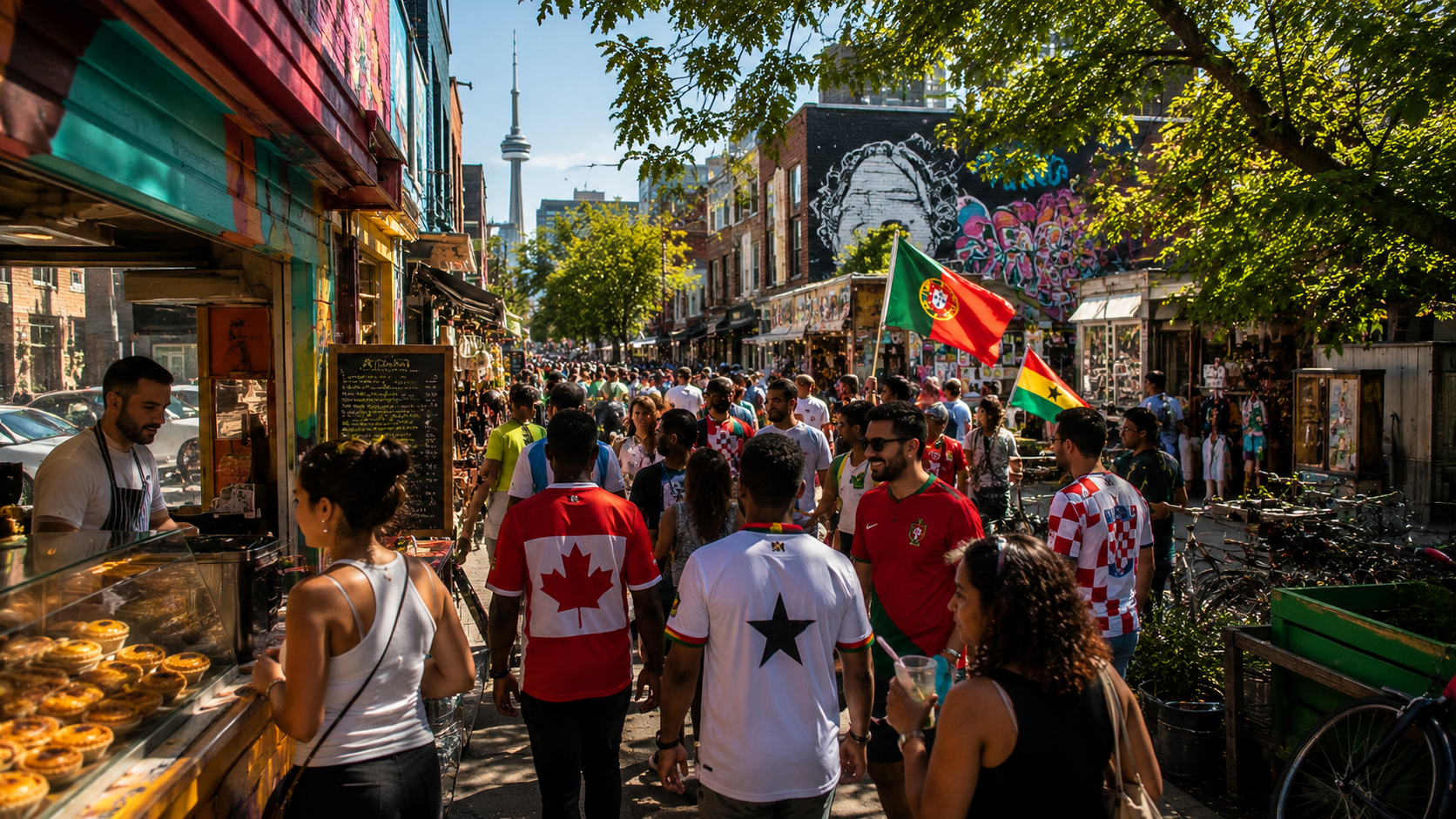
On June 12 at 3:00 PM Eastern, Canada plays its first Men's World Cup match on home soil. The opponent is Bosnia and Herzegovina. The venue is BMO Field in Exhibition Place, west of downtown Toronto, a twenty-minute streetcar ride from Union Station. Over 250 ethnicities are represented in the city around it. One hundred and sixty languages are spoken. The local soccer scene operates clubs called Toronto Italia, Futebol Clube do Porto de Toronto, and the Korean Canadian Soccer Association, names that tell you precisely what kind of city this is and what kind of welcome the World Cup will receive here.
Toronto does not need to become a football city for June and July. It already is one, in the way that a city becomes football-native when enough of its population arrived from countries where the game is the primary cultural inheritance. When Canada plays, the whole city watches. When Portugal plays — and Portugal plays here too — Little Portugal on Dundas West gathers in a way that the official fan zones do not replicate. When Ghana plays, the communities in Scarborough and North York and along Eglinton have been waiting for this since the draw was made.
Six matches. Canada's opener. Germany vs Ivory Coast. Ghana, Panama, Croatia. A Round of 32 on July 2. The stadium is in the city. The streetcar goes directly there. The food is the best argument the guide makes for staying longer than the matches require.
The Stadium
Toronto Stadium — BMO Field's tournament name — sits at Exhibition Place on the western edge of downtown, home to Toronto FC and the Canadian Premier League, expanded for the World Cup to approximately 63,000 through a combination of permanent and temporary seating. Four massive LED screens, a new rooftop patio, AI-powered food kiosks. June 12 will be the first Men's World Cup match ever played on Canadian soil. The building will know it.
The stadium's location is a genuine advantage. Unlike most North American venues, BMO Field is walkable from Liberty Village and the King West neighbourhood, a short streetcar ride from downtown, and approximately one mile from Billy Bishop Toronto City Airport — the closest airport-to-stadium of any Canadian host city and one of the shortest in the tournament globally. Porter Air operates from Billy Bishop; for domestic Canadian fans and some US East Coast routes, it is the most practical entry point into the tournament.
Getting There
The TTC 509 and 511 streetcar routes from Union Station run directly to Exhibition Loop, the stop at the stadium entrance. It is the most reliable option on match days — streetcars continue running even when traffic locks up, which it will. GO Transit operates service to Exhibition Station for fans arriving from the suburbs and surrounding regions. The journey from Union Station takes under twenty minutes.
Union Station, at the base of the Financial District, is where everything connects: TTC subway, GO Transit, UP Express from Pearson International Airport (25 minutes, C$12.35), and VIA Rail for intercity connections. For visitors attending matches in multiple Canadian cities or crossing into the US for other fixtures, Union Station is the hub.
International fans require either a Canadian eTA (Electronic Travel Authorization, approximately C$7, processed online in minutes for eligible nationalities) or a full visitor visa. Check canada.ca/eta well before departure. This is not the same as a US visa — they are entirely separate. Fans attending matches in both Toronto and US host cities need to ensure both entry requirements are met independently.
🏨Find Hotels
Book on Hotels.com
Hotel links are affiliate links. We earn a commission on completed stays at no extra cost to you.
The Fan Festival
The official FIFA Fan Festival operates at two connected sites: Fort York National Historic Site and The Bentway — free, open throughout the tournament, with live match screenings, food, and entertainment. Fort York is the site of the 1813 Battle of York, the oldest surviving building complex in the city, with the CN Tower and the downtown skyline visible across the railway corridor. The Bentway is a linear park running beneath the Gardiner Expressway, one of the more quietly remarkable pieces of urban infrastructure reimagined as public space. On Canada's opening match day, both sites will be at capacity before the afternoon kickoff.
The Food Neighborhoods
Toronto's food neighborhoods are the guide's real subject. The city's immigration history has produced corridors that serve their communities first and welcome visitors as a secondary matter — which is why the food is as good as it is.
Kensington Market
Kensington Market is the most compressed food corridor in the city — a few walkable blocks west of the downtown core where Jamaican patties, Portuguese custard tarts, and Mexican birria sit within a few blocks of each other. No chains have ever been established here. The vendors are owner-operated, the streets are narrow, and the whole thing resists the curation that turns neighborhoods into dining districts. The West Indian roti shops do curried goat and chicken in a flatbread wrap alongside doubles — the Trinidadian fried flatbread filled with curried chickpeas — for prices that reflect the neighborhood's economics rather than downtown restaurant markups. Go on a weekday when the streets are navigable. Stay as long as the food keeps arriving.
Chinatown
Chinatown along Spadina Avenue and Dundas Street West is one of the densest Chinese food corridors on the continent. Dim sum houses running the same service for three decades sit alongside newer Sichuan and Shanghainese spots. The depth is generational, and the prices mirror a neighborhood feeding its own. Saturday morning dim sum here is the correct start to any day between matches.
Little Portugal
Little Portugal along Dundas Street West is lined with pastelarias, bifanas, and bacalhau, with Brazilian and Cape Verdean communities layered into the same corridor over decades. It feeds itself first and happens to welcome visitors, and there is nothing quite like it in any American city. For fans following Cape Verde — who play their group stage elsewhere in the tournament but whose diaspora is concentrated here — Little Portugal is where the community watches. The custard tarts are the pasteis de nata standard, the coffee is espresso-dark, and the bifana — marinated pork in a roll — is the sandwich that justifies the trip from downtown.
Greektown on the Danforth
Greektown along Danforth Avenue east of the Don Valley is one of the largest Greek commercial corridors in North America. The neighborhood tavernas that haven't updated their menus since the 1980s are the real reason to make the trip east. Souvlaki, loukoumades, grilled octopus. Subway Line 2 runs along Bloor/Danforth directly to the strip. On a match night involving Greece or any Aegean team, the Danforth will be operating at a frequency it manages most naturally.
Little Italy and Corso Italia
College Street's Little Italy has second- and third-generation Italian-Canadian cooking alongside the wine bars and late-night spots that moved in as rents changed. Corso Italia along St. Clair Avenue West is the other Italian strip — quieter and older than College Street, with less scenery and considerably better food. The recipes at the old-guard spots haven't changed in 40 years. That's not nostalgia, and that's the point.
St. Lawrence Market
St. Lawrence Market, operating since 1803, is the practical anchor of the downtown food scene — a covered market south of King Street East with cheese vendors, butchers, fresh pasta producers, and the peameal bacon sandwich, a Toronto institution, at Carousel Bakery on the main floor. Saturday mornings bring the farmers market to the north building. It is not Kensington in character — it is organized, clean, and reliable — but the food is excellent and the building itself, with its Victorian cast iron and brick, is worth the visit independent of what you eat there.
Between Matches
The Toronto Islands — a short ferry ride from the foot of Bay Street — offer beaches, rental bikes, and the best view of the Toronto skyline available from any point in the city. The ferry costs C$9 return. On a summer afternoon between matches, the islands are where the city exhales.
Niagara Falls is 90 minutes southwest by car or GO Bus — one of the more spectacular natural sights within day-trip range of any host city in this tournament. The Falls themselves are free to view from the Canadian side, which is the better side. The tourist infrastructure around them is not the point. The Falls are the point.
The CN Tower, at 553 meters, held the record as the world's tallest free-standing structure for over 30 years. The EdgeWalk, a hands-free walk along the outside of the main pod at 356 meters, is available for those whose tolerance for exposure at height extends to football away trips. The Distillery District, a preserved Victorian industrial complex in the eastern end of downtown, has galleries, restaurants, and the particular atmosphere of a neighborhood that has been used for something before.
What It Costs
Toronto is expensive relative to the Canadian cost of living but competitive with mid-range American host cities when currency conversion is factored in. The Canadian dollar typically trades at approximately 0.73 USD.
| TTC streetcar to stadium | C$3.30 |
| UP Express, Pearson to Union Station | C$12.35 |
| Kensington roti | C$12–$18 |
| St. Lawrence peameal bacon sandwich | C$8–$12 |
| Alo tasting menu (special occasion) | C$225–$275/person |
| Hotel, Liberty Village/Downtown (mid-range) | C$220–$380/night |
| Group stage ticket, mid-tier | C$85–$700 (dynamic pricing) |
Find Hotels
Book on Hotels.com
Hotel links are affiliate links. We earn a commission on completed stays at no extra cost to you.
Essential Information
Stadium Toronto Stadium (BMO Field), Exhibition Place. ~63,000 capacity. 6 matches: Canada vs Bosnia-Herzegovina June 12 (3PM ET, first Men's WC match on Canadian soil), Germany vs Ivory Coast June 20, Ghana, Panama, Croatia group games, Round of 32 July 2.
Transport TTC 509/511 streetcar from Union Station to Exhibition Loop — most reliable match-day option. GO Transit to Exhibition Station. UP Express from Pearson Airport to Union Station — 25 mins, C$12.35. Billy Bishop Airport (YTZ) — 1 mile from stadium, Porter Air.
Fan Festival Fort York National Historic Site and The Bentway — free, official sites, live screenings throughout tournament.
Canadian entry eTA (Electronic Travel Authorization, C$7, processed online) for eligible nationalities — not a visa. Check canada.ca/eta. Separate from any US visa requirement.
Neighborhoods Liberty Village/Exhibition Place (stadium adjacent). Kensington Market (compressed, owner-operated, Jamaican/Portuguese/Mexican). Chinatown, Spadina (generational dim sum, Sichuan). Little Portugal, Dundas West (pastelarias, bifanas, Cape Verdean community). Greektown, Danforth (souvlaki, tavernas, Line 2 direct). Corso Italia, St. Clair West (old-guard Italian).
Food St. Lawrence Market (since 1803, peameal bacon sandwich, Saturday farmers market). Kensington Market (roti, doubles, custard tarts, walk and eat). Alo, downtown (Michelin-starred French, book weeks ahead). Carousel Bakery, St. Lawrence (peameal bacon, under C$10).
Between matches Toronto Islands (C$9 return ferry, beaches, skyline views). Niagara Falls (90 mins, GO Bus, free to view). CN Tower (553m, EdgeWalk available). Distillery District (Victorian industrial, galleries, restaurants).
Weather June/July highs ~77°F (25°C), humidity can feel like 90°F (32°C). Cooler by the lake in evenings — bring a light layer. Brief summer rainstorms common. Locals pack breathable clothes and something waterproof.
Currency Canadian dollar (CAD). Approximately 0.73 USD. Card payments accepted widely; cash useful for Kensington Market vendors.