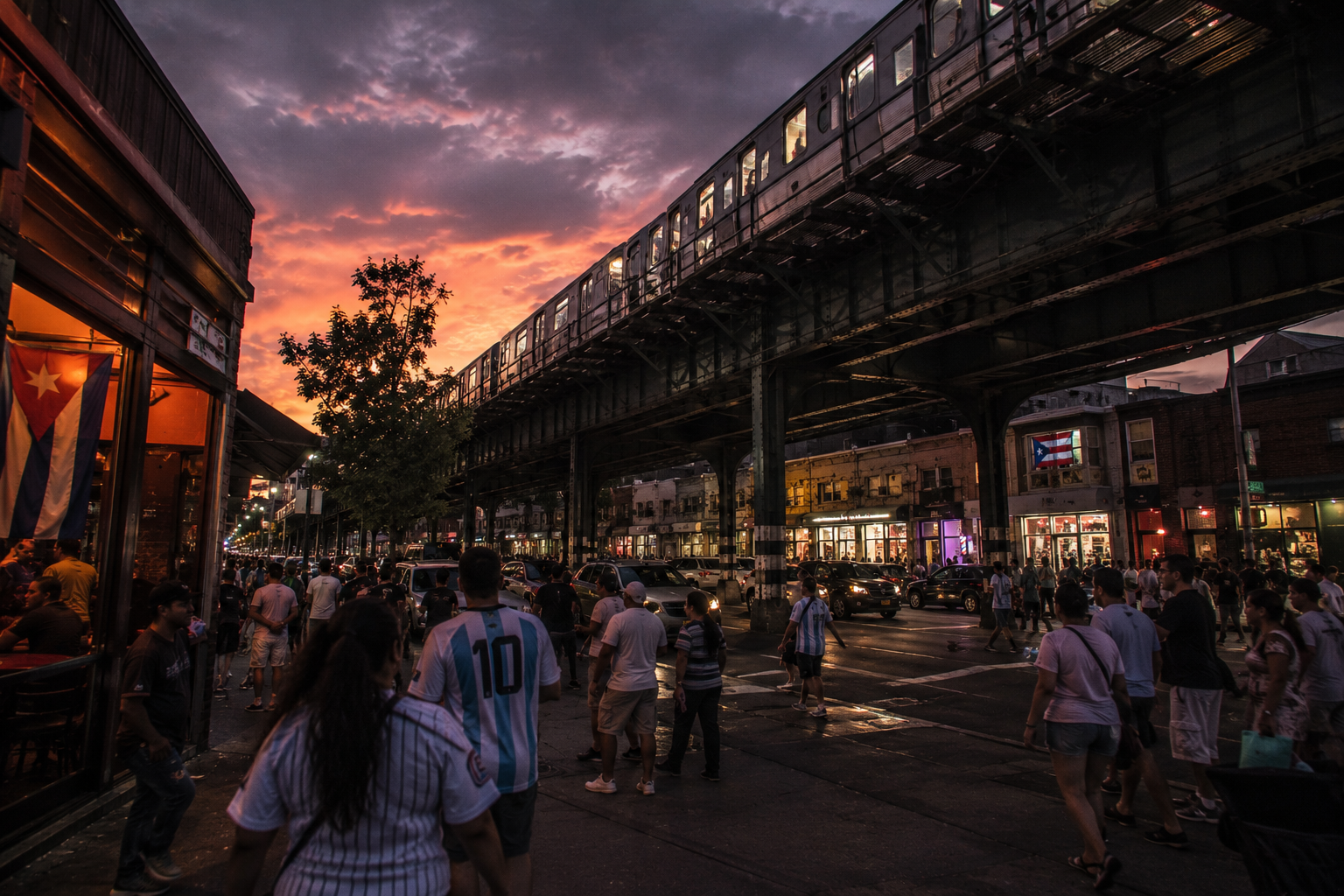
In June, the city does not slow down for the tournament. It absorbs it — the jerseys and the flags and the particular anxiety of international football folded into its gray, mechanical momentum alongside everything else. The subway still runs late. The heat settles into the pavement without apology. And in the basement bars of the East Village and along the elevated stretch of Roosevelt Avenue in Jackson Heights, where the 7 train rattles overhead and the street below carries the smell of charcoal and the sound of half a dozen languages spoken simultaneously, the World Cup is already happening. It has been happening here for years, long before FIFA arrived to confirm the fact.
New York has always been this. A city where the Colombian community in Queens has watched Colombian football with more intensity than most people in Bogotá, where the Senegalese community in Harlem carries an investment in the national team that a tournament cannot manufacture from scratch, where the word football means something different depending on which block you're standing on and which generation of immigrant you're talking to. The World Cup does not bring football to New York. It gives New York permission to show it.
Eight matches at the stadium — which is not, it should be said, in New York. One Final.
The Stadium, and the Honest Truth About Getting There
New York New Jersey Stadium — MetLife's official tournament name — holds 82,500 people and hosts eight World Cup matches, ending with the Final on July 19 at 3:00 PM ET. It sits in East Rutherford, New Jersey, nine miles west of Manhattan in the flat sports complex of the Meadowlands. There is no neighborhood around it. There are no bars to walk to before the match. What there is, is scale: 82,500 people from every corner of the planet arriving, somehow, at the same place at the same time, which is its own kind of spectacle.
The train from Penn Station takes approximately fifteen minutes. The World Cup round-trip fare is $150. The standard fare is $12.90. This discrepancy has generated considerable frustration and no satisfying explanation. Tickets are capped at 40,000 per match, available only through the NJ Transit app in advance — not at windows, not at machines, not on the day itself. Four hours before kickoff, Penn Station service toward Secaucus is restricted to match ticket holders only.
Buy transit tickets the moment they go on sale. They will sell out.
The official shuttle buses run from Port Authority Bus Terminal and a Midtown East pickup east of Grand Central. Also advance only, also limited. The state is building a new bus terminal at MetLife and a Turnpike ramp dedicated to tournament traffic, aiming for a bus every thirty seconds in the hours around each match. Rideshare exists but is geofenced away from the stadium property, with post-match surge pricing that will be aggressive across all operators.
The honest alternative: stay in New Jersey. Jersey City and Hoboken are real cities with good restaurants and bars, served by the PATH train from Manhattan for under four dollars, and close enough to MetLife that a rideshare on match day is a fraction of the cost without any of the cordon. The view of Manhattan from the Jersey City waterfront is, for what it's worth, better than the view of Jersey City from Manhattan.
🏨Find Hotels
Book on Hotels.com
Hotel links are affiliate links. We earn a commission on completed stays at no extra cost to you.
The Bars, the Neighborhoods, and Where It Actually Happens
Here is what matters about New York and the World Cup: the best experiences will not be at the stadium. They will be in rooms that already exist, in neighborhoods that already care, in bars where the person next to you is not a neutral observer but someone for whom this particular match carries thirty years of family history.
Roosevelt Avenue, Jackson Heights — The South American Circuit
Take the 7 train to Jackson Heights-Roosevelt Avenue and walk out onto a street that operates at a different frequency from the rest of the city. The elevated tracks run overhead; below them, the avenue carries the commercial and social life of communities from Colombia, Ecuador, Argentina, Mexico, and a dozen other places simultaneously. The bars and cafes along Roosevelt Avenue have been watching South American football with genuine intensity for decades. On a night when Colombia or Ecuador is playing, the atmosphere is not manufactured for tourists. It is the real thing — flags, noise, the collective stillness that descends over a room when a penalty is being taken, followed by whatever the penalty produces.
For South American nations, this is the place. Jackson Heights and Corona in Queens carry a depth of investment in these teams that no sports bar in Midtown can replicate. Go here. Eat something first — the Colombian and Ecuadorian food along the avenue is excellent and inexpensive — and be in position before kickoff. The room will be full.
Arthur Avenue, the Bronx — The European Alternative
Arthur Avenue in the Bronx is the city's real Little Italy, quieter and more genuine than the tourist-facing version in Manhattan, and on a match day involving Italy or a Southern European team it becomes something worth making the trip for. The bars here are not trying to be anything other than what they are. The food — the bread, the cured meats, the pasta — is the reason to arrive early and stay late regardless of what's on the screens.
For Greece and the Eastern Mediterranean: Astoria in Queens, where the community has existed long enough to have its own infrastructure, its own sense of occasion, its own way of watching.
The Established Football Bars — Manhattan
The Football Factory at Legends, just off West 33rd Street in Koreatown, hosts more than thirty supporters' groups and screens over a hundred matches a week. During the World Cup it will be one of the hardest places in the city to get into without a plan. For any match involving England, Ireland, or a large European fan base with an existing New York presence — arrive early, or secure a reservation. The bar knows how to handle a crowd, but the crowd will be large.
Nevada Smith's in the East Village has been doing this longer than most. Low ceiling, screens stacked wherever there is wall, the kind of place where the air changes when a goal goes in. For a late-night match, for a group stage game between two teams with no diaspora presence but with traveling support who know what they're doing, this is the right room.
Kent Ale House in Brooklyn opens at 8:00 AM on most match days. That information is useful more often than you'd think.
The Free Fan Zones
The city's official fan zones are worth knowing about, particularly for fans without match tickets or for the days between games when the energy of the tournament needs somewhere to go.
The Queens Fan Zone runs inside Louis Armstrong Stadium at the USTA Billie Jean King National Tennis Center in Flushing Meadows from June 17 through June 28 — 10,000 capacity, match broadcasts on a 60-foot screen on the stadium floor, local vendors, free with advance registration at nynjfwc26.com. The 7 train to Mets-Willets Point takes approximately thirty minutes from Times Square at standard fare. On matchdays featuring Brazil, France, Germany, or England, this will be one of the more remarkable rooms in the city: Queens is the most demographically diverse place in the United States, and at the USTA campus in June, that diversity will be concentrated and visible in ways it usually isn't.
Brooklyn Bridge Park hosts the Adidas Home of Soccer from June 13 through July 19 — 25,000 square feet beneath the bridge, a fan pitch, free screenings, the Manhattan skyline across the East River. The most visually spectacular of the free venues.
Hudson Yards has a 30-foot outdoor screen showing every match of the tournament — all 104 — free, no registration, walk up from the subway. The simplest option and the most useful to know when everything else is full.
Rockefeller Center becomes the Telemundo Fan Village from July 4 through the Final, open access, no capacity limit. The plaza will be loudest when the Spanish-speaking fan bases who constitute the tournament's most passionate traveling support are playing or watching. Turn up and stay.
The Jersey Fan Hub at Sports Illustrated Stadium in Harrison, New Jersey — home of the New York Red Bulls — is accessible via PATH from 33rd Street or Christopher Street, twenty-five to thirty-five minutes from Midtown. A football-first venue, operated by people who understand what that means. Worth the trip, particularly for fans based in New Jersey who want the organized fan experience without the MetLife logistics.
What It Costs
A matchday at MetLife Stadium from Manhattan, honestly:
| NJ Transit round trip | $150 |
| Group stage ticket, mid-tier | $300–$600 |
| Food and drink at stadium | $60–$100 |
| Pre-match drinks | $20–$40 |
| Total | $530–$890 |
The Final will cost significantly more at every line. A match watched from Roosevelt Avenue in Jackson Heights — $2.90 subway each way, bar prices — costs almost nothing. Both are the World Cup in New York. The difference is that one of them is the match, and the other is the city.
🏨Find Hotels
Book on Hotels.com
Hotel links are affiliate links. We earn a commission on completed stays at no extra cost to you.
Between Matches
New York during the World Cup will be operating at an intensity it has not reached since 1994, when the United States hosted for the first time and the city discovered that it had been a football city all along without quite knowing it. The fans arriving this summer — from Brazil, from Senegal, from Germany, from South Korea, from everywhere — will move through the same subway cars and the same parks and the same neighborhoods, and the city, indifferent to any individual's experience, will absorb all of them the way it always has.
The boroughs are worth exploring beyond the match-day map. The Bronx on a Tuesday morning, when the Arthur Avenue market is running and the city feels like a place people actually live. Brooklyn Bridge at 6:00 AM before the heat arrives. The Staten Island Ferry, free, the crossing taking twenty-five minutes each way with an unobstructed view of the harbor that no tourist attraction can improve on. Flushing, where the food alone — the soup dumplings, the Sichuan hot pot, the Taiwanese beef noodle soup — is worth the thirty-minute subway ride regardless of whether a match is scheduled.
Between games, New York keeps offering itself. Most visitors decline. The ones who don't tend to remember the city more than the matches.
Essential Information
Stadium New York New Jersey Stadium (MetLife), East Rutherford, NJ. 7 matches including the Final, July 19, 3:00 PM ET.
Train Penn Station → Secaucus Junction → Meadowlands Rail Line. $150 round trip. NJ Transit app only. 40,000 tickets per match. Book early.
Shuttle Port Authority Bus Terminal or Midtown East (east of Grand Central). Advance booking at nynjfwc26.com.
Fan zones
- Queens: Louis Armstrong Stadium, USTA BJK Tennis Center, Flushing Meadows. June 17–28. Free, advance registration required at nynjfwc26.com
- Brooklyn Bridge Park: Adidas Home of Soccer. June 13–July 19. Free
- Manhattan: Rockefeller Center / Telemundo Fan Village. July 4–19. Open access
- Hudson Yards: 30-foot screen. All 104 matches. Free, walk-up
- Bronx: Bronx Terminal Market. June 13–14
- Staten Island: Staten Island University Hospital Community Park. June 29–July 2
- NJ: Sports Illustrated Stadium, Harrison. PATH from 33rd St or Christopher St
Bars Football Factory at Legends (Koreatown, 30+ supporters groups). Nevada Smith's (East Village). Kent Ale House (Brooklyn, opens 8AM). Roosevelt Avenue (Jackson Heights, South American football). Arthur Avenue (Bronx, Italian and Southern European).
Bar hours Extended to 4AM during late-night matches. Outdoor viewing permits citywide.
Correction, 4 October 2026: this guide first said the stadium would host seven World Cup matches. It hosted eight, ending with the Final.