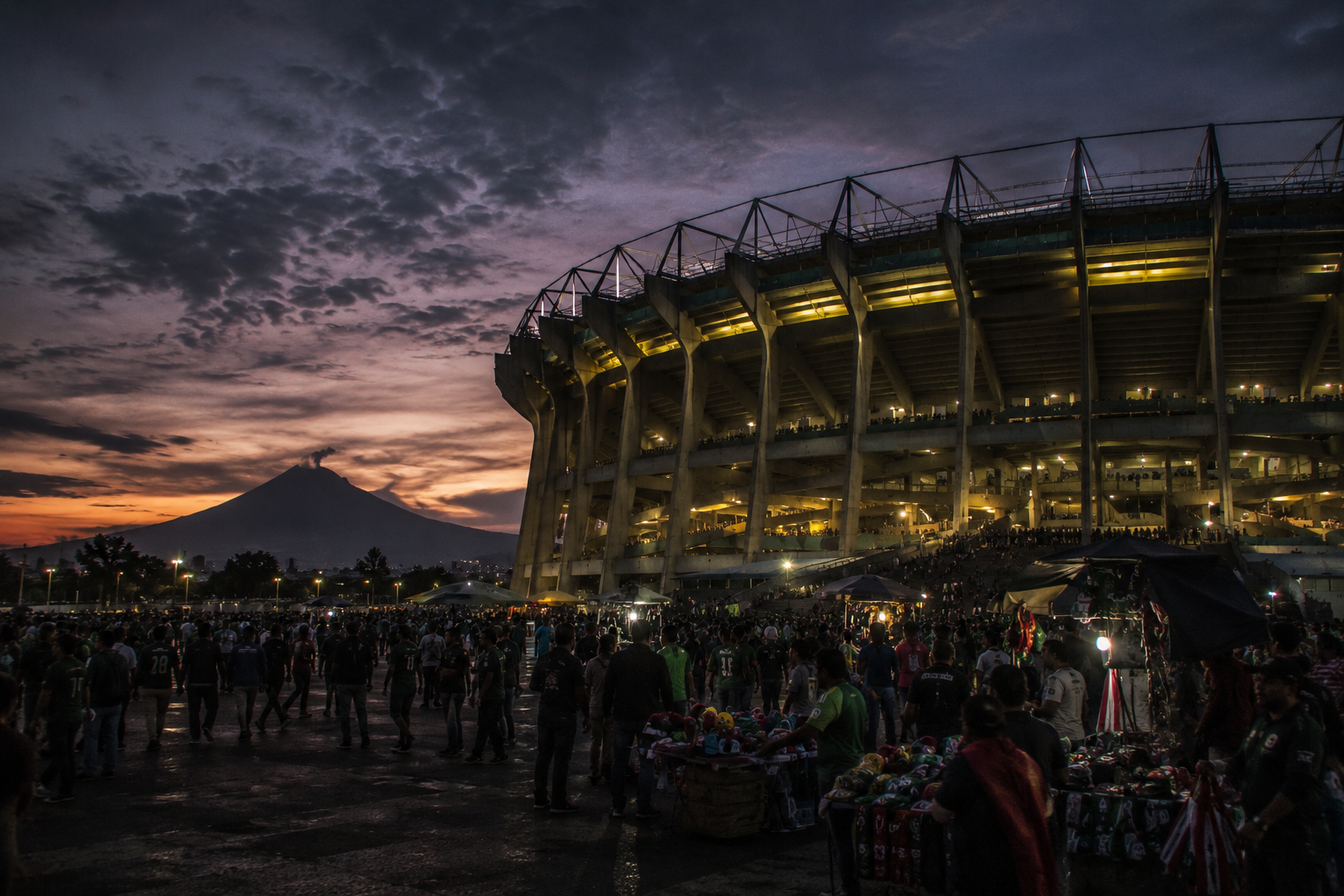
The heat in Mexico City arrives differently than it does in the coastal cities further south. At 2,240 metres above sea level, the air is thinner and the sun sharper, the light over the Zócalo in the middle of a June afternoon bleached and relentless. The city sits in a valley ringed by volcanoes, and on clear days — the clear days that the city's particular relationship with smog does not always permit — you can see Popocatépetl to the southeast, its snow-capped peak rising above everything man-made. The World Cup is arriving in a city that has been here for seven centuries, that has absorbed empires and revolutions and earthquakes and everything else, and that will absorb this too, with the particular energy of a place that understands both greatness and impermanence.
On June 11, Estadio Azteca opens the 2026 FIFA World Cup for the third time. The first was 1970. The second was 1986. No other stadium in the world has done this twice. None is doing it three times.
The Stadium
Estadio Azteca — officially renamed Estadio Ciudad de México for the duration of the tournament — sits in the Santa Úrsula Coapa neighborhood of the Coyoacán borough, in the southern reaches of the city. It holds approximately 83,000 people and hosts five World Cup matches: the opening match on June 11, a group stage game on June 17, Mexico's second group match on June 24, and two knockout-round fixtures on June 30 and July 5.
It is where Pelé lifted the trophy in 1970 after Brazil's 4-1 demolition of Italy, the greatest team of the last century playing the finest football it ever played. It is where, sixteen years later, Diego Maradona scored twice against England in eleven minutes — one with his hand, which he later attributed to God, and one with his feet, which he attributed to nothing because no attribution was necessary. The goal stood on its own.
The stadium has recently been renovated, a process that has generated some controversy: fans attending Liga MX matches after the March 2026 reopening reported construction still in progress, poor sightlines from newly installed pitchside seats, and organizational issues that do not reflect well on a venue preparing for the largest sporting event in the world. FIFA has been monitoring the situation. Come with calibrated expectations for the experience inside — the history, at least, is beyond dispute.
Getting There
Do not drive. This is the most important piece of practical advice this guide can offer. Mexico City's traffic is severe at the best of times; on a match day, with tens of thousands of fans converging from across the city and the country, the roads around the Azteca become impassable. Uber and DiDi operate freely in the city and are fine for most journeys, but not for the stadium on matchday.
The correct route: Metro Line 2 (the Blue Line) from anywhere in the center to Tasqueña station, then transfer to the Tren Ligero (Xochimilco Light Rail) to Estadio Azteca station, which sits a short walk from the main gates. The Metro costs 5 pesos — approximately 30 US cents. The Tren Ligero costs 3 pesos. The total journey from Roma Norte or Condesa takes 45 to 60 minutes, depending on starting point and wait times. A new dedicated Metrobús line is also being added for the tournament, running between Perisur and Cañaverales, with stops near Gate 8. Payment is cashless — cards, smartphones, and NFC-enabled devices.
Arrive early. The opening match on June 11, Mexico vs South Africa, will be the hardest ticket in this tournament and the match around which the city will organize itself completely. The streets around Tasqueña will be overwhelming from mid-morning. Budget two hours from your neighborhood to your seat.
For food and drink: buy outside, before you go in. The vendors around the stadium sell everything — tacos, elotes, drinks, souvenirs — at prices that will not recur inside the ground. Bring cash for the vendors. Tip 20 pesos for anyone serving you seat-to-seat inside.
🏨Find Hotels
Book on Hotels.com
Hotel links are affiliate links. We earn a commission on completed stays at no extra cost to you.
Where to Stay
The area immediately surrounding Estadio Azteca is residential and, frankly, not the right place to base yourself. The hotels are limited, the neighborhood offers little between matches, and the journey into the city's better areas takes time you would rather spend in them. Stay further north and travel to the stadium on match days.
Roma Norte and Condesa are the best bases in the city for the World Cup. Tree-lined boulevards, Parque México, tables spilling onto sidewalks from restaurants and cafés that have been getting steadily better for a decade. The walking is good, the food is excellent, the bars are genuine, and Uber to the Azteca on a non-matchday costs four to six dollars and takes thirty to forty minutes. The best restaurant scene in the city is here — Contramar for seafood (book ahead, or arrive at opening and wait; the red-and-green grilled fish is the dish), Máximo Bistrot for a market-driven seasonal menu at prices that seem impossible given the quality, El Vilsito for tacos al pastor from 9PM, when the mechanic shop closes and the taco stand opens. Cash only at El Vilsito. The queue is worth it.
Coyoacán is the alternative — quieter, more historically textured, the neighborhood where Frida Kahlo lived and worked and which still carries the atmosphere of a Mexico City that moved at a different pace. The Mercado de Coyoacán is exactly what a market should be. The streets around Plaza Hidalgo are among the most pleasant in the city for an evening walk. It sits closer to the stadium than Roma or Condesa, though the journey on match days is still best made by train rather than road.
Centro Histórico offers the Zócalo — the vast main square, second only in size to Tiananmen, flanked by the Metropolitan Cathedral and the Palacio Nacional — and the ruins of the Templo Mayor, the Aztec ceremonial center excavated from beneath the colonial city. For those who want to be inside Mexico City's history rather than its present, this is the area. Budget-friendly, walkable to the FIFA Fan Festival, and the Metro is downstairs.
Polanco is the luxury end — international hotels, high-end restaurants, the Museo Soumaya with its extraordinary collection. For those for whom comfort is the priority and cost is not a concern.
🏨Find Hotels
Book on Hotels.com
Hotel links are affiliate links. We earn a commission on completed stays at no extra cost to you.
The Fan Festival and the City's Own Celebrations
The official FIFA Fan Festival is expected to operate at the Zócalo, Mexico City's vast central square, with free entry and screenings of every match throughout the tournament. The Zócalo has hosted revolutions and coronations and protests and earthquakes; it will accommodate a football fan zone without difficulty. The energy there on the night of June 11, when Mexico plays its opening match on home soil for the first time in forty years, will be something.
Beyond the official zone, the city has divided itself into sixteen smaller fan zones across its districts. Mexico City takes football seriously in the way that cities take things seriously when the game has been woven into the fabric of daily life for generations. Club América, Cruz Azul, and Pumas UNAM are the three major clubs whose supporters fill the Azteca throughout the Liga MX season; their supporter cultures — La Rebel, La Sangre Azul, Barra 51 — will be fully present throughout the tournament. Find the bars where they watch. The atmosphere will be nothing like a neutral fan zone.
The cantinas of Roma and the mezcal bars of Condesa will be showing the World Cup. A Mexico City cantina on a match day involving the national team is one of the more specific pleasures the tournament offers: the combination of mezcal, noise, genuine investment in the result, and the particular warmth that Mexicans extend to foreign visitors who have made the effort to be in the right room. Get there early — cantinas traditionally open in the late afternoon and close by 11PM.
The Altitude
Mention it once and then stop thinking about it: Mexico City sits at 2,240 meters (7,350 ft) above sea level. First-time visitors at altitude often experience mild symptoms in the first 24 to 48 hours — headaches, fatigue, a slight shortness of breath on physical exertion. The remedies are the obvious ones: drink more water than you think you need, avoid heavy alcohol consumption on arrival, sleep. The city's permanent residents are entirely acclimated; within a day or two, most visitors are too. The football players will have all been managing it in training camps for weeks.
Between Matches
Mexico City has more than 150 museums, which is a statistic that does not capture what it actually feels like to be in a city of this cultural density. The National Museum of Anthropology in Chapultepec Park is among the greatest museums in the world — the collection of pre-Columbian civilizations, including the Aztec Sun Stone and the reconstructed Mayan temple façades, is extraordinary and should not be rationed to an afternoon. The Frida Kahlo Museum (Casa Azul) in Coyoacán requires advance booking and is worth the planning. Chapultepec Castle, the only royal castle in the Americas, sits above the park with views across Paseo de la Reforma.
Teotihuacán — the Pyramid of the Sun, the Pyramid of the Moon, the Avenue of the Dead — sits 45 minutes northeast of the city and is one of the most visited archaeological sites in the Americas. Go early. The site opens before the heat arrives; the midday climb in June will be genuinely difficult.
Xochimilco, in the southern reaches of the city, is where the pre-Hispanic canal system survives: colored trajineras (flat-bottomed boats) navigating the waterways while mariachis play from passing boats and vendors sell food and drinks alongside. It is chaotic and loud and absolutely worth a morning.
For food: Roma Norte's street stalls produce tacos al pastor and tlacoyos that are, by most reasonable measures, among the finest street food on the planet. The Mercado de San Juan, in the Centro, is where the city's chefs shop and where you can eat alongside them. The correct order of operations in Mexico City is: eat first, then plan, then eat again.
What It Costs
Mexico City is significantly more affordable than the North American host cities. A rough guide:
| Metro ride | 5 MXN (~$0.30) |
| Tren Ligero | 3 MXN (~$0.20) |
| Street tacos (3-4) | 60–100 MXN (~$3–5) |
| Sit-down meal, Roma/Condesa | 200–600 MXN (~$10–30) |
| Mezcal, bar | 80–200 MXN (~$4–10) |
| Uber, Roma to Azteca | |
| Hotel, Roma/Condesa (mid-range) | $80–180 USD/night |
Group stage tickets for Mexico matches are the most expensive in the Mexican fixture allocation — demand far exceeds supply and the secondary market will reflect that. For non-Mexico matches in the city, pricing is more accessible.
Essential Information
Stadium Estadio Ciudad de México (Azteca), Santa Úrsula Coapa, Coyoacán. Capacity ~83,000.
Matches June 11 (opening match, Mexico vs South Africa, 1:00 PM local), June 17, June 24, June 30, July 5.
Transport Metro Line 2 (Blue) to Tasqueña → Tren Ligero to Estadio Azteca station. ~50 mins from city center. 8 MXN total. Cashless. No driving on matchdays.
Fan Festival Zócalo (main square). Free entry. All matches screened. Plus 16 district fan zones across the city.
Best neighborhoods Roma Norte / Condesa (bars, food, walkable, Parque México). Coyoacán (quieter, closer to stadium, markets, Frida Kahlo Museum). Centro Histórico (history, Zócalo, budget-friendly).
Food El Vilsito (tacos, 9PM, cash only). Contramar (seafood, book ahead). Máximo Bistrot (seasonal, excellent value). Mercado de Coyoacán, Mercado de San Juan.
Bars Cantinas in Roma (open afternoon, close 11PM). Mezcal bars, Condesa. Covadonga, Roma (1940s cantina, dominoes, Asturian food).
Altitude 2,240m. Drink water. Rest on arrival. You will be fine within 48 hours.
Currency Mexican peso (MXN). Withdraw from BBVA or Santander ATMs for best rates. Cash essential for street food and tipping vendors at the stadium.