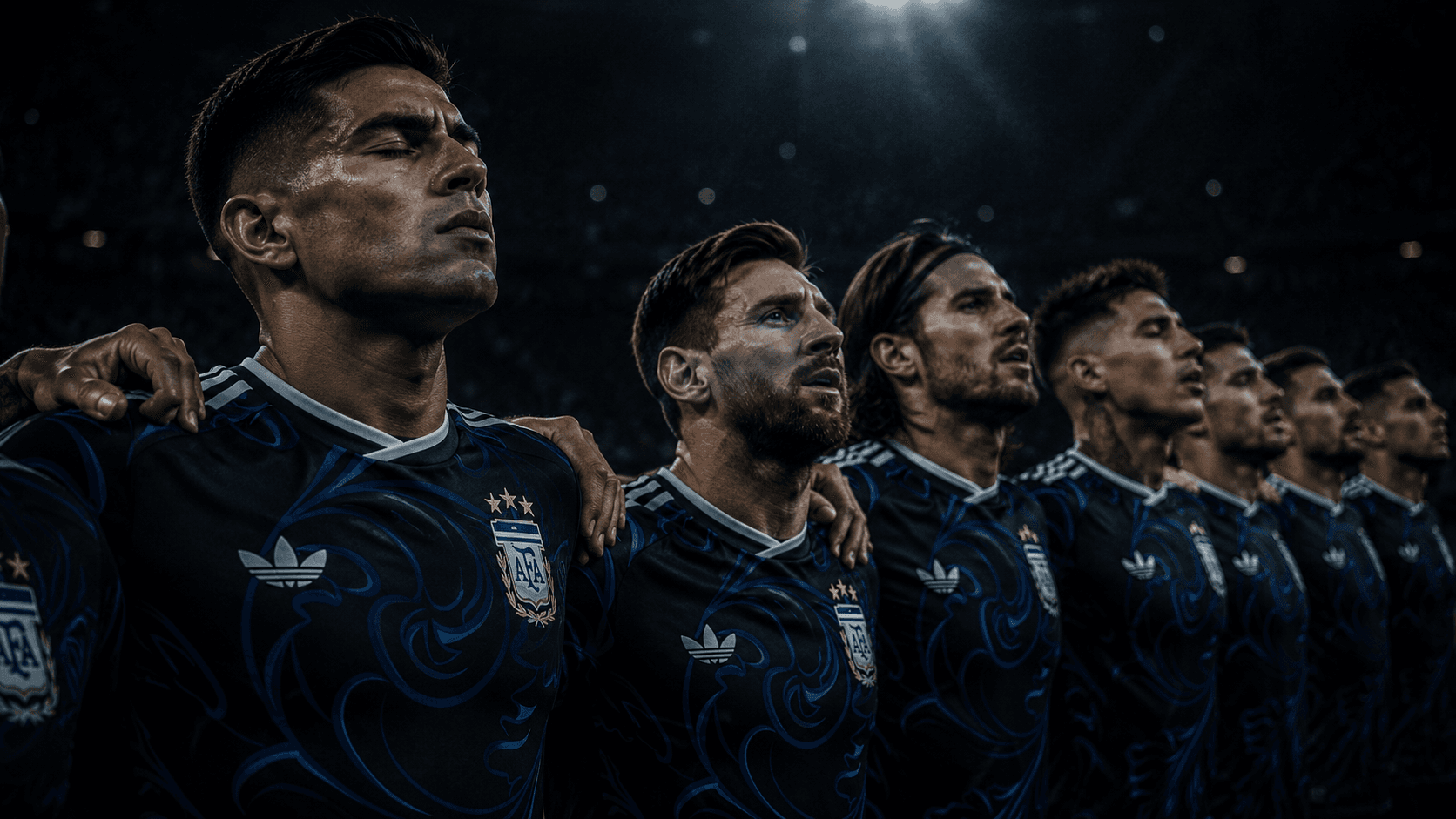
Before any of it — before the nineteen fouls, before Gordon's goal, before the last five minutes turned the thing over — there was the anthem.
Argentina do not sing their national anthem so much as discharge it. Eleven men in a line with their arms locked, eyes shut or fixed on nothing at all, faces working with something that is not quite joy and not quite rage. They are not singing to the stadium. They are singing at something. And behind them the staff are doing the same, among them Walter Samuel, who spent fifteen years as one of the most uncompromising center backs in Europe and built a career out of showing you nothing, jaw set, mouthing every word. It was possibly the calmest I have ever seen him look.
I do not know where it comes from. I have wondered about it for years and I have never landed on an answer I trust, and I am suspicious of anyone who offers one too quickly — the sort of tidy cultural explanation that flatters the writer more than it explains the country. What I do know is that it is not decoration. It is the same thing you watch for the next two hours. By the time the anthem finishes, Argentina are already at a temperature the opposition has to find from somewhere.
England found it. They played well. They led. That was the mistake.
Blood in the water
They do not overcome adversity. They expect it.
Here is the strange thing about this Argentina, the thing that separates them from every other good team and from the ordinary understanding of what makes a team good. They are not activated by comfort. They are activated by trouble. Adversity is not the thing they survive. It is the thing that switches them on.
Lionel Scaloni said it himself afterward, flatly, the way he says everything: this team plays best when it is facing a difficult situation. There was blood in the water, he said, and they went for it. That is not the usual manager's boilerplate about character. It is a claim about mechanism — that discomfort, for these players, is not an obstacle to their best football but the precondition for it.
Watch what happens when you take the trouble away, and the theory holds in the negative. Give Argentina a quiet, even game and they can look like what they partly are: a collection of good players rather than great ones, several of them more functional than transformative at club level, capable of drifting through forty-five minutes without ever quite becoming a team. It is the moment the game turns against them that they cohere. A goal down, a man light, a penalty missed, a clock running out — that is when eleven separate players become the thing nobody in this knockout run has found a way to finish off. Most sides have a ceiling that adversity lowers. Argentina have one it raises.
The record now reads like a dare the tournament kept making and losing. In Qatar they opened by losing to Saudi Arabia, a result that ended a thirty-six-game unbeaten run and which one firm rated the greatest upset the competition had ever produced — and they won the World Cup. Here they have not taken a single knockout tie in comfort: Cape Verde forced extra time, Egypt went two goals up and Messi missed a penalty before he hauled them back, Switzerland pushed them to extra time while down to ten men. Every round the water has darkened. Every round they have come. You begin to suspect they cannot function any other way, and would not want to learn.
England, of all teams, should have understood the danger of provoking them, because they have been on the receiving end of the ugliest expression of the same instinct. In Saint-Étienne in 1998, Diego Simeone went into the back of David Beckham, Beckham flicked a boot at him from the floor, Simeone made the most of it, and the referee produced a red card. Argentina won on penalties. Simeone admitted years later that he had gone looking for exactly that. Beckham spent four years paying for two seconds of temper — the effigies, the tabloids, a nation's worth of blame — before answering it with a penalty against the same opponent in 2002, though the reputation took the better part of a decade to shake. That is the rivalry England remember. It is also, precisely, the trait: a willingness to do whatever the ninety minutes actually asks for, including the parts nobody frames for the wall.
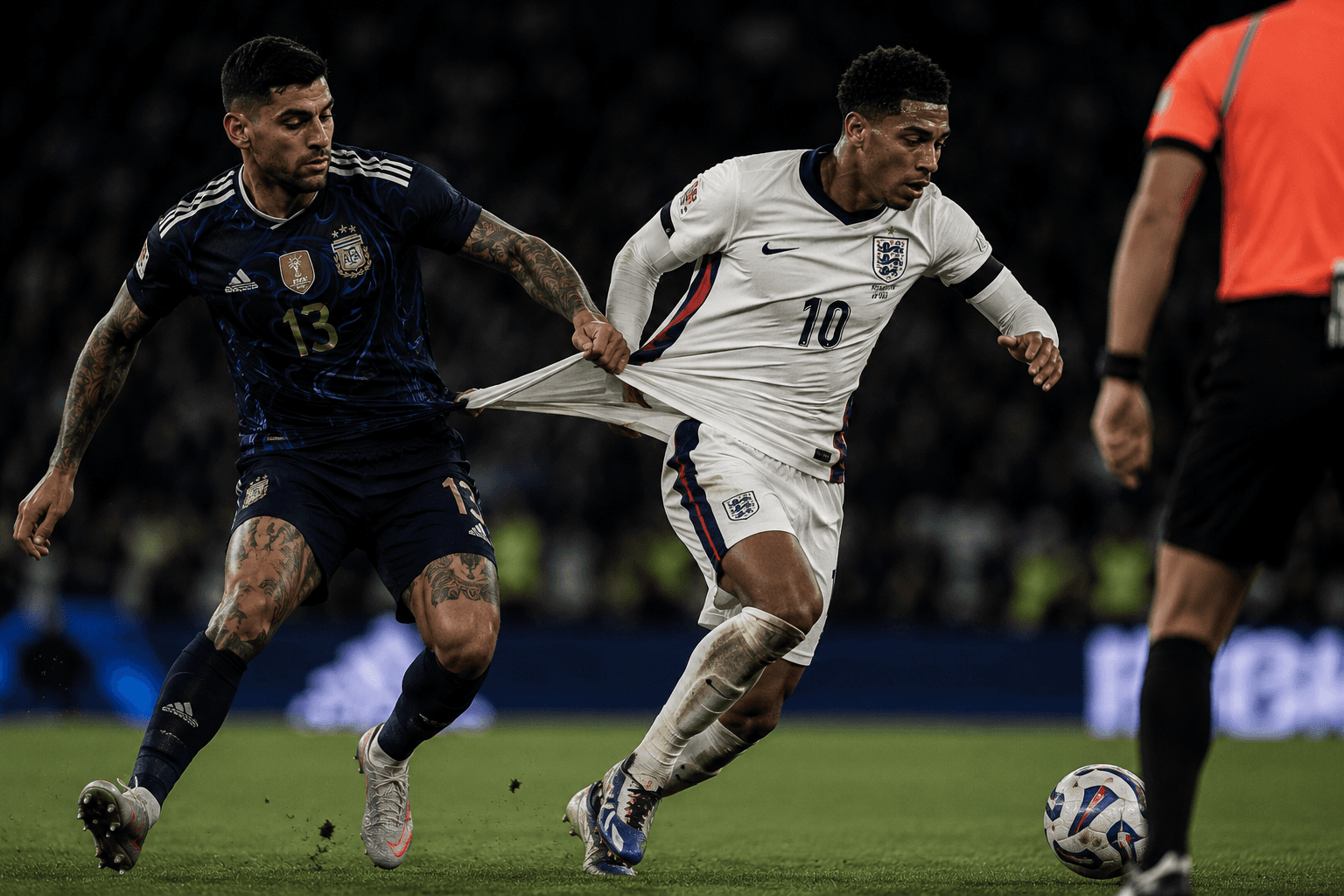
Because that is the other half of it, and the half that visitors tend to find distasteful. They have no interest in being morally admired at the expense of advancing. They will go down. They will hold a shirt. They will take the booking that costs them a place in a final if the alternative is losing the semifinal in front of them. What they possess is not sportsmanship but a total absence of squeamishness — a moral flexibility in service of the result — and it is not separate from the grit. It is the same faculty. A team that needs adversity to find its best will not hesitate, when necessary, to manufacture some of its own.
Cristian Romero is what all of it looks like compressed into one man. He made seventeen defensive contributions in Atlanta; the entire rest of Argentina's back line managed thirteen between them. He was booked in the 51st minute for hauling Jude Bellingham backward to smother an England attack that had started to look like something — a foul with no ambition beyond stopping the thing from happening, taken on purpose, earning a yellow he then managed for the remaining forty minutes without seeing a second. Lisandro Martínez had been booked nine minutes earlier. Both center backs spent the second half walking a line, and neither stepped over it once. That is not recklessness. It is the opposite: the cold, exact calibration of a team that knows precisely how much it is willing to risk, and does not flinch from risking all of it.
Don't wake the beast
The switch, and its purest expression
Everything so far has been about eleven men, a country, and a mechanism that lives in the group. But the mechanism has its purest, most terrifying expression in a single body, and midway through the second half England went and found it.
Messi and Bellingham had a disagreement over a foul — nothing much, a few words, the kind of thing that happens in every match ever played. Then Messi nodded at him. Slowly. Eyebrows raised, mouth pulled down at the corners, the face of a man conceding a point he has no intention of losing.

It was not an angry face. That is the part worth sitting with. Anger would have been better news for England — anger is hot and brief and makes people worse at football. This was the other thing: the look you give somebody whose argument you have just stopped taking seriously. The look of a decision already made.
Thierry Henry, who played alongside him at Barcelona and was watching from a studio, knew at once what he had seen. England, he said on air, had made a mistake. Don't wake the beast. Henry had told the story before. He told it again that night. Messi was fouled in training, the coach waved play on, and he went back to his own goalkeeper, demanded the ball, and dribbled through the entire side to score — not past a couple of them, through all of them, some of the best players alive arranged for his convenience. Rio Ferdinand, relaying it once, added the line that lands it: and it wasn't just that one time.

That is the whole article in one anecdote, running inside one person. Messi at 39 no longer operates at his maximum for entire matches; he distributes his effort with ruthless selectivity, strolling through the passages that do not require him because he can. What he has kept — what may be the last and most frightening thing he has kept — is the switch. The ability to decide, mid-match, that now it will be him. It is the individual version of the anthem, the individual version of blood in the water: the best football arriving not on schedule but on provocation. England provided the provocation.
He did not score. He did not need to. He completed nine dribbles against them, more than any player has managed in a single game at this World Cup, and every one of them carried the same message. He simply began going past people, and there was no version of England that could stop him doing it, and everything after that was arithmetic.
The last five minutes
What the mechanism produces
For the first half hour, neither side had a shot. Nineteen fouls in the opening forty-five minutes, two bookings, no football — the first time since 1966 that both teams had gone that long to start a World Cup match without an attempt on goal. England were content with it, and it was a reasonable plan.
Anthony Gordon broke it in the 55th, reading Morgan Rogers' curling cross, cutting across Nahuel Molina and slotting it into the far corner past Emiliano Martínez, and for half an hour England had a World Cup final. Then, in the 82nd, Thomas Tuchel took off Reece James for Dan Burn and Declan Rice for Nico O'Reilly: more height and defensive weight, sent on to deal with the crosses that were plainly coming.
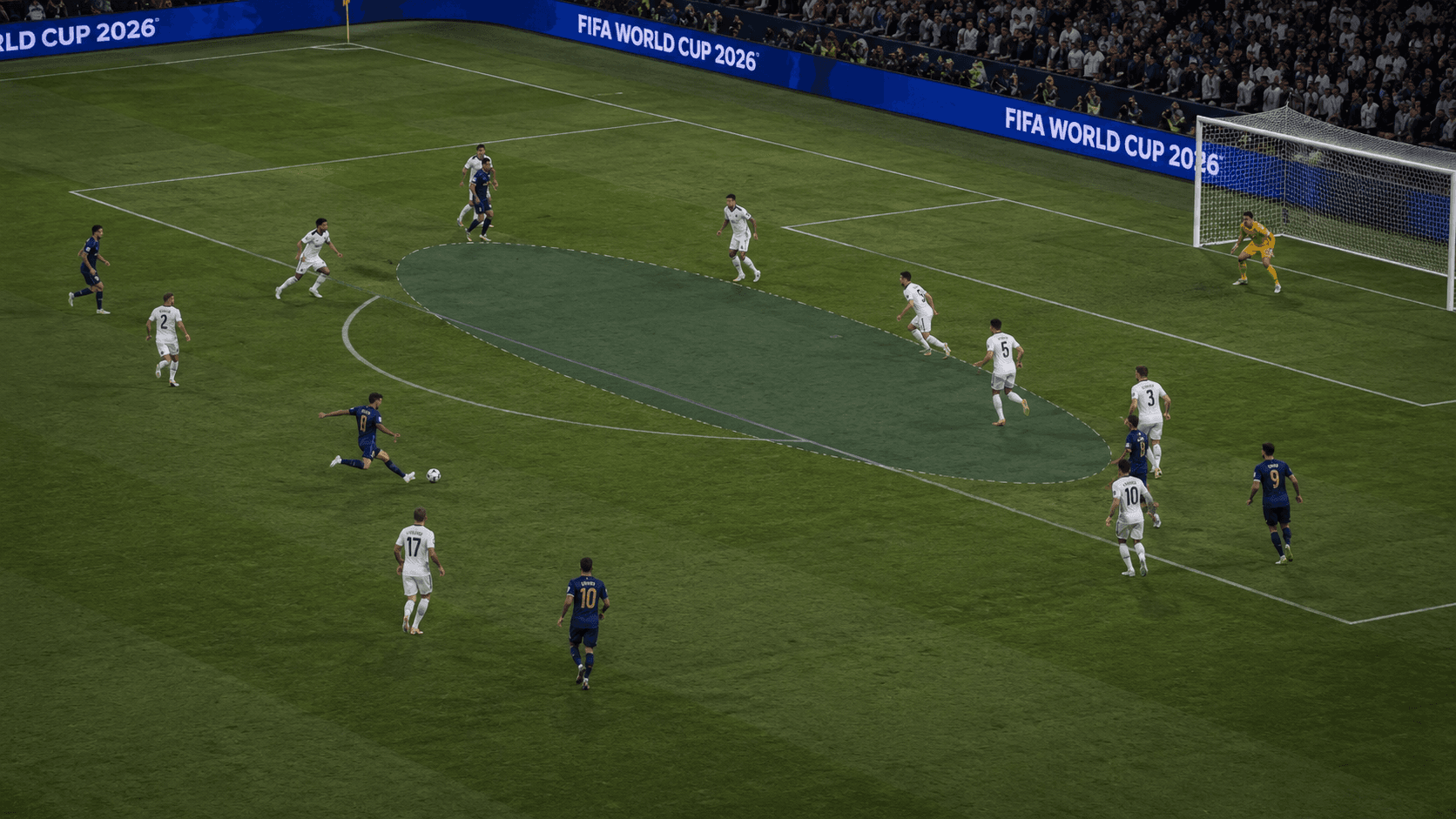
Three minutes later Enzo Fernández struck from outside the box, through the space where Rice had been standing, and Jordan Pickford could not reach it. It was not a cross.
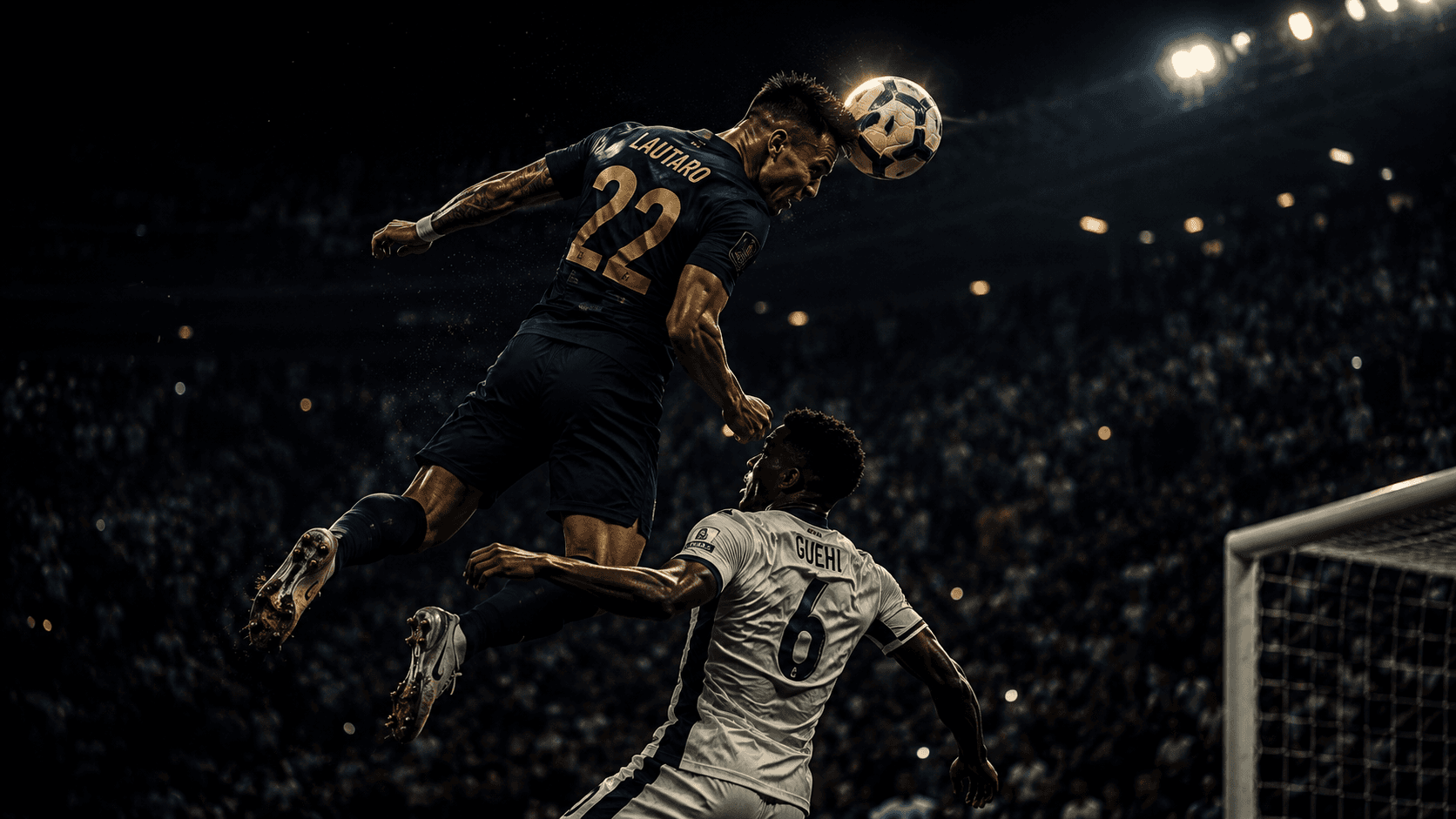
Two minutes into stoppage time Mac Allister hit the post, Messi collected the rebound, held it until the picture reset, and floated a right-footed ball to the back post. Lautaro Martínez, a substitute, headed it in. That one was a cross. England lost him anyway. Both substitutions had failed on their own terms, in opposite directions, inside seven minutes.
From Gordon's goal to Lautaro's, England had twelve percent of the ball.
"I dreamed it, I swear," Lautaro said afterward. "I told Alexis I was going to come on and win it." Two years ago, in the Copa América final, he scored the winner in the 112th minute — sent on, with Paredes, in the 97th. This is not a hot streak. It is a rehearsed reflex, refined across Scaloni's years in charge.
Lionel Scaloni does not work the touchline. He mostly watches, with the still, absorbed look of a man reading something, and then at the exact moment the game asks its question he answers it — Lautaro on, and the match tilts. It is tempting to call it luck, and easier than the truth, which is that he seems to feel these games in a way that does not reduce to a plan. As a footballer, he was a right-back who spent fifteen years as a utility man, filling whatever role a coach handed him, doing the least glamorous work in the squad: reading the game and plugging its gaps. He does the same thing now from the bench, and it remains the only senior head-coaching post he has ever held. When he got it, on an interim basis at 40, Maradona said he could not direct traffic. He was at the 2006 World Cup as a player, in the same squad as a nineteen-year-old Messi. What he now manages from the touchline, he first learned from inside it.
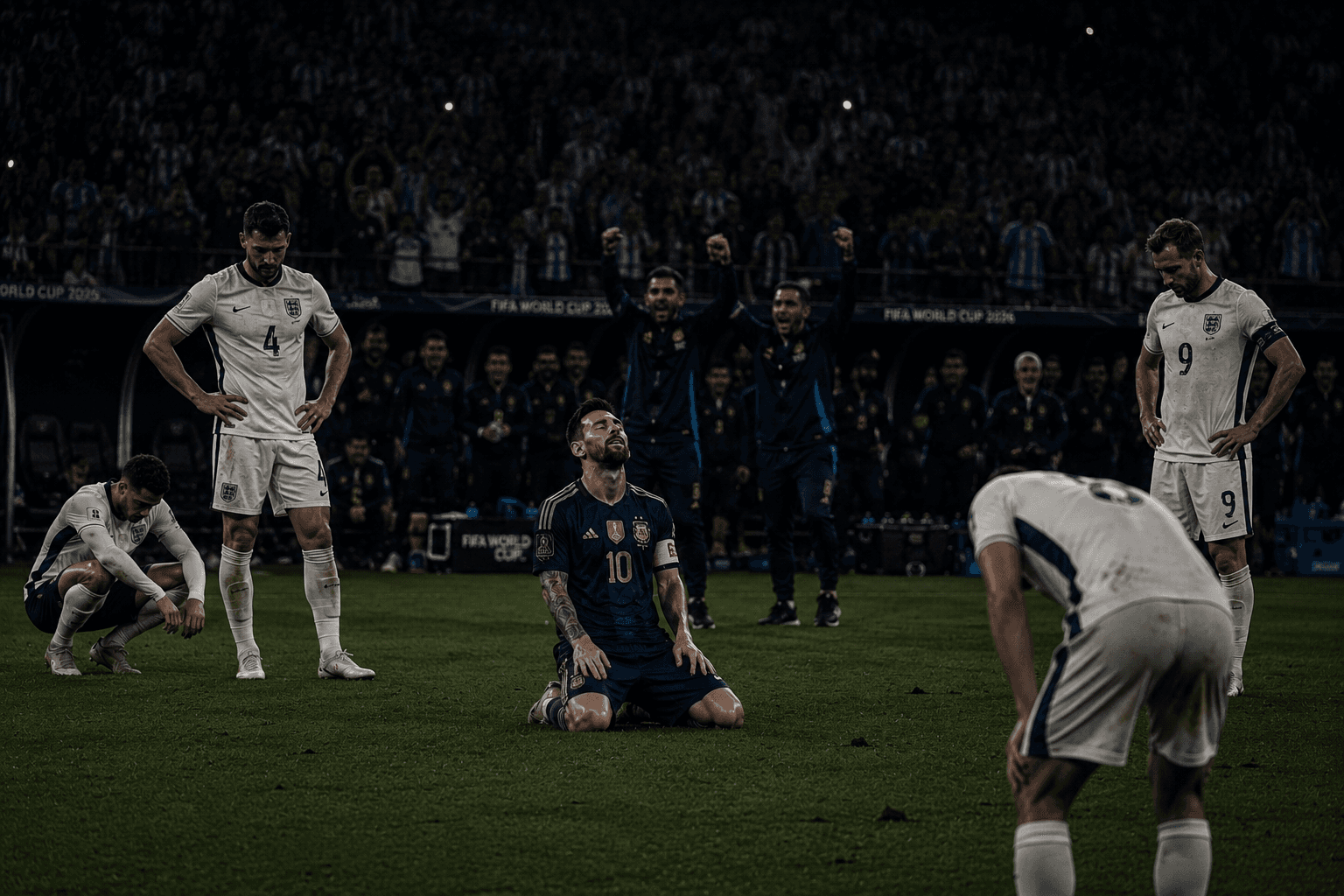
At the final whistle Messi went to his knees, then rose and went to find Kane and Pickford to shake their hands. Behind him, Walter Samuel and Roberto Ayala were celebrating — the center-back pair from Argentina's previous meeting with England, a friendly in Geneva in November 2005 that an eighteen-year-old Messi missed through suspension after being sent off forty-seven seconds into his international debut. Twenty-one years later, they watched him finally enter the rivalry and end it on his knees.
And on Sunday, at MetLife, Argentina meet the one team built to deny them the conditions in which they become most dangerous. Spain have conceded a single goal in seven matches. They have not trailed for one minute of this tournament. They have spent a month refusing to let football become difficult.
By the time the anthem ends, Argentina will already be at a temperature most teams spend ninety minutes trying to reach. Spain have spent the whole tournament making sure nobody reaches it at all.
The final is the argument between those two ideas.
Read more World Cup 2026 coverage: Baby Out With the Bath Water — Argentina's Disgrace · The Best Form of Defense — Spain's World Cup Final · Dead Rubber — England vs France · The View From Above — Rodri's World Cup · O Kylian — Mbappé's World Cup · Braut — Haaland's World Cup · Hey, Jude — Bellingham's World Cup · El Matador — Mikel Merino · The Round of 16 · The Group Stage Is Over