The Plan Was in the Bin
Priya's Board — the written board.
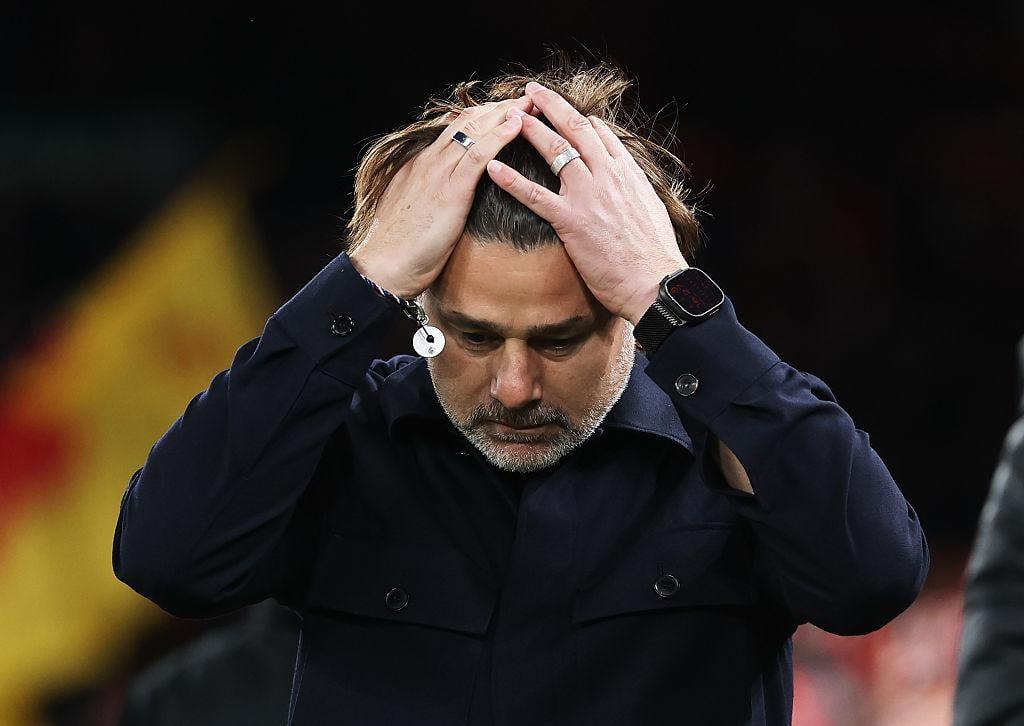
…"after eight minutes, I think, the plan was in the bin."
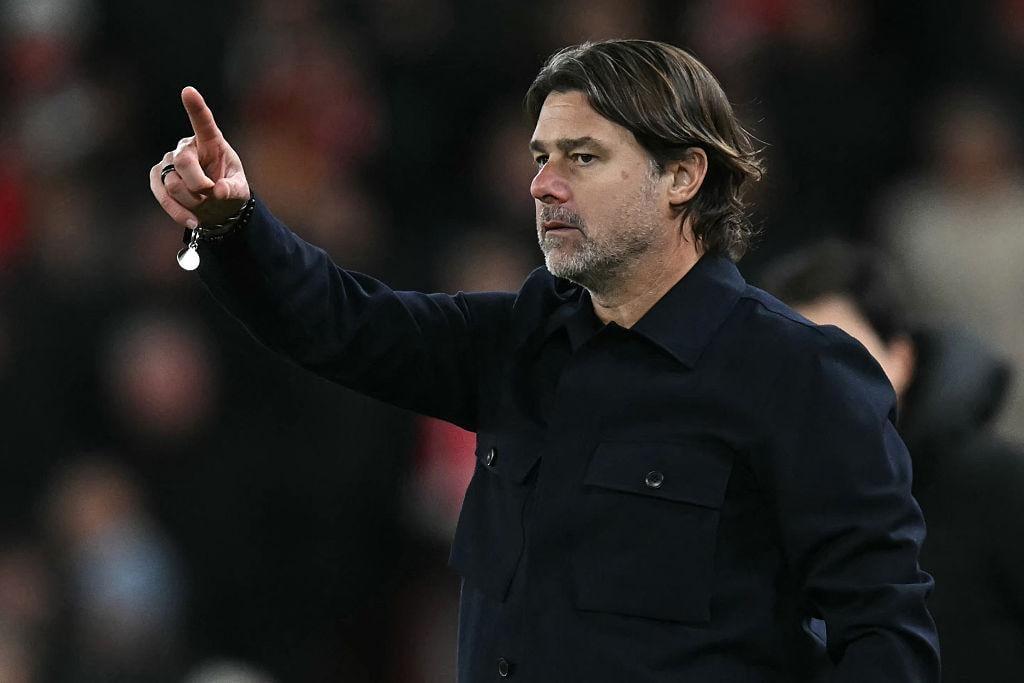
That is not a headline written about Mauricio Pochettino. It is Pochettino, after the match, describing his own first game in charge of Manchester United. Four days in the job. Three training sessions. Then Anfield, and a plan that lasted eight minutes.
It would be easy to file what followed under the red card and stop there. Liverpool 4, Manchester United 0. A man sent off in the eighth minute, a free kick scored two minutes later, a second goal three minutes after that. Contest over before it had settled. Iraola himself said the game was conditioned by how long Liverpool played against ten men. He was right about the result. He was not the whole diagnosis.
Watch the eight minutes again, at eleven against eleven, and a different match appears — a shorter one, and a more useful one. Because the sequence that produced the red card did not catch United by surprise. It had already happened. Twice.
The warnings
Inside the opening minutes, Bradley Barcola was running at United's defence and Matthijs de Ligt had to throw himself in front of a powerful strike to keep it out. No goal, no card, no lasting damage — except this: United's line had been breached, cleanly, with every player on the pitch.
Then it happened again. Barcola posed the problem a second time, and this one ended with Alexander Isak free inside the penalty area, denied at close quarters by Senne Lammens. Two warnings, two different routes — one through the middle, one into the space behind — and both asked the same question about the spaces behind United's pressure. Whether the pressing distances and the recovery cover could have been corrected inside three minutes is harder to establish; nobody is obliged to rebuild a formation in the opening minutes of a match. What is clear is that nothing in United's response changed the question. Liverpool simply found another way to ask it.
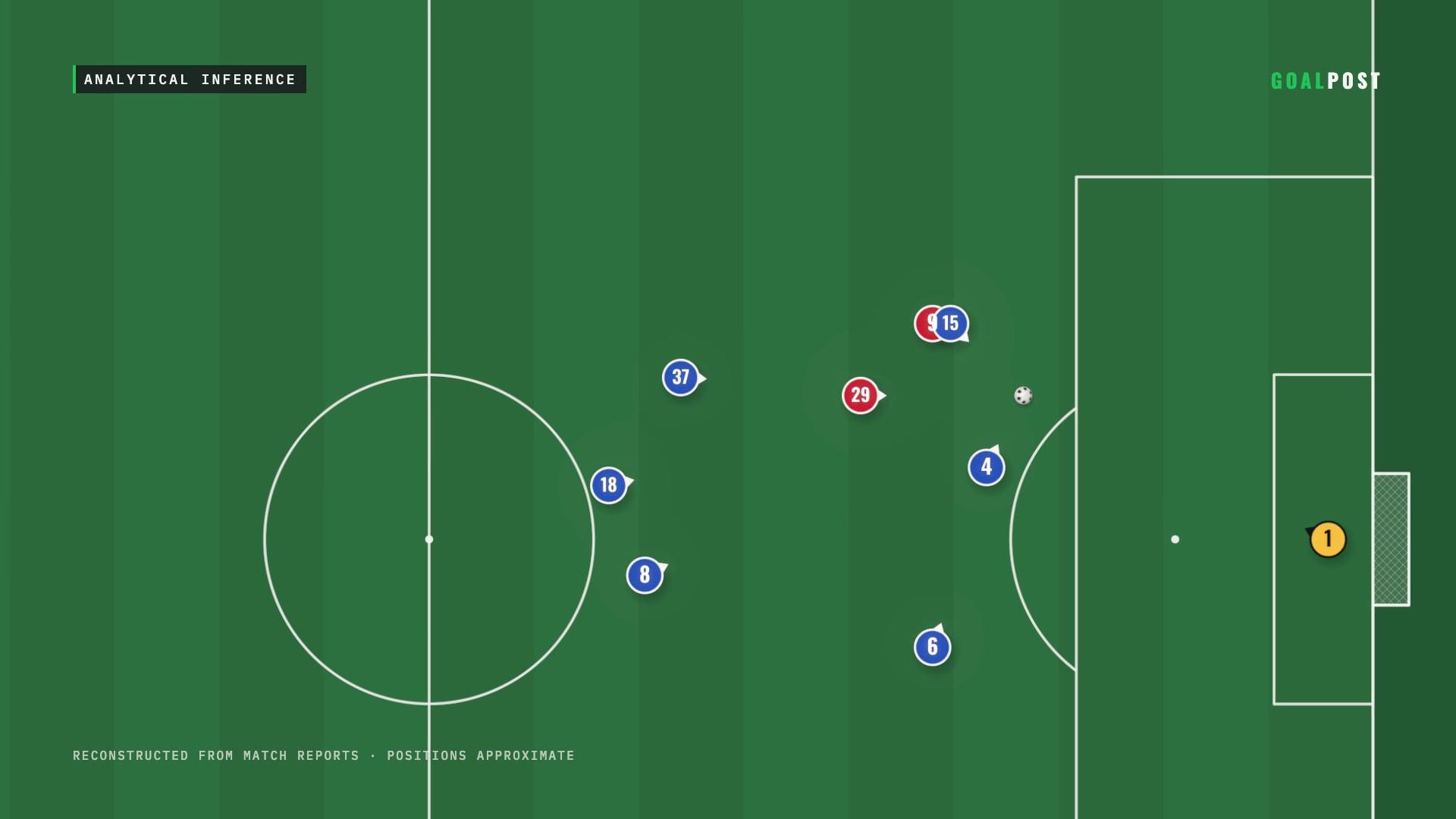
A warning is only useful if something changes because of it. United's distances did not, or could not, in the minutes that followed. What changed instead was the ball. Liverpool went longer, and the question the warnings had asked on the ground was asked again, over the top, where there is less time to answer it.
The eight minutes
Start further back than the pass, because Liverpool built this moment before they played it.
United's press, in those opening minutes, was player-oriented: men going to men, trying to lock Liverpool in. When Ronald Araújo took the ball, Patrick Dorgu released from the left of United's midfield to go and press him. That jump is the first domino. It thins the line behind the press at the exact moment the ball is with the one Liverpool player whose long passing can punish it.
Then Isak moved — twice. First he dropped towards the ball, a small step with a large effect: it drew De Ligt's attention, and half his bodyweight, towards the play. Then he spun and ran in behind, into the space a high line keeps behind itself. Araújo played the shaped pass over the top. Between De Ligt and Leny Yoro there was too much ground: no cover, no balance, nobody close enough to make the space safe if the first man failed to own the ball.
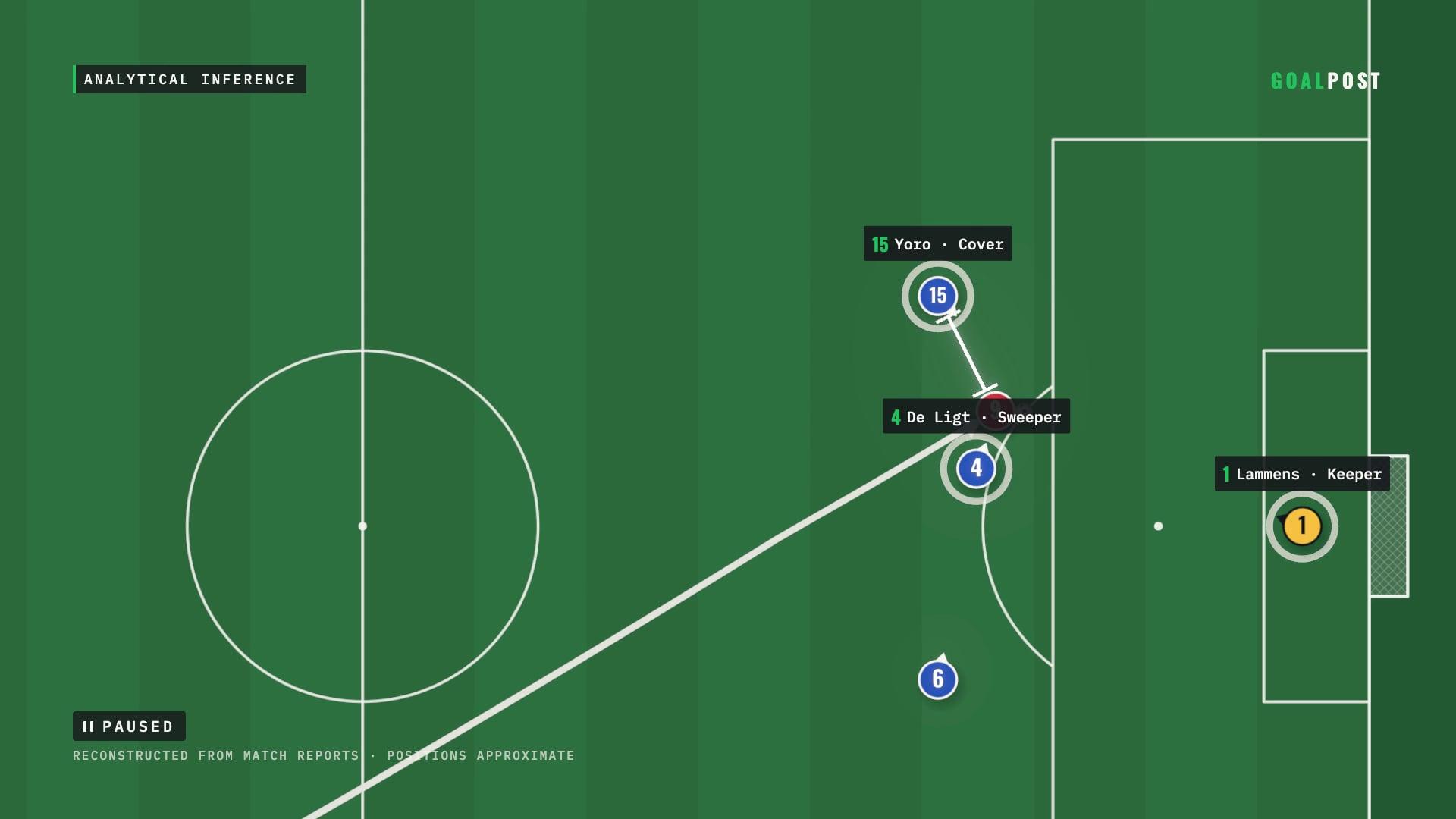
And the first man did fail to own it. De Ligt was in the sweeping role, the deepest man, the one whose job on that ball is either to attack it or to make the space behind him safe. He did neither. He let it sail past him, apparently expecting Lammens to come for it. Lammens stayed home. Between those two decisions — one man stepping away from the ball, one man not stepping towards it — Isak was running free.
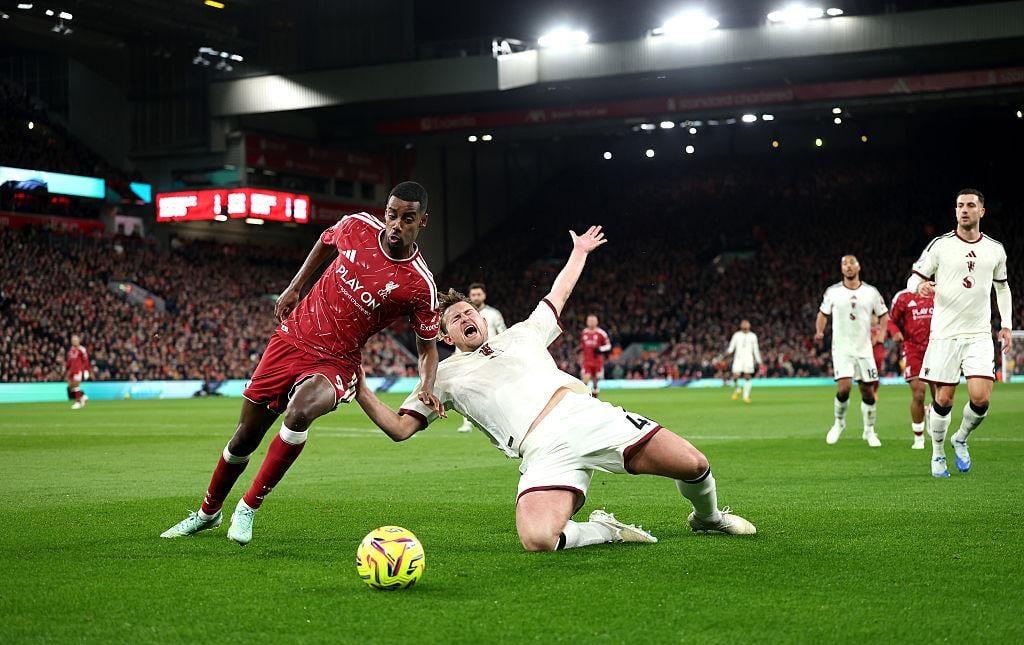
Yoro had to come across to cover, from too wide, by a longer route than the ball had taken. He reached Isak as the last man and brought him down just outside the box. Sam Barrott showed the red card. Eight minutes played.
Freeze that picture and name it, because the names are the mechanism. The sweeper let it go. The keeper stayed home. The cover arrived as a foul. But hold the two halves of the sequence together: Liverpool manufactured the moment — the press drawn out, the striker's double movement, the pass played into the one channel the cover could not reach. The failure inside it was still United's. Three roles, three decisions, one ball — and not one of them is a decision about numbers. United had eleven men when that pass was played. The failure was spacing and role clarity: who owns the first long ball, and how far away is the help if he does not.
Nor was the rest of the plan absent. In possession, United built with a 3-2 base — Martínez, De Ligt and Yoro behind Tielemans and Mainoo. Out of it, they settled into a compact 4-4-2. Before this match, this series set out what to look for in Pochettino's first side: whether the press would be coordinated, whether the protection behind it would hold, whether he would adapt when it didn't. The first answer arrived inside eight minutes. The press was recognisably his. The protection behind it was not yet anybody's.
Two minutes later came the detail that gives the game away. Dominik Szoboszlai took the free kick Yoro's foul had conceded, and scored through a gap in the wall, between Bruno Fernandes and Youri Tielemans. A wall is not only a numbers problem — though ten men change who can stand in it, and who is left to guard the space around it. Underneath the numbers it is a standing routine — who stands where, who does not move — rehearsed in training and carried out the same way whoever is available to build it. In the seconds after a dismissal, with a new shape still being shouted into place, United's wall had a hole in it. The Times called it a shambles. On the picture, that is fair.
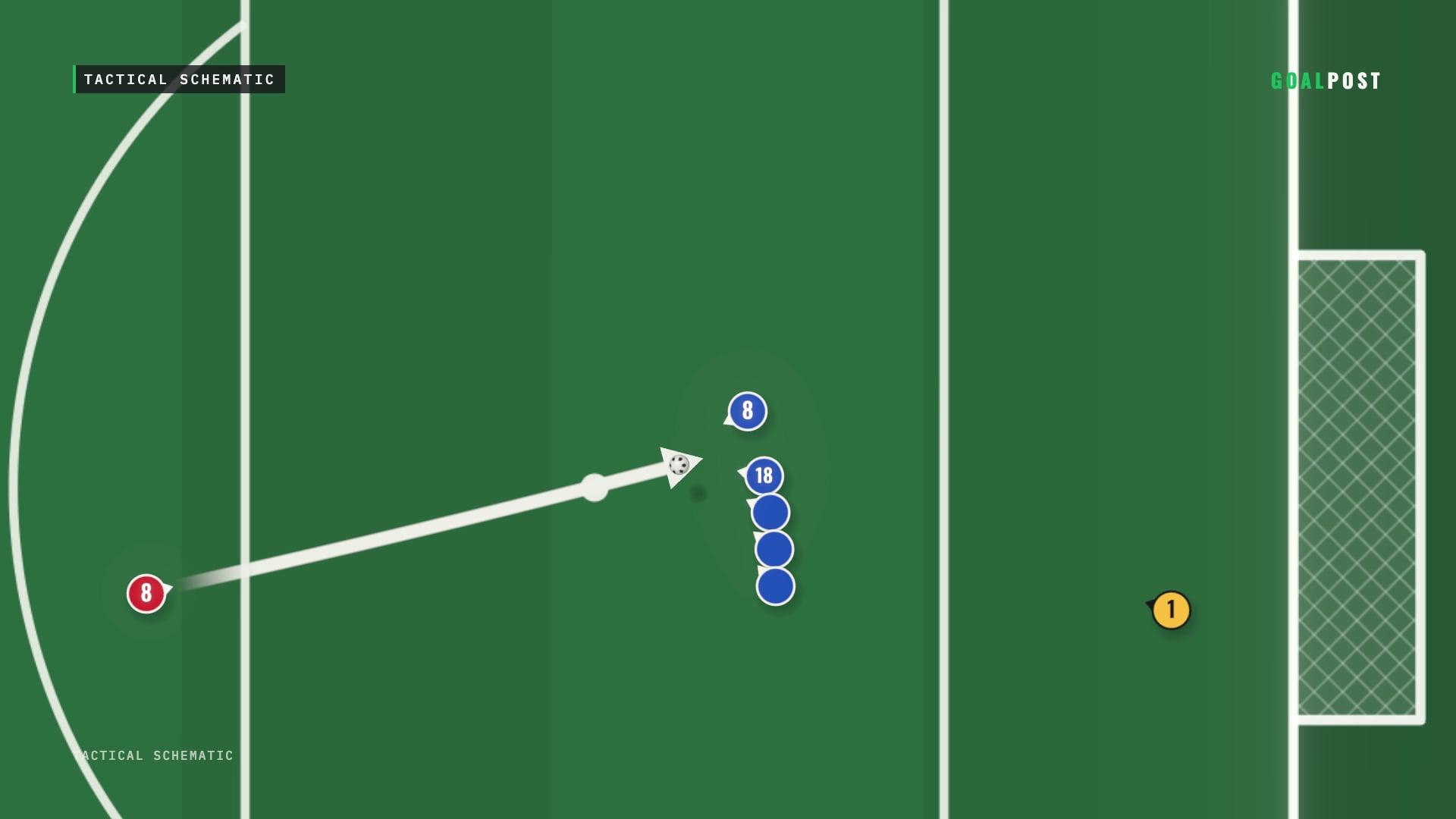
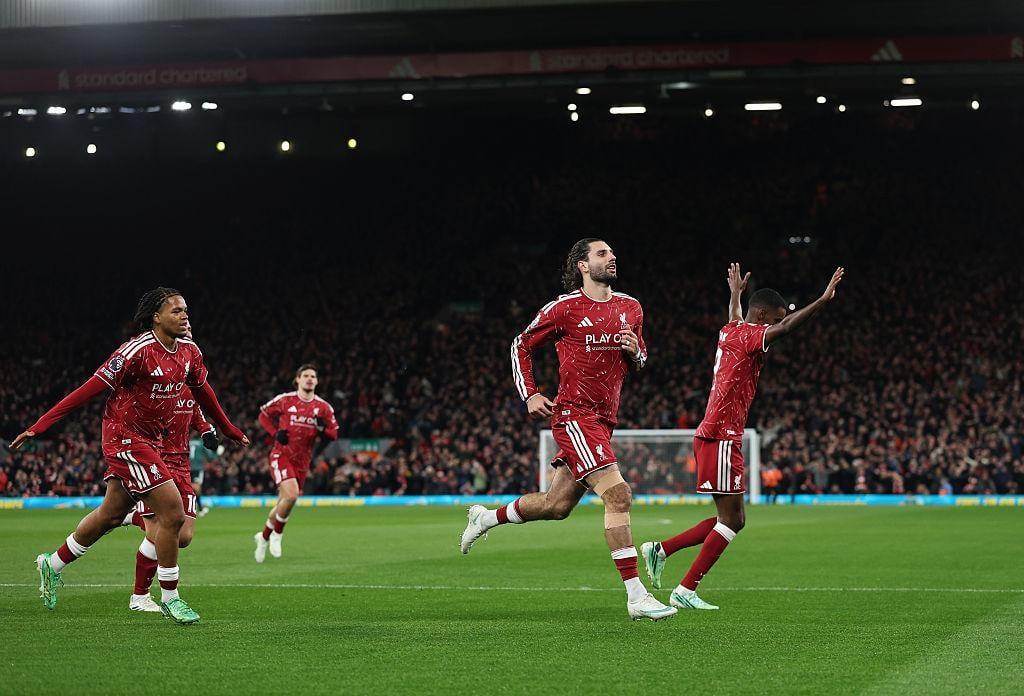
Then, at 13 minutes, the second goal — and this one belongs to Liverpool's design, not United's error alone. Isak turned in midfield and fed Rio Ngumoha on the flank. Ngumoha beat Diogo Dalot, drove into the box and clipped the ball back, and Florian Wirtz volleyed in off the underside of the bar. Liverpool were 2–0 up at 12:40 on the clock the record keeps — their fastest-ever two-goal lead over United in the Premier League. Notice the route: turn in midfield, wide runner isolating the full-back, cutback, late finish. That is Iraola's Liverpool working as intended — direct when the direct ball is on, fluid when the space opens in front of them. United's failure opened the door. Liverpool had built the corridor behind it.
What the numbers can and cannot say
The full-time figures, on GoalPost's own record, are stark: expected goals 4.42 to 0.32, shots 28 to 10. Liverpool controlled the match absolutely, in Iraola's words, and created enough to score more than four.
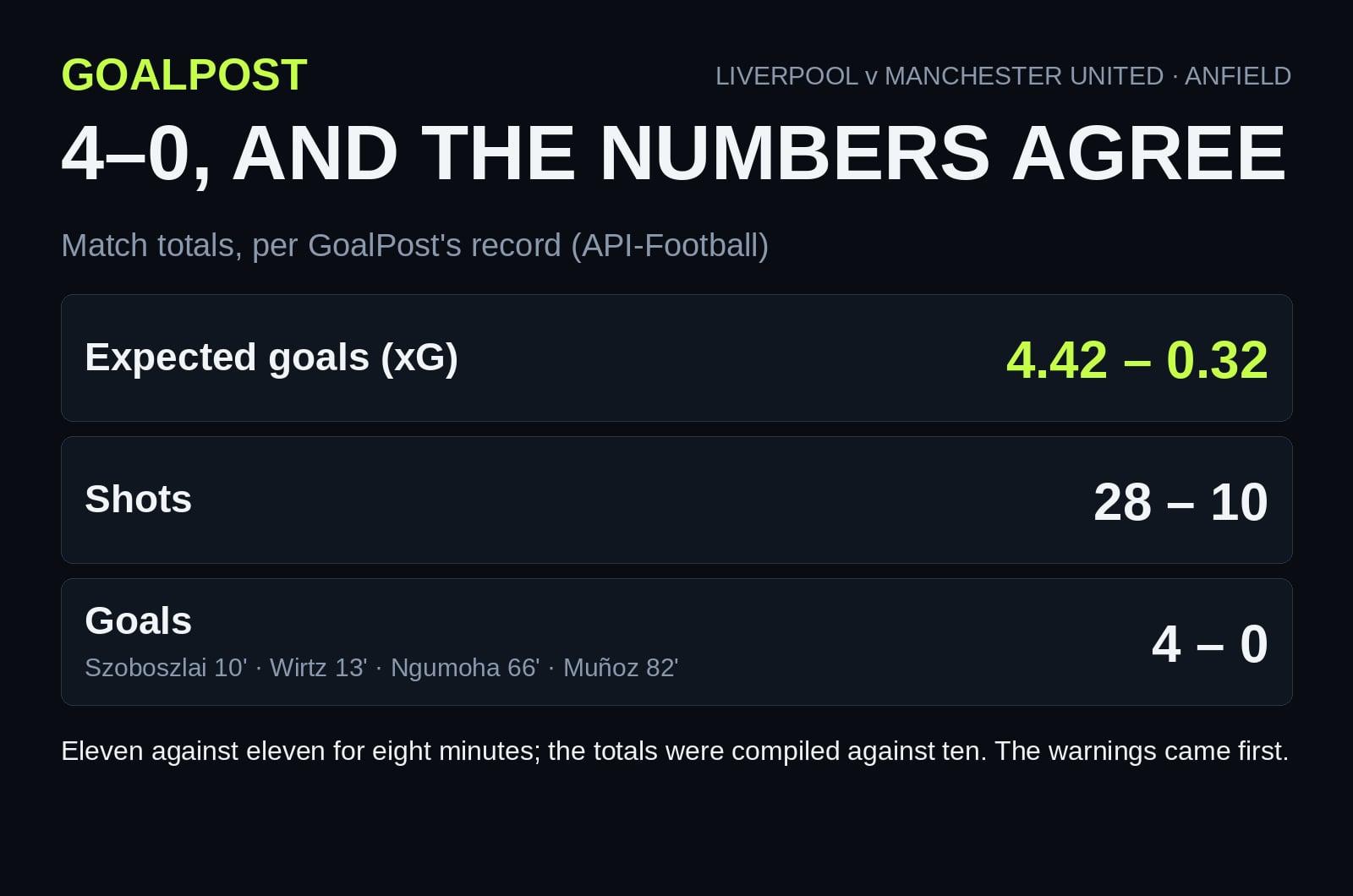
Use those figures carefully. Most of that gap was built against ten men, across 82 minutes. It tells you Liverpool were ruthless with an advantage. It does not, on its own, tell you United's plan was failing at eleven against eleven. For that, you do not need the totals. You need the warnings and the eighth minute: a line tested twice in the opening minutes, then beaten over the top, by the same defence, in the same shape, before any card had been shown.
The record around the match needs stating once, because it is the context Pochettino has inherited rather than created. United are 19th, on eight points from eleven games, nine league matches without a win. They have conceded 23 league goals, and 34 in all competitions — the most of any team in Europe's big five leagues. Yoro's dismissal was the earliest sending-off of a United player in Premier League history. Pochettino is the first manager in the competition's history to concede twice and receive a red card in the first half of his first match in charge, and the defeat equals the heaviest a United manager has suffered in his first match since 1926. None of that was built in eight minutes at Anfield. The eight minutes were where it all became visible at once.
The honest case for the red card
A forensic account has to put the strongest opposing reading on the board, and here it is not weak.
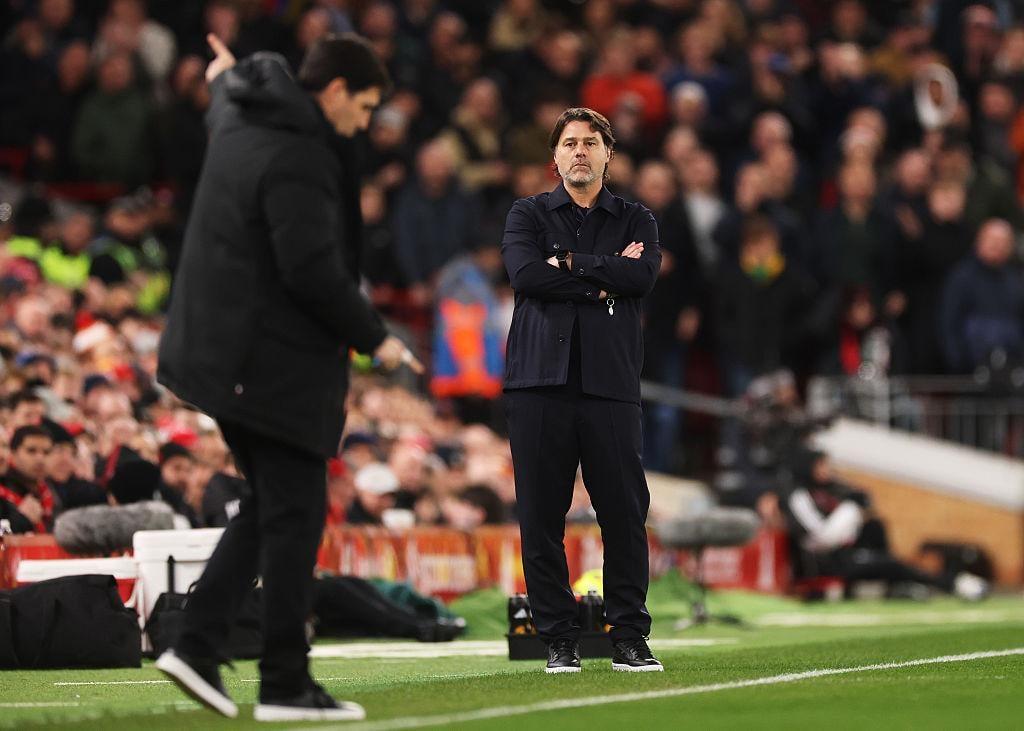
The plan existed for eight minutes, after four days and three training sessions. No system survives that test fairly. And the decision itself is genuinely contestable. The officials' reasoning is technical, and it is not mysterious: Yoro was the last man, Isak was through, the contact came from behind — and the VAR check confirmed the red card for denying an obvious goalscoring opportunity. The live question inside that reasoning is control. The law asks whether the attacker was likely to keep or gain control of the ball, and Isak's first touch was heavy, and it was carrying towards Lammens. Pochettino argued Isak did not have the ball under control — "It is never a foul," he said afterwards — and Fernandes and Kobbie Mainoo said the same, in stronger language. United have since told the FA they intend to appeal the dismissal. Even Iraola, who called it a last-man foul and a red card, added the sentence that matters: would Alex or the keeper arrive first to the ball? We will never know.
Watch it again, though, and common sense settles somewhere plainer than the law book: two players coming together at full stretch as much as a challenge — a yellow card at most — and a referee who might have been more prudent with a decision that ends a contest in its eighth minute. On another day, the officials might have judged that Isak was unlikely to control the ball before Lammens could intervene. That would have changed the disciplinary decision — and almost everything that followed.
But hold both truths at once, because they do coexist. A disputed dismissal does not explain why Liverpool were already finding the space behind United's press. A harsh card and poor defensive spacing are not alternatives. United got both.
Then there is what happened next, which cuts against any simple story of collapse. Harry Maguire came on for Bryan Mbeumo at 22 minutes, United rebuilt into a back five — a more cautious 5-3-1 that shortened the distances across the line and gave Dalot support against Ngumoha — and the score stayed 2–0 from the 13th minute to the 66th. Credit the rebuild honestly, though: it survived with its goalkeeper's help. Lammens saved from Isak, from Mac Allister low to his left, twice from Szoboszlai early in the second half; Isak skewed a golden chance into the stands; Barcola shot wide. The adjusted shape reduced what Liverpool could build. It did not stop them creating. Damage limitation is an unglamorous phrase. At Anfield, down to ten, it worked — until it didn't, and how it stopped working matters.

The bookend
The third goal, at 66 minutes, was a footrace. Barcola outstripped Lisandro Martínez near the halfway line and ran into open ground down the right before squaring for Ngumoha to finish low. Ngumoha, 18 years and 85 days old, became the youngest player ever to record a goal involvement in this fixture in the Premier League. A duel lost at halfway, yes — but the open ground Barcola ran into was the adjusted shape's own spacing, the price of a line still willing to step up. Pace beat the man. The space was already there. One transition does not convict a structure — a sound shape can lose a footrace — but the ground was there to run into, and it had been there all afternoon.
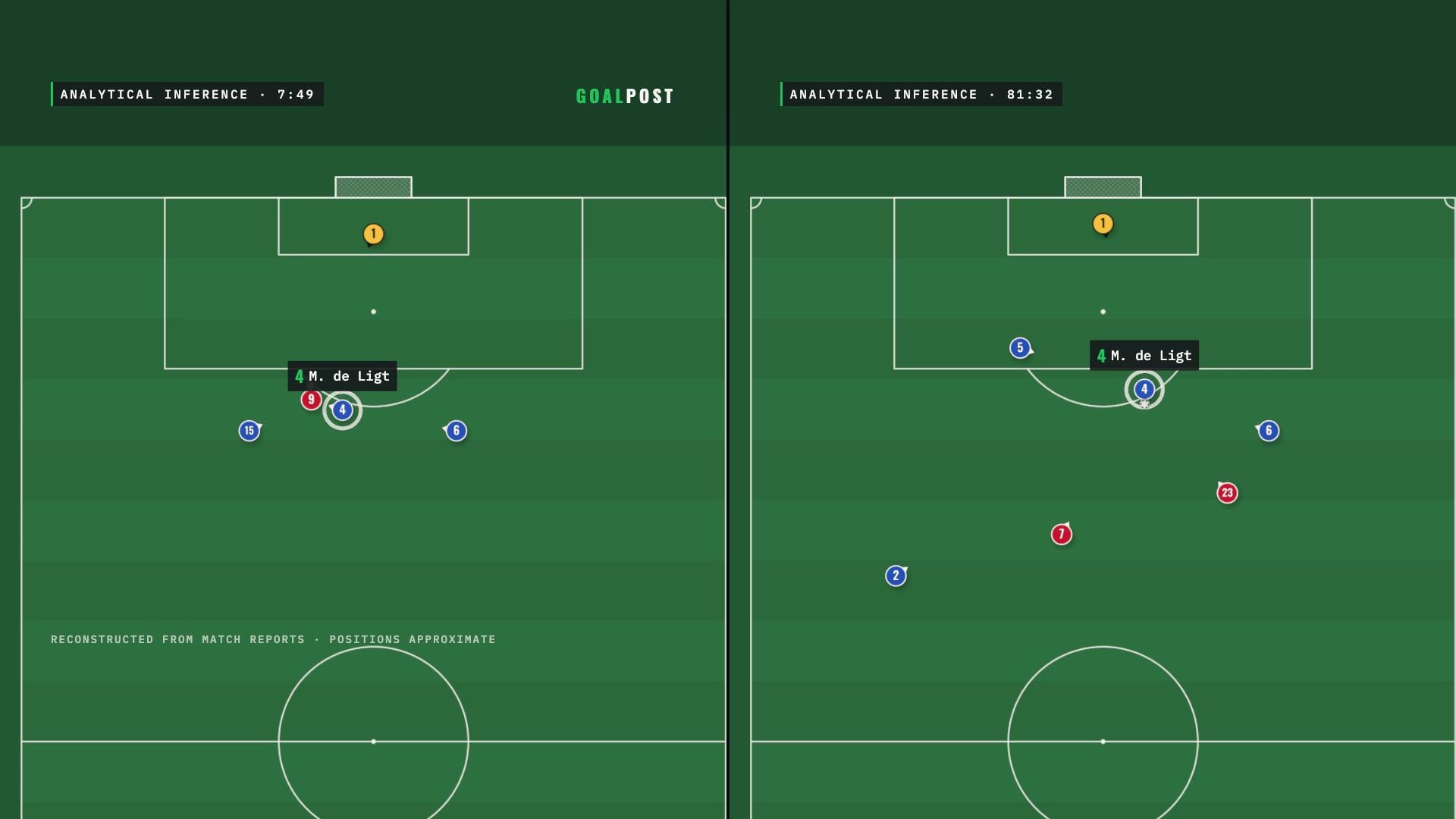
The fourth goal is the one this article exists to set beside the first.
At 82 minutes, in United's own third, De Ligt's pass towards Joshua Zirkzee was cut out, Víctor Muñoz and Wirtz combined in a one-two, Wirtz's return pass took what remained of the defence out of the game, and Muñoz finished. 4–0.
Same player. But look closer, because the honest version is more useful than the neat one. These are not the same error twice. At eight minutes, De Ligt failed to own the space behind his line — a job done without the ball. At 82 minutes, he failed to protect the ball in front of it — a job done with it. Defending a long pass and keeping a short one are different actions, with different causes, and pretending otherwise would be a slogan, not an analysis.
What the bookend actually shows is narrower, and harder. A defender in Pochettino's intended approach carries both of those responsibilities: own the space behind the team when it presses, and keep the ball securely when it builds, so the opposition cannot attack a side caught mid-shape. At Anfield, both halves of that job failed in the same match, in the same player — a player back in the league lineup after a long absence, placed in the sweeping role in a structure four days old. That is not proof the selection was wrong. It is evidence of what the role demands. Selections create failure points. Pochettino's selection placed both of those responsibilities with that defender, in that structure, on that afternoon. Whether preparation, positioning or individual execution weighed most heavily in either moment, the match cannot tell us. What it establishes is how costly both responsibilities became when they failed.
And here the counterevidence has to be weighed honestly, because it does not all point one way. The goals that finally beat the rebuilt shape were an individual footrace and an unforced pass. A reader who concludes "players, not plan" from the second half has real material to work with. What turns errors into structure is repetition: the warnings in the opening minutes, the same seam at eight, the same player's two responsibilities failing at either end of the match. Once is an error. A shape that keeps presenting the same picture in the same place is a shape problem wearing an error's clothes.
The correction
None of these corrections begins with a transfer. They begin with clearer responsibilities, better spacing and routines that survive disruption — whether the current players can execute them against the quickest opponents is a separate question, and the test below starts answering it. Three specific things, each concrete enough to be checked.
First, the sweeping brief. Against a direct team, with a new back line, the sweeper attacks the first long ball — or the whole line drops five yards and concedes the space in front instead. What cannot happen is both men waiting: the sweeper expecting the keeper, the keeper expecting the sweeper. One owner, named before the match, for the first ball over the top — and the same clarity about who steps to the ball and who covers when the press is beaten, because Liverpool's chain started there.
Second, the distances. What Maguire's introduction actually changed was geometry: an extra defender, shorter gaps across the back line, support next to the full-back facing the runner. The match cannot tell us whether Maguire, starting in De Ligt's place, prevents the eighth minute — that counterfactual is unknowable, and this board will not pretend otherwise. What it does tell us is that the spacing of the rebuilt shape is closer to what the opening minutes needed. Begin nearer to it.
Third, the wall. A defensive free-kick routine has to survive changes in personnel and game state. The goalkeeper's instructions, the wall's alignment, the responsibility for closing gaps — those must stay clear even in the minutes immediately after a dismissal, with different men standing in it. At Anfield, two minutes after the red card, they were not clear. That is precisely when routines are supposed to carry a team.
The test
Pochettino said afterwards that the anger has to become energy, starting with the trip to Portugal in midweek. The board's test is narrower than a result, and it runs as a pattern across United's next two matches — because one ball, dealt with or not, proves nothing either way.
Watch what happens, repeatedly, when opponents play behind United's first line. Who responds to the first long diagonal? Does the sweeper attack it, does the line drop as one, does the keeper come? Does the far-side defender arrive as cover, or is the distance the same distance as Anfield? And when United lose the ball in their own third, count how many players are still positioned to protect the goal.
A single clean recovery will not prove eight minutes was only an installation fault. A single failure will not prove the design is broken. But repeated, coordinated answers — the same picture, handled the same way, by men who clearly know it is theirs — will tell us what is actually being coached. That is the evidence. Everything else is one afternoon.
Show me the shape, not the score.
— Priya Shah