The First Action, the Second Ball
Priya's Board — the written board.
Manchester United took 26 shots and scored four. Aston Villa needed twelve attempts to score four of their own. Priya Shah examines the pressing decisions, defensive spacing and second balls that left United chasing the match twice — and the adjustment that rescued a point.
The puzzle
Start with the scoreboard and you will learn nothing. Four-four describes an afternoon; it does not explain one. Start with the shape instead.
The numbers first, because they are the puzzle. On the BBC's count, United took 26 shots to Villa's 12, put nine on target to six, held 56 per cent of the ball, and produced the higher expected goals — 3.55 to 2.88. United created more, on both counts. They also trailed by two goals twice, and ended up celebrating a point at home.
But divide before you conclude. Villa's 2.88 came from twelve attempts — roughly 0.24 per shot. United's 3.55 came from twenty-six — roughly 0.14. Villa were not creating more. They were creating better: more danger per attempt. Part of that gap is mechanical: each side scored a penalty, worth most of an expected goal by itself. Strip one penalty from each column — at a standard penalty value, an approximation, since providers price a penalty slightly differently — and the picture survives: about 0.19 per shot for Villa, about 0.11 for United. The question, then, is how Villa generated so much danger from so little — and it leads directly to the defending.
Two problems follow, kept separate by the evidence. The first: protection around the first defensive action — the screen, the cover, the structure meant to meet an attack before it becomes a shot. The second: the reaction to the second ball — the phase after the first contact, when a clearance, a parry or a header decides where the ball lands. They are related, and they may share a cause. But calling two problems one failure is a conclusion, and conclusions have to be earned.
The first four minutes
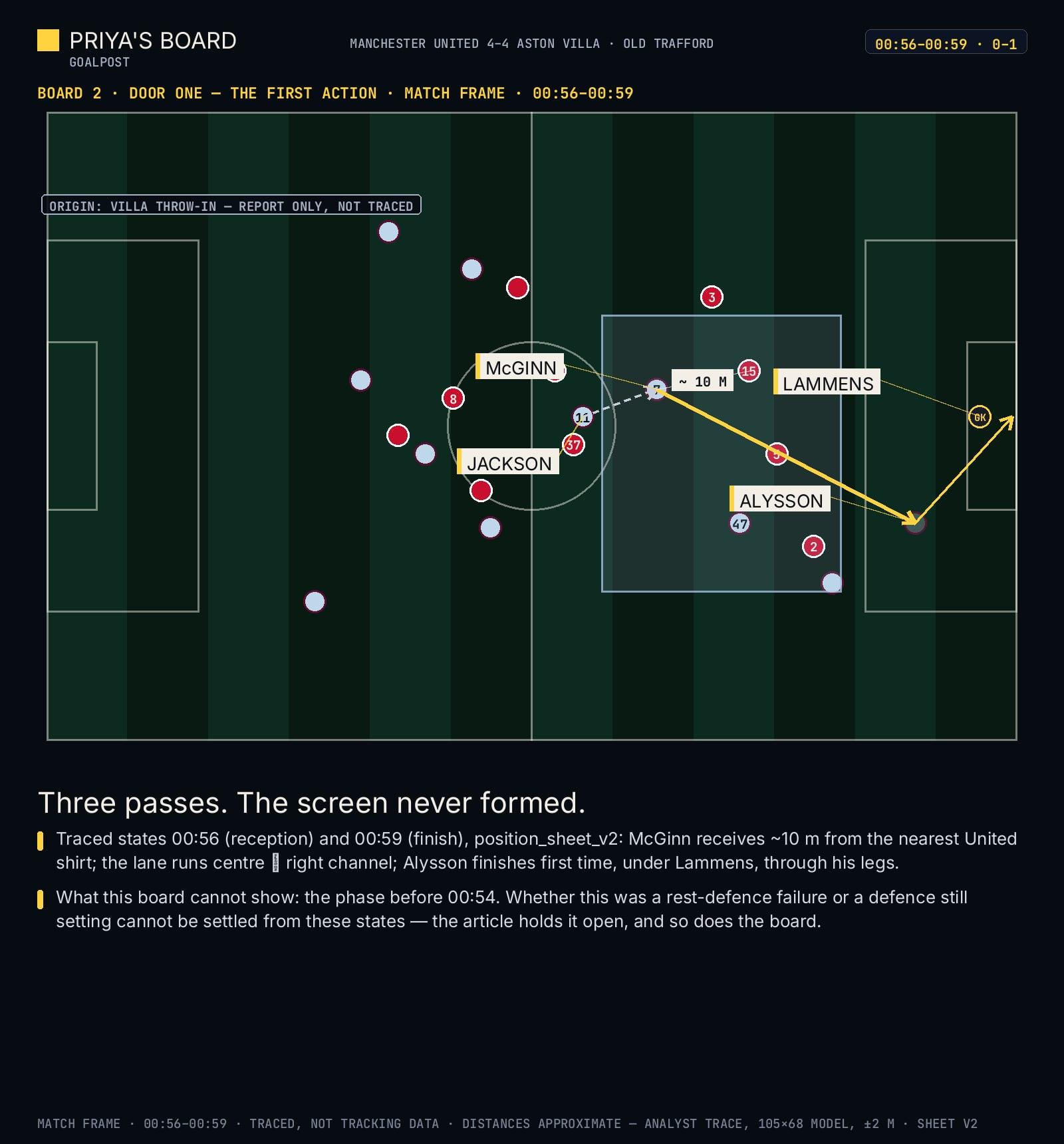
The first goal took 59 seconds. United's own match report describes it developing from an early Villa throw-in: Jackson and McGinn combined, McGinn found Alysson, and Alysson finished first time — under Senne Lammens, through his legs. That origin is United's report; no traced frame shows the throw-in.
GoalPost's tracing covers the finish, from 00:56. When McGinn received, the nearest United shirt — Yoro — stood some ten metres away, and the lane into Alysson's right channel was open. Ten metres is not a screen. It is a rumour of one. Whether that makes the goal a failure of rest defence stays open: a rest defence is the shape a team holds while it attacks, and establishing its failure would need the missing phase. Without it, the honest concepts may be plainer — compactness, a delayed recovery, late pressure on the receiver. What you see is a defence still travelling back into its shape, the protection in front of the centre-backs not yet formed. The first action went unprotected. Whether that was design, transition, or a match only 59 seconds old is what the rest of the afternoon would test.
Three minutes later, a failed Yoro clearance kept a Villa free-kick alive. Alysson shot, Lammens pushed the ball back into the middle of his area, and Jackson — who had beaten the offside line and kept running — was first to the rebound, tapping in his ninth goal of the season.
Two failures contributed, and they should not be merged. The clearance failure is one: a free-kick not cleared, an attack that should have ended continuing. The rebound failure is another: a parry is only a defensive action if somebody owns where the ball lands. Nobody did. One concerns the first contact; the other, the half-second after it. That phase is a coached behaviour: when the first contact is made, the phase is not over. For United, repeatedly, it was treated as over.
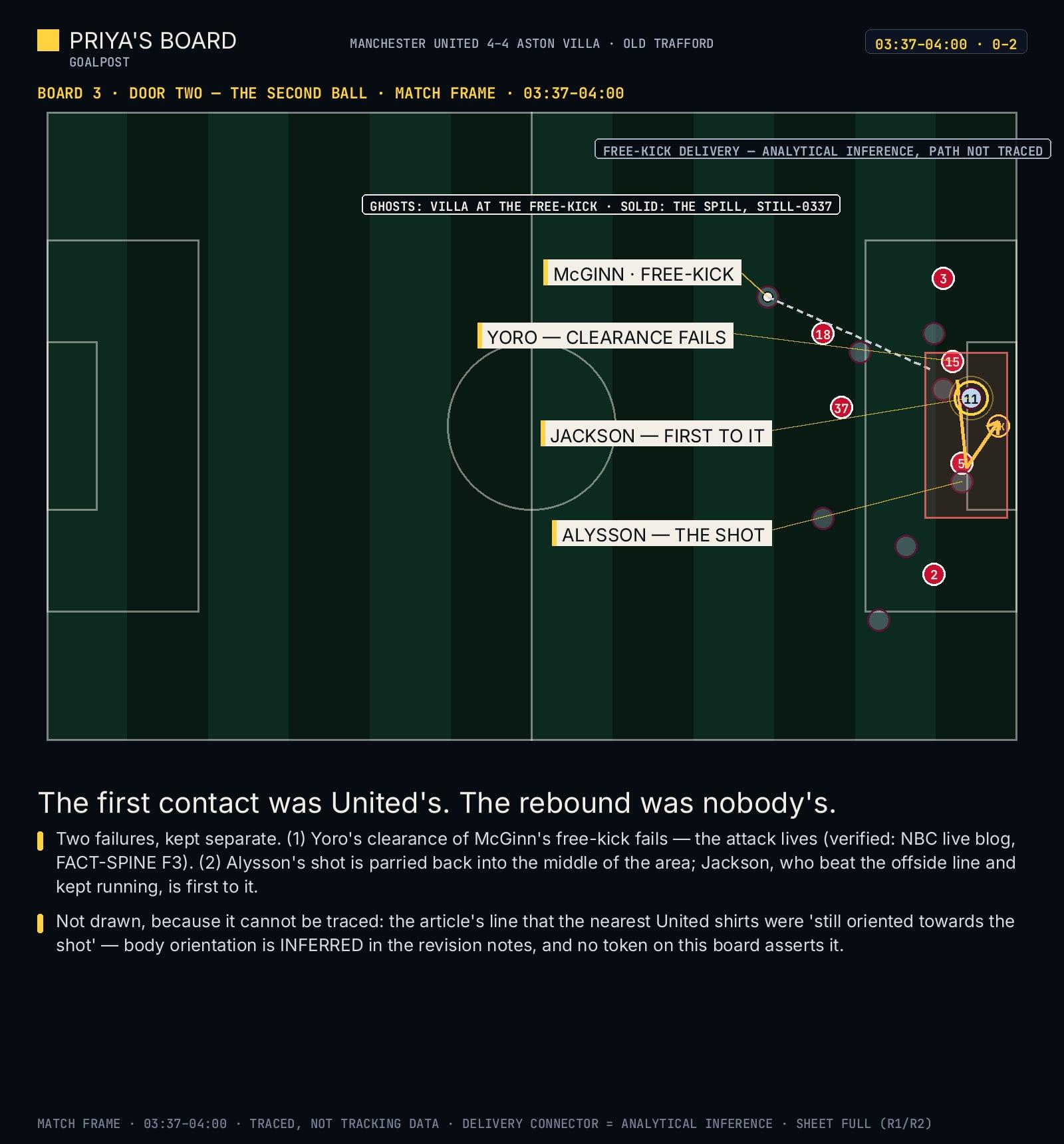
Four minutes gone: one goal against a defence that had not set, one from the phase after the save. Two mechanisms — not yet one explanation.
The trade-off
United's attacking strengths and defensive problems were not separate stories. They may have been the same decision, seen from two ends.
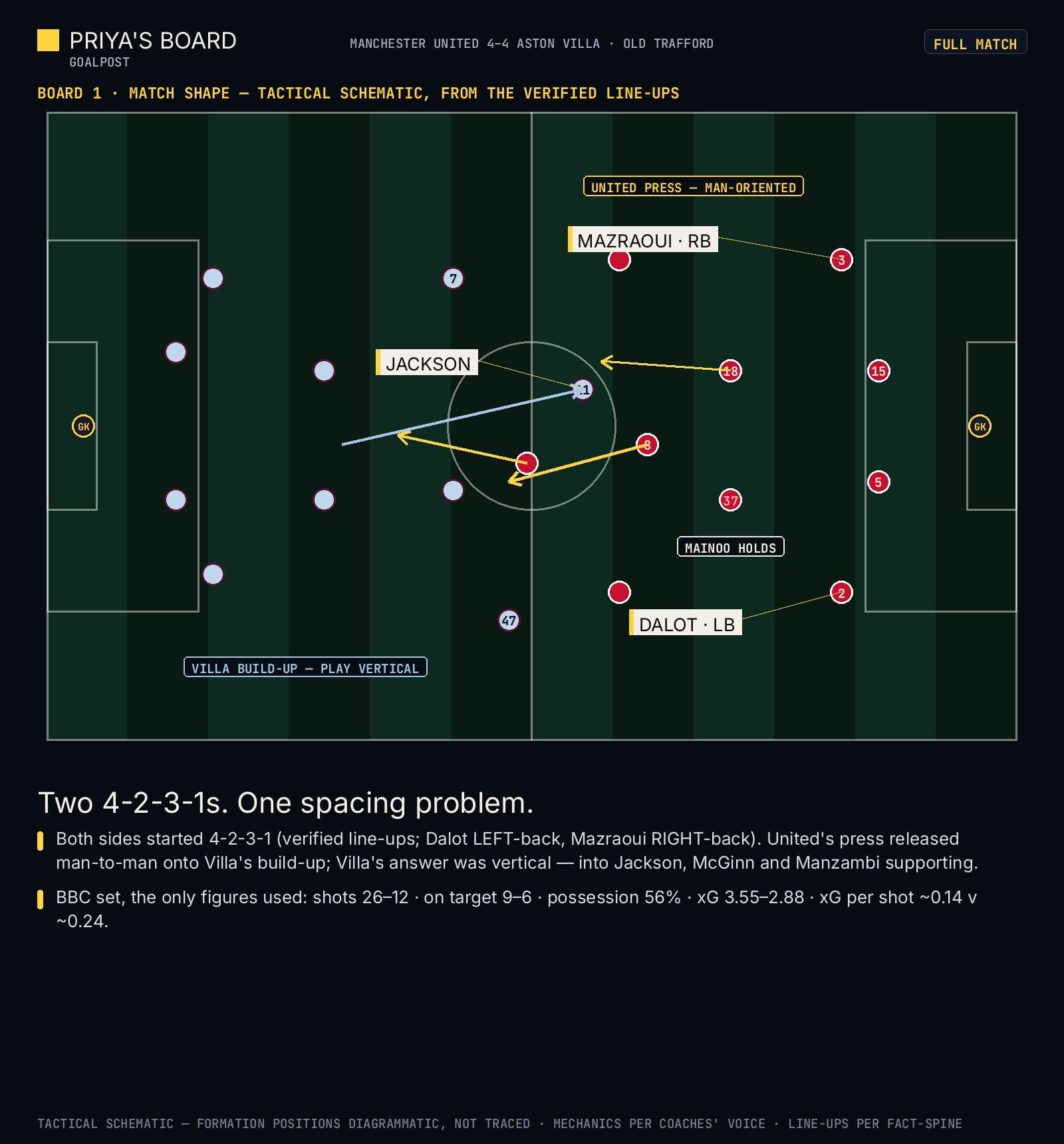
Villa's plan was plain to see: attract United's press — invite it onto their back line — then play vertically into Jackson on the last line, with McGinn and Manzambi supporting either side. When the first contact could not be secured, those supporting runners were already positioned to counter-press and force an error high up. A plan built to punish exactly the defending United brought.
Because United's defending was aggressive by design. From a man-oriented block, they released onto Villa's build-up: Mbeumo and Fernandes leading onto the back line, Tielemans, the ball-side midfielder, jumping to close the inside pass, Mainoo holding the balance behind him. The centre-backs stepped out to meet their men — Maguire engaging McGinn high, unconcerned by the distance opening to Yoro. Mazraoui was drawn inside from right-back, following Manzambi as Villa built into a 3-2-5. Board one draws the two starting shapes and that outlet lane — a diagram of the line-ups, not a traced match moment.
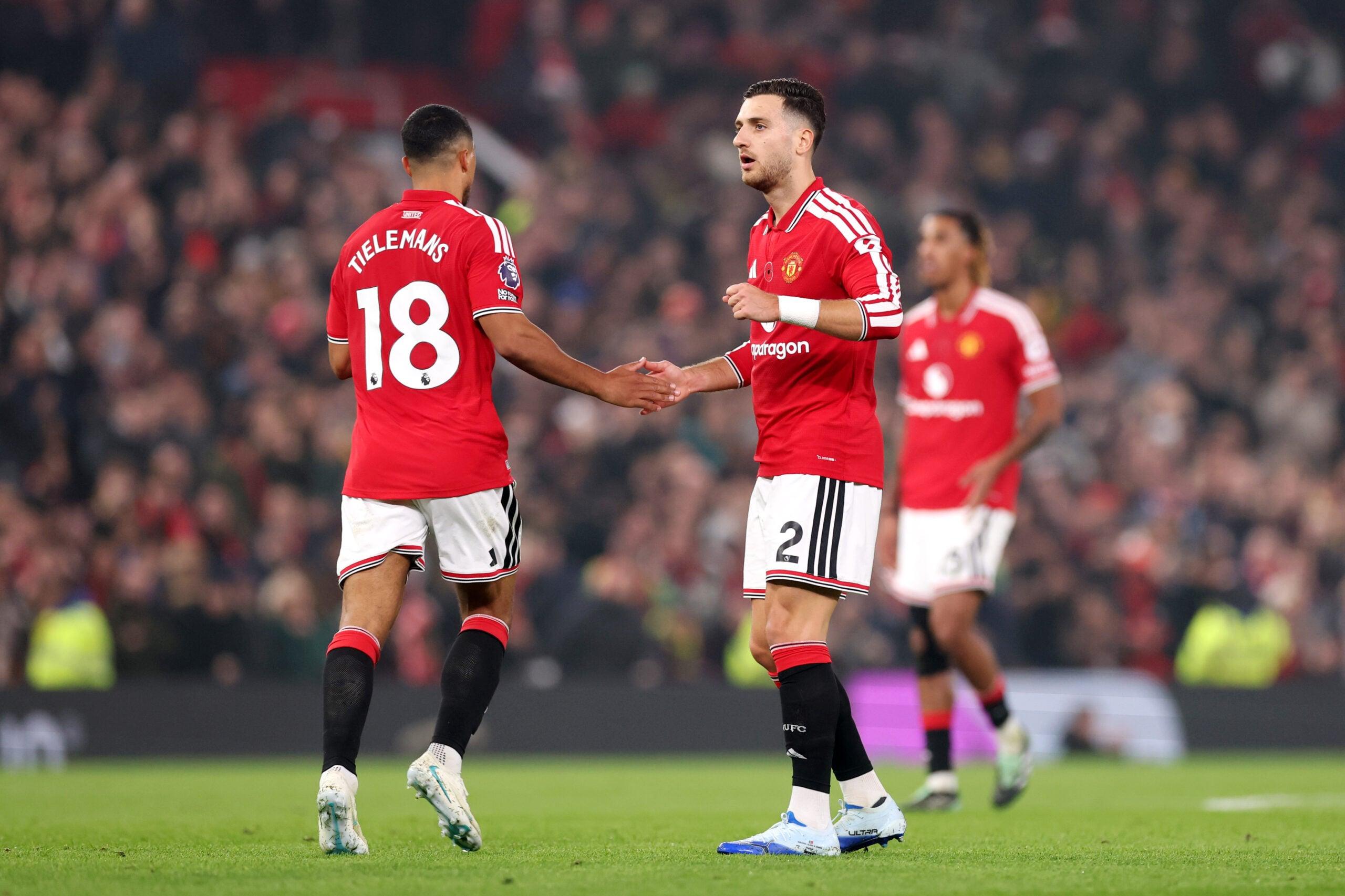
It worked, on its own terms: regains in the middle third, quick forward play, runs in behind Villa's rest defence through Cunha and Amad — and the best mechanism of all: Mazraoui arriving high on the right, the cutback, Tielemans arriving late to finish against his former club at 44 minutes. The penalty at 16 minutes — Kamara's foul on Cunha, converted by Fernandes — was a duel, not a pattern. The equaliser was the pattern, working exactly as designed. But a reply is not a repair.
A press that commits centre-backs into duels high up creates the distances a direct team wants to attack. A structure stretched by its own aggression protects its first action worse — and its second balls fall further from help. It is plausible that one mechanism connects the two problems: attacking pressure bought with defensive exposure, the cost either underestimated or unmanaged. The hypothesis stands because Anfield will test it; it is not promoted to a verdict, because one match of event data cannot carry it there.
The equaliser changed the score and changed nothing structural. Watch what happened after half-time.
The repeat
Eight minutes into the second half, both problems had recurred.
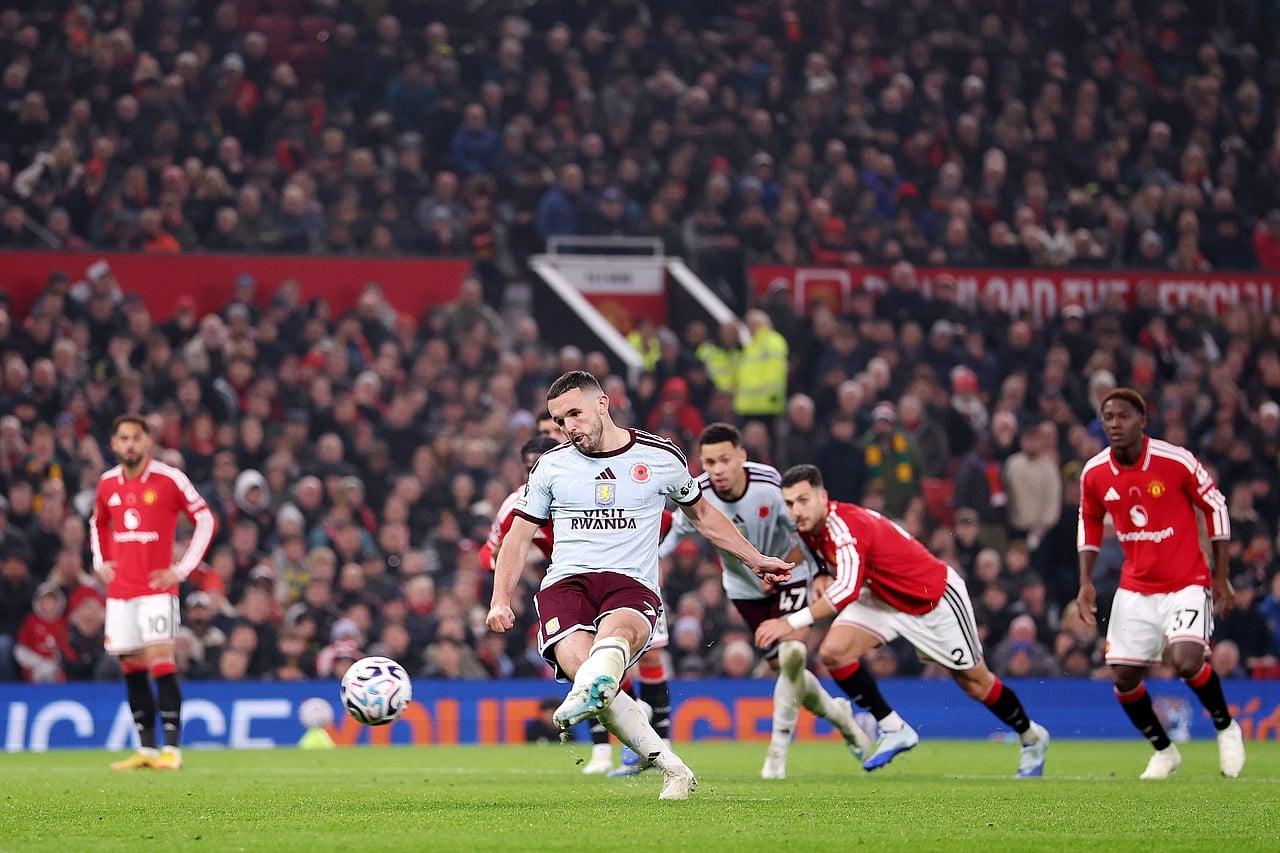
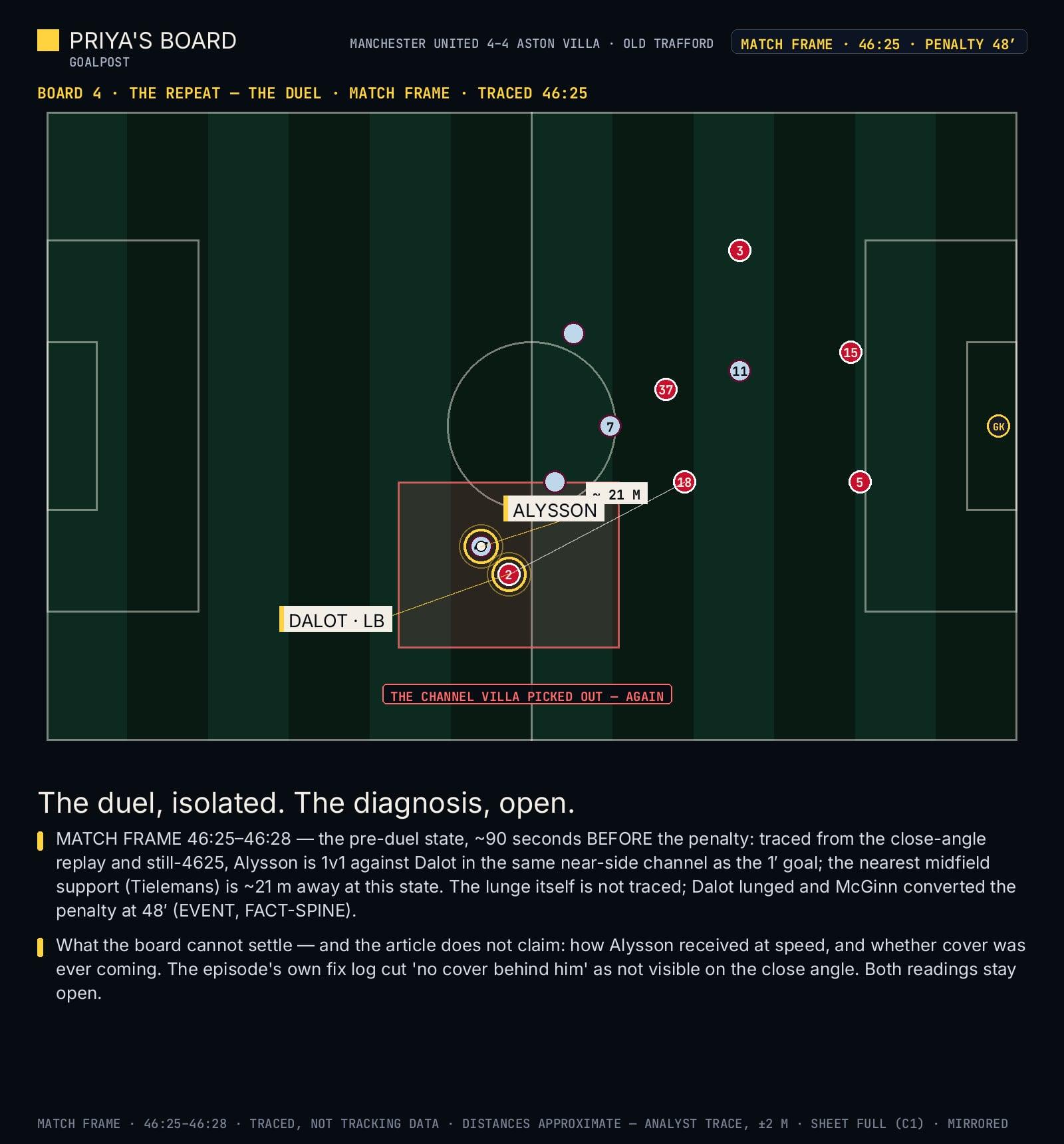
At 48 minutes, Diogo Dalot — at left-back — was isolated against Alysson, the same duel Villa had picked out before the break. Alysson ran at him, Dalot lunged, and McGinn converted the penalty.
A full-back defending a winger one-on-one is not, by itself, a structural failure — sometimes that duel is the intended arrangement. Isolation is a description, not a diagnosis. So measure it. Go back to 46:25, ninety seconds before the penalty: Dalot is already isolated, exactly as he will be when Alysson runs at him. His nearest midfield support, Tielemans, is some 21 metres away. Twenty-one metres is not cover. It is a spectator with a head start. The lunge, then, was Dalot's: a duel lost, and discipline with it — in a channel Villa had already attacked before the break. The foul was Dalot's. The earlier distance to his nearest support raises a different question: why had United allowed that channel to become so difficult to protect?
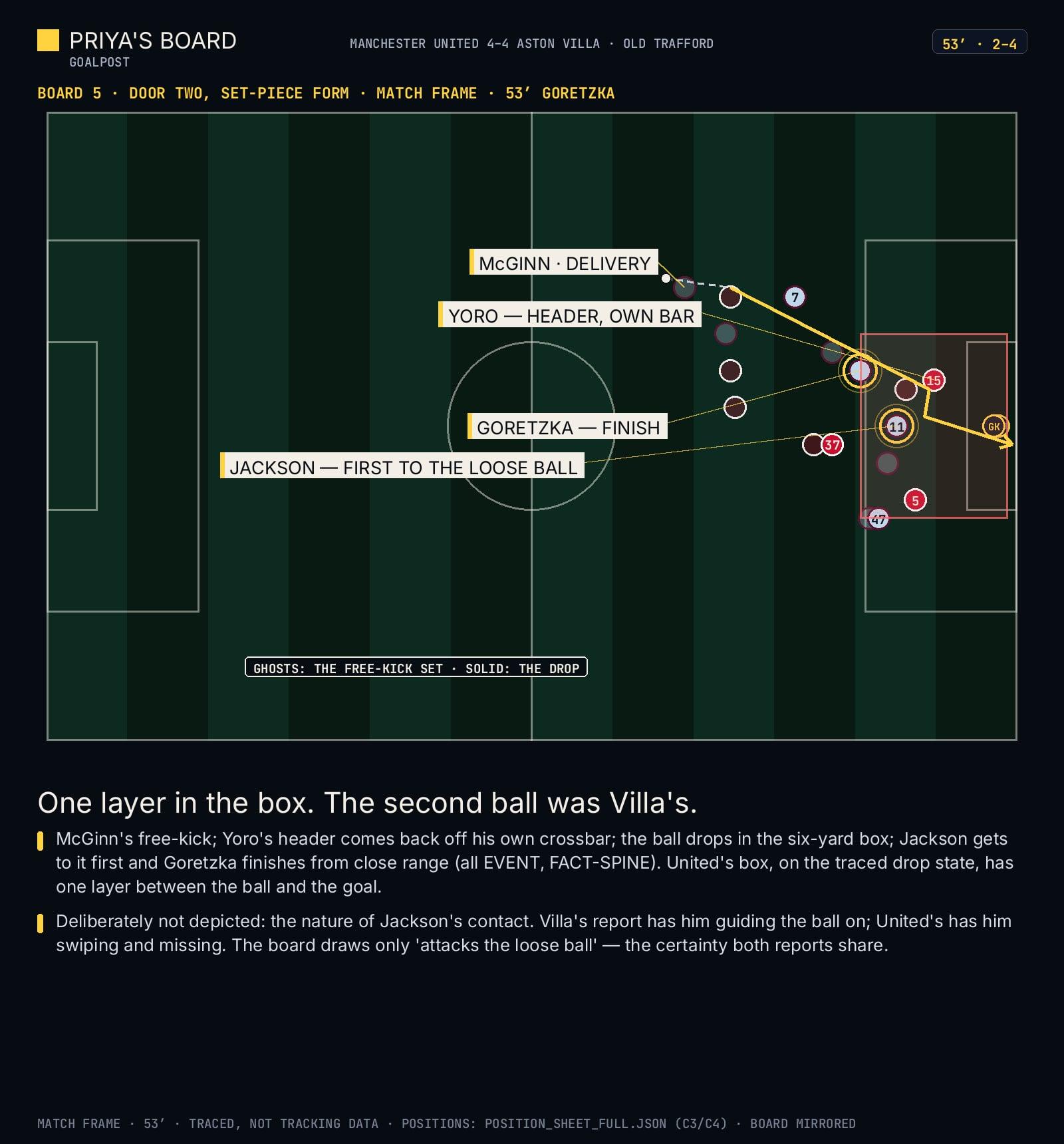
At 53 minutes, the second problem, in its set-piece form. McGinn's free-kick was met by Yoro, whose header came back off his own crossbar; the ball dropped loose in the six-yard box; Jackson attacked it, and Goretzka finished from close range — his first goal for the club. The contact itself is hard to read even on replay. What is certain is the sequence: the ball came back from the woodwork, Jackson got to it first, Goretzka finished. The first contact was United's. The second ball was Villa's. Board five traces the drop state. Jackson stood 3.2 metres from the loose ball — closer than any United player but Yoro, the man who had just headed it. Goal-side of the ball, besides Lammens, stood Yoro alone; the next United shirts, Maguire and Mainoo, were nine and ten metres away. That is one layer — where a defensive box needs a second layer to exist for exactly the ball that comes back.
And Villa did change: Emery's half-time plan, by his own account, was to control the game better — and for long stretches his side did, before dropping into a deeper 4-4-2 to see the match out. The interval changed Villa's approach, not the two situations United kept offering.
The adjustment
The rescue, when it came, was also an adjustment — where United's coaching actually worked.
At 66 minutes, Carrick made three changes at once: Mason Mount for Tielemans, Shea Lacey for Amad, and Patrick Dorgu for Dalot. Joshua Zirkzee followed at 83 minutes, for Mbeumo. What Dorgu changed was not effort. It was geometry. Where Dalot had received as a defender, Dorgu received as a winger stationed at full-back: higher, wider.
Villa's back four by then looked narrowed, drawn inside as they protected a two-goal lead. Look at the cross moment again and it tells a different story. The line was deep — but across its width it still spanned some 36 metres, and Lindelöf, Villa's right-back — the man on Dorgu's flank — stood wider than Dorgu himself. The room was not outside the full-back. It was inside him: Lindelöf some ten metres away and wider still, Harwood-Bellis holding the channel directly goal-side, and the low cross threading the corridor between Harwood-Bellis and Pau Torres, passing within two metres of Torres. The room Dorgu took was not outside a narrow block. It was beyond a deep one.
So the third United goal, at 90+2, was made by both benches. Carrick's substitute supplied the starting position and the run; Emery's deepening block supplied the room. Dorgu crossed low, into the corridor between Villa's defensive and midfield lines, and Zirkzee — whose run started before the cross did — swept in the finish. Adaptation, not luck. Board six sets the two traced moments side by side — the same position, two geometries.
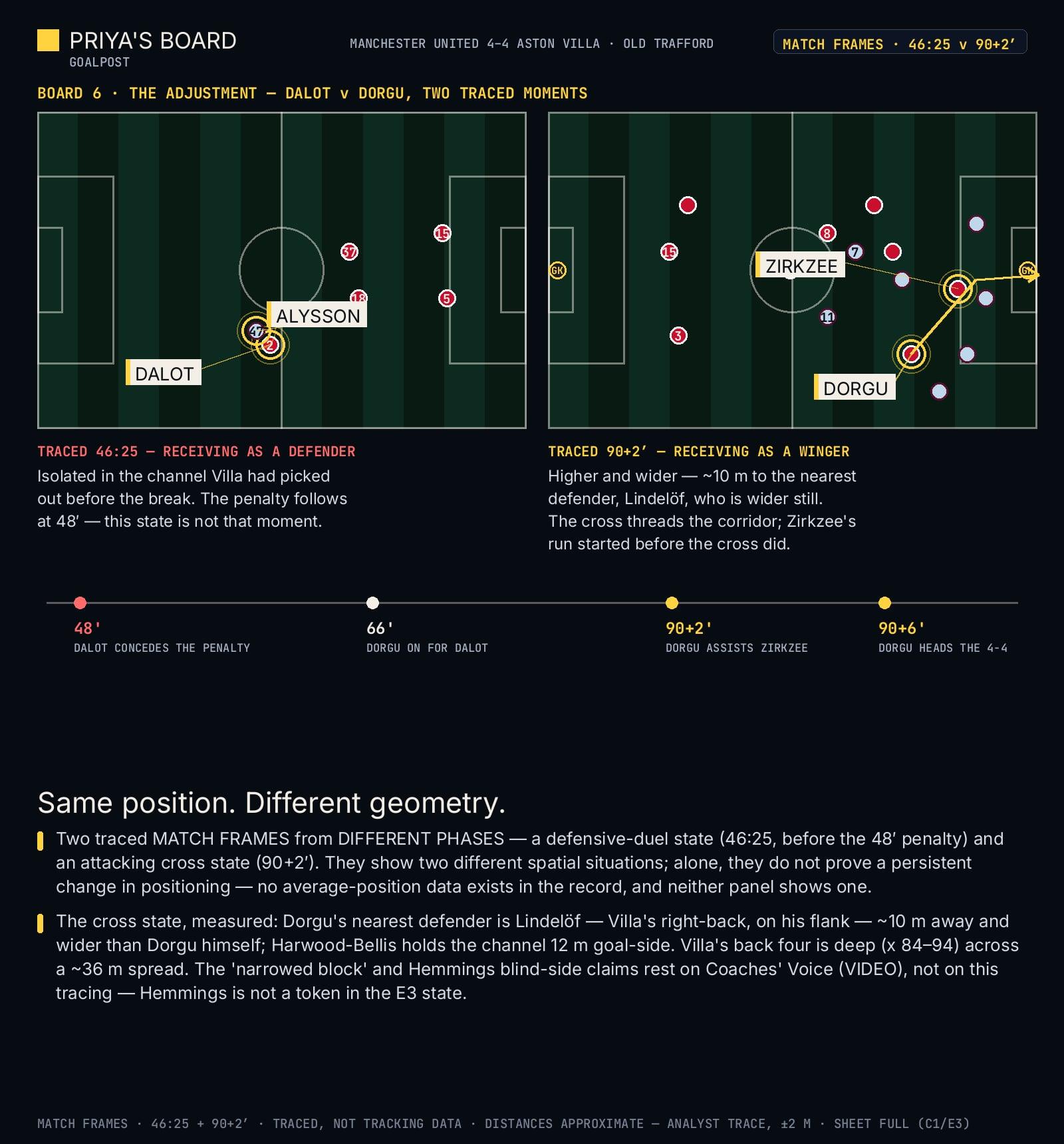
Two traced MATCH FRAMES from DIFFERENT PHASES — a defensive-duel state (46:25, before the 48′ penalty) and an attacking cross state (90+2′). They show two different spatial situations; alone, they do not prove a persistent change in positioning — no average-position data exists in the record, and neither panel shows one.
The cross state, measured: Dorgu's nearest defender is Lindelöf — Villa's right-back, on his flank — ~10 m away and wider than Dorgu himself; Harwood-Bellis holds the channel 12 m goal-side. Villa's back four is deep (x 84–94) across a ~36 m spread. The 'narrowed block' and Hemmings blind-side claims rest on Coaches' Voice (VIDEO), not on this tracing — Hemmings is not a token in the E3 state.
MATCH FRAMES · 46:25 + 90+2′ · TRACED, NOT TRACKING DATA · DISTANCES APPROXIMATE — ANALYST TRACE, ±2 M · SHEET FULL (C1/E3)
Mount had struck the woodwork at 89. Then, at 90+6, the fourth: a Fernandes corner, a crowded six-yard area, Suzuki coming for it and misjudging it, and Dorgu rising highest. The goal stood after a VAR check; Emery — taking charge of his 200th Premier League game, and still without a win at this ground — claimed a foul on his goalkeeper; the check did not agree.
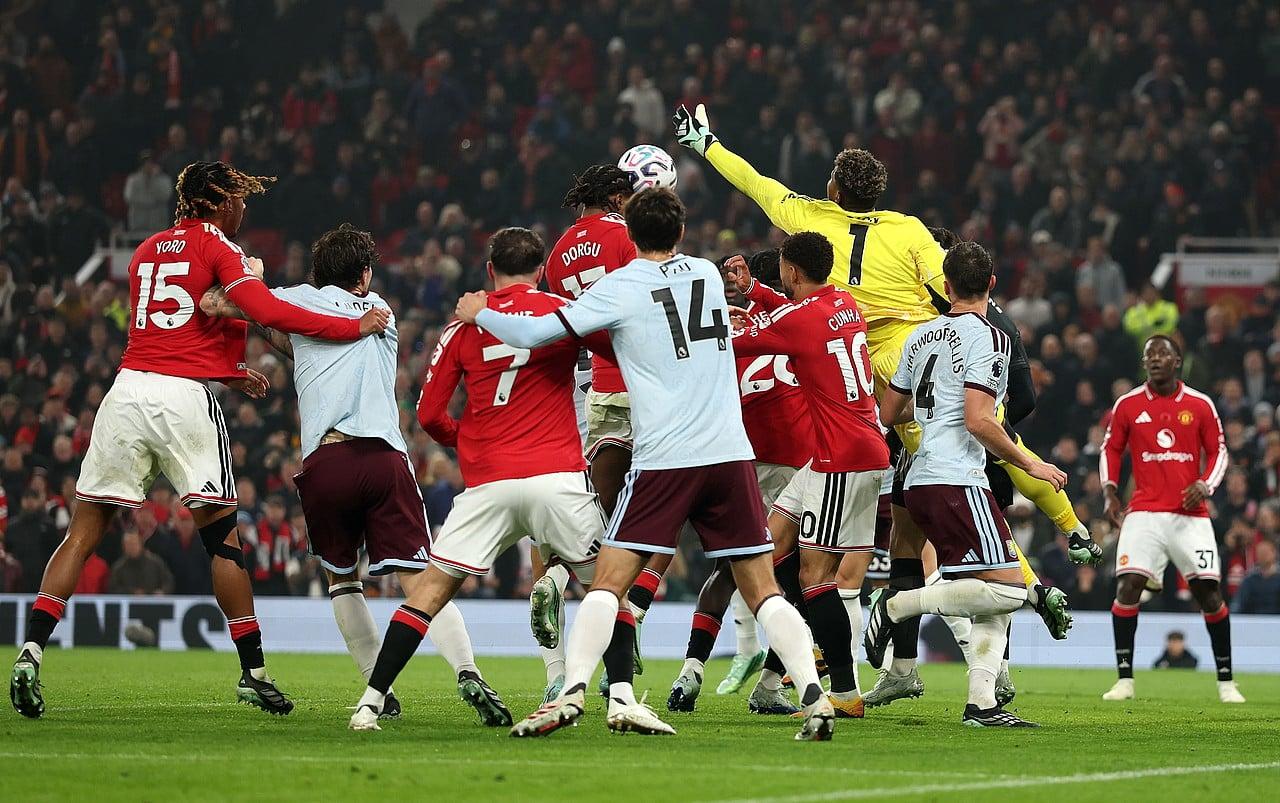
The rescue was two different things. The first goal was earned: a structural answer to a structural problem, found late. The second was a set piece in the game state that most flatters a chasing side, and it needed the goalkeeper's error. Both count. Neither repairs what the first fifty-three minutes showed. United had needed the same rescue in midweek, against Roma — and a team that keeps needing rescue is telling you something about its structure, not its spirit. Spirit is what the last four minutes showed. Structure is what the first four, of each half, showed.
The diagnosis, and the test
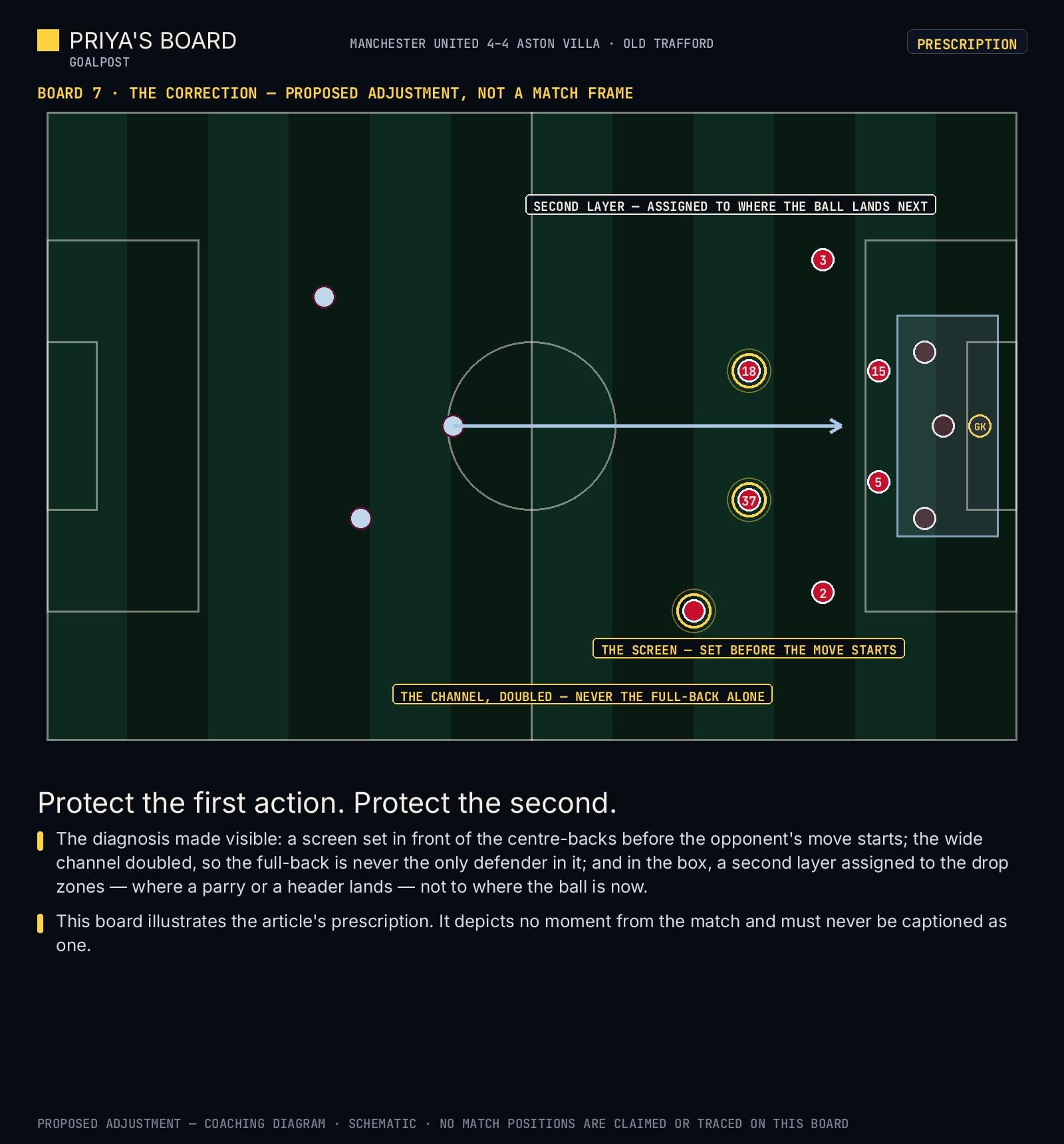
The corrections are not mysterious, which is what makes their absence an indictment. Protect the first action: a screen set before the move starts, and a full-back who is never the only defender in his channel. Protect the second: bodies assigned to where the ball lands next, not only to where it is. Neither begins with a transfer. Both begin with positioning, responsibility and rehearsed habits. Board seven draws that prescription — a coaching diagram, not a match frame.
Those corrections are now another man's inheritance. This match was played under Michael Carrick, since dismissed; Mauricio Pochettino has been appointed in his place — and that turns this match from a post-mortem into a baseline. If the same two problems appear under a new manager, what were they ever made of? Personnel. Collective habits. Or an approach — aggressive, front-footed, expensive behind the ball — that has survived the coaching change because the squad was built for it. Villa's match cannot answer that. Liverpool might start to.
So the test goes to Anfield, where Pochettino takes charge of United for the first time on 22 November. The test is not the first four minutes — a pattern of early concessions is a narrative; a test has to work whenever the situation occurs. Watch the first transition, and every one after it. When United lose the ball with their full-backs advanced: where is the midfielder nearest the turnover — jumping, or screening? Who protects the wide channel behind the full-back, and how quickly? And when the first contact is made, in either box, who is moving towards the likely second ball before it lands? One match, after a handful of training sessions, cannot show whether Pochettino's coaching has taken hold. It will show his immediate priorities — what he has chosen to fix first.
The scoreboard told Old Trafford it had witnessed an extraordinary comeback. It had. The harder question is why United needed one, twice. Liverpool will offer another test — not of comebacks, but of whether the players behind the ball know where to stand before the fighting starts.
Show me the shape, not the score. The score was 4–4. The shape revealed two recurring problems: an unprotected first action and an unclaimed second ball. Whether they came from the same failure is a question the evidence has not yet settled.
— Priya Shah