
Chelsea told England that Cole Palmer was fit. Not managing something, not a doubt — fit, and ready for selection. Thomas Tuchel named his squad for Croatia and Spain on Friday, and Palmer was not in it. He did not telephone him either — though Tuchel has said the two spoke after the previous camp, and his reasoning this time was blunt: Palmer was not in that camp, so there was no change to explain.
That is the starkest selection fact of this international break, and it is worth sitting with. England's most gifted attacking midfielder of the last two seasons — a player who has started every league game for Chelsea this season — has been left out of a 25-man squad on merit, while two uncapped players, Fulham's Josh King and Borussia Dortmund's Jobe Bellingham, have been called up for the first time. Bukayo Saka is absent with a thigh injury. Even the vacancy did not save him.
The easy reading is a feud. The more interesting one is a selection policy. This squad was not picked on reputation. Club form matters — but Tuchel appears to have decided that the evidence he trusts most is the evidence his own environment produced: what a player has done inside England camps, or where England's own coaches have watched him at close quarters. By that measure, Palmer's recent file is thin. The two newcomers' files, in different ways, are not.
The Palmer ledger, both columns
By the club column, Palmer's exclusion is hard to defend. He has started all ten of Chelsea's league games, scored three and made three, and has five goals in all competitions. He scored against Manchester United on 31 October. If selection were simply the season's output, ordered, he would be in the squad and the argument would be over.
The other column reads differently. Palmer was left out of England's World Cup squad in the summer. Recalled in the autumn, he withdrew from the camp with a minor muscular problem — having played ninety minutes for Chelsea days earlier — and Tuchel's irritation was public. He has played twice for England in the whole of 2026, both times in March. His manager's verdict, repeated on Friday without softening, is that he "misses too many opportunities to impress."
Listen to the exact words Tuchel used about the men who kept their places: "We have enough number tens and we stick to the guys who were in the previous camp, because we were happy with the two and a half weeks we had together." Then, of Palmer: "It counts when you are in camp." Selection, in this regime, is not a simple judgement on a player's season. Club form gets a player into the conversation; what he shows Tuchel inside the England camp increasingly decides whether he stays in it.
The teenager who fits everywhere
Josh King is nineteen, and he is the pick that tells you what the policy rewards. He has started every one of Fulham's ten league games — 813 minutes, the trust of a Premier League manager given to a teenager in the middle of the pitch — and with two goals he is Fulham's top scorer in the league this season, with an assist on top. Those are good numbers. They are not, on their own, England numbers.

What completed the case happened in June, when King was invited into the World Cup warm-up camp and, by every account, impressed in it. That gave Tuchel something Palmer has recently been unable to give him: recent, first-hand evidence, gathered in an England shirt, inside England's system. Tuchel's description of him is a squad-builder talking, not a romantic: an extra player who can play all four attacking positions, to be looked at on both wings. In a 25-man squad, versatility is a form of form — the teenager covers four slots, which is arithmetic no specialist can argue with.
And the utility is specific, not generic. Cover on either wing means an injury in the front line does not force a reshaping of the side; and his ability to play centrally gives Tuchel the option of adding another midfield presence against a press without removing a forward. Tuchel is not collecting a spare part. He is buying insurance in four positions at the price of one squad place. There is a fitness footnote, and it matters: King left Fulham's match against Newcastle on Saturday with a groin problem, described by Fulham as minor, and his participation in the camp was still to be confirmed at the time of writing.
A different job, done by the pathway
Jobe Bellingham's call-up is the one the policy explains least until you notice it is not the same job. He is twenty-one, not a teenager, and he has not been picked to do Palmer's work. England are short in central midfield for the Croatia game — Alex Scott is injured, Myles Lewis-Skelly suspended — and Bellingham has played fifteen games for Borussia Dortmund this season, Champions League nights among them, with three assists. Lee Carsley, who coached him in the under-21s, spoke for him.
His route matters as much as his numbers. Under-21 to senior is becoming a conveyor rather than a leap, and the player at the end of it arrives pre-graded: the staff have watched him in their own building, in their own system. That is not camp currency earned one level down; it is the same principle applied one level down — evidence generated inside England's own environment, carrying extra weight precisely because England's own coaches produced it. Not weight above everything else: club form, tactical need and squad balance all still count. But this evidence counts for more than the same evidence would from outside. Reputation used to move in the opposite direction: a famous name at a famous club was itself the evidence. Here, the evidence is a file the selectors built themselves.
What the numbers say
GoalPost's own table can be consulted — and it should be, because it does not simply agree with the manager. GPS, our 1–99 rating of a player's current level, makes Jude Bellingham (90) the best attacking midfielder England have by a distance; nobody argues with his place. Behind him, among players GoalPost classifies as attacking midfielders, Cole Palmer rates second in the country at 80 — above Morgan Gibbs-White (79) and Eberechi Eze (76), with Phil Foden, whom the screener classifies box-to-box, at 77. His output score, 89, is the highest in that group after Bellingham. If GPS were the selection policy, Palmer would not merely be in this squad. He would be its second name in his position.
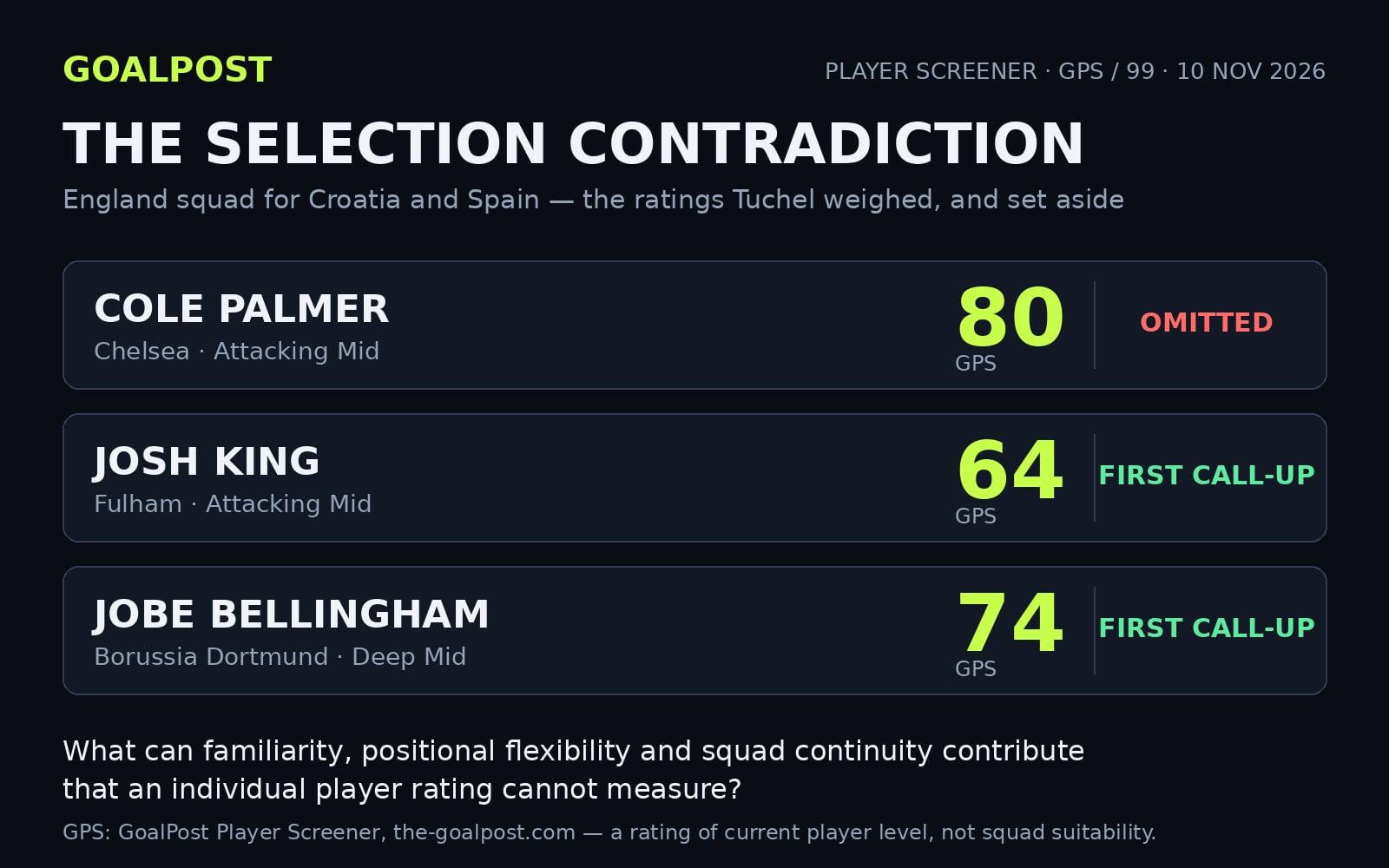
Two qualifications keep the table honest. The first is Morgan Rogers. GoalPost classifies him as a forward rather than a midfielder, and rates him 81 — a point above Palmer. The man whose season at Chelsea has most directly kept Palmer out is, on our numbers, fractionally the better player this season; the measurable cost of the policy is not paid to him. The second qualification is that GPS measures the player, not the squad place. Josh King rates 64, the lowest figure anywhere in this argument. Jobe Bellingham rates 74 — solid, not spectacular, and below other young English midfielders the screener grades more highly: Nico O'Reilly at 83 — a player Tuchel himself set aside over fitness concerns — James Garner at 81, Adam Wharton and Kobbie Mainoo at 80 and 79. None of them has Jobe's under-21 file in Lee Carsley's handwriting. Our numbers do not make either newcomer's case. They were not picked on our numbers.
That is the finding, and it cuts both ways. England's second-rated attacking midfielder is watching from home, and two squad places have gone to men our model grades as prospects rather than peers. They were not picked to do Palmer's job — Jobe fills a central-midfield shortage, King is cover in four positions — so the gap is a measurable difference in individual rating, not proof of an inferior squad. On GoalPost's scale, Palmer rates sixteen points above King; but the two were never competing for the same chair, and a rating gap is not a points deduction from the team. Tuchel has taken the lower-rated player because he believes King offers something the rating cannot settle: flexibility, familiarity, and a role in the squad he has already built. GPS can price the decision. It cannot take it.
The case against the policy
A word of caution, because continuity has a cost and it will come due somewhere. The players who were in the last camp hold evidence Palmer cannot produce, for the simple reason that they were in the last camp. If the group plays well, they earn the next invitation; the longer the arrangement works, the harder it becomes for anyone outside it to demonstrate that he should replace someone inside it. That is how cohesion is built. It is also how a closed shop begins.
King and Bellingham prove the door is not shut. They also show that some routes through it are easier than others.
And the practical risk stands behind the structural one. Palmer, at his best, is the most naturally gifted number ten England have, and Spain in Madrid on Sunday is not obviously a fixture for auditions. A manager who grades familiarity risks teaching his best players that the relationship is transactional — and Palmer's club output this season, six goal involvements in ten games, is good rather than irresistible — which means this coldness can be defended as judgement right up until the night England need a goal from nothing.
All of that is true. It is also true that Tuchel has been consistent to the point of predictability: the previous camp built, in his words, something extraordinary, and he has declined to break it for a player who was not part of it — even a fit one, even a famous one. England put seven past Croatia in the away game last month and need a point from these two games to be sure of the quarter-final. The competitive risk of experimenting is close to zero, and he has taken the experiment anyway, which tells you it is not an experiment. It is the system.
Tuchel says the door is always open. Doors, though, have schedules: there is no England squad again until March, so Palmer will spend the winter outside it, and his two England appearances in March are now the whole of his year. The old selection maths allowed reputation to earn interest. Tuchel wants more immediate evidence, much of it gathered by coaches he trusts — and club form, while it still counts, is no longer sufficient on its own. The currency is not fame. It is evidence he trusts. Cole Palmer may be fit enough for Chelsea and good enough for England. For the moment, he has not done enough in the place Tuchel has decided matters most.