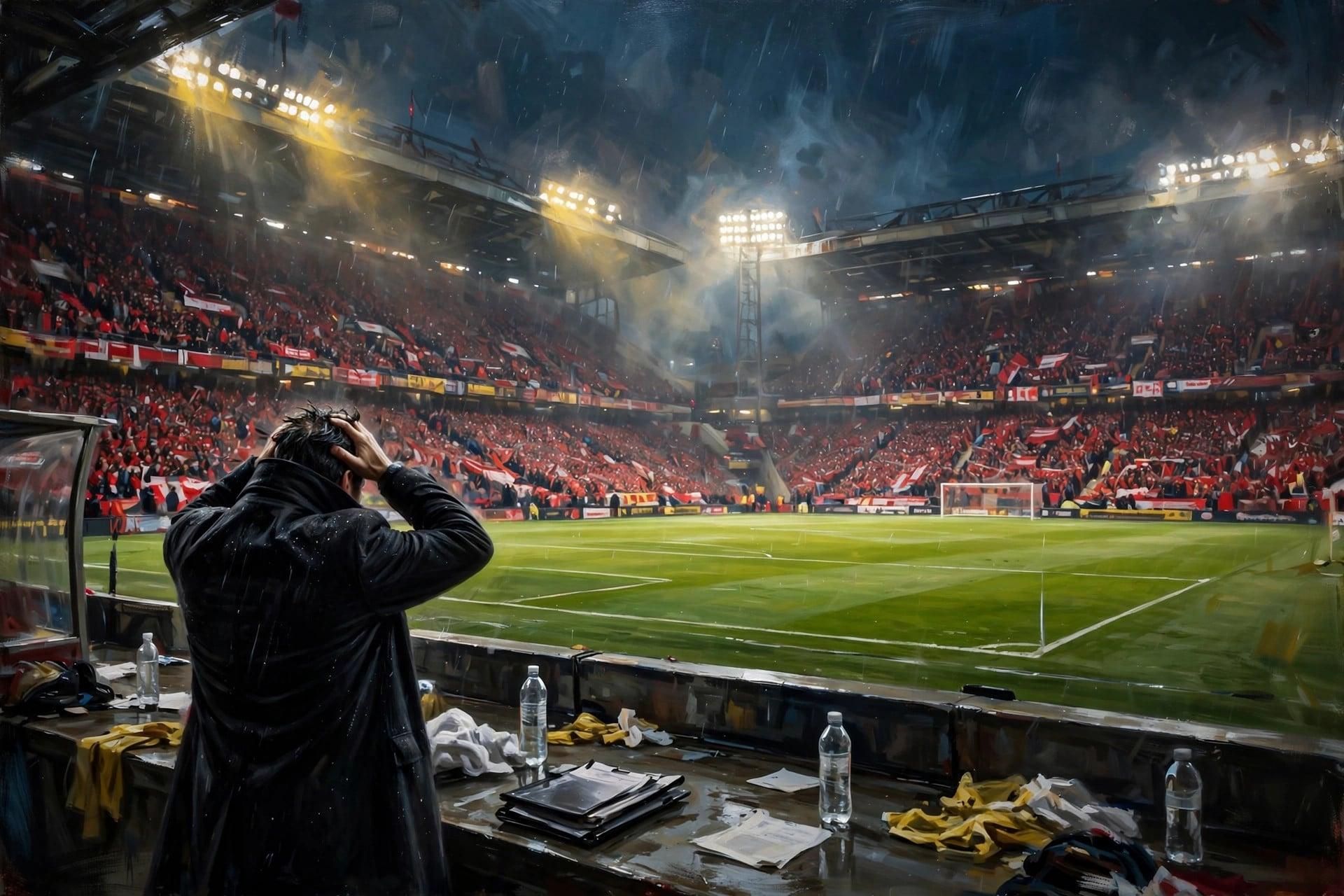
Patrick Dorgu scored in the sixth minute of added time, and Old Trafford celebrated a point as though it were a trophy.
It was United's second equaliser of the afternoon. Aston Villa had led 2–0, and then 4–2. Zirkzee scored in the second minute of added time, Dorgu in the sixth, and a 4–4 draw that belonged among the season's wildest matches was filed, within hours, under a different heading: evidence. The Villa game was the third of a three-game stay of execution granted to Michael Carrick — Chelsea lost, Roma won, Villa drawn. The set was complete. Nothing was settled.
The story is not whether Michael Carrick deserves to keep his job. On this season's evidence, that argument is shorter than this article. The story is the job itself — what it has become in the thirteen years since Alex Ferguson left it, and whether anyone, a young Alex Ferguson included, would now be given long enough in it to become what Ferguson became.
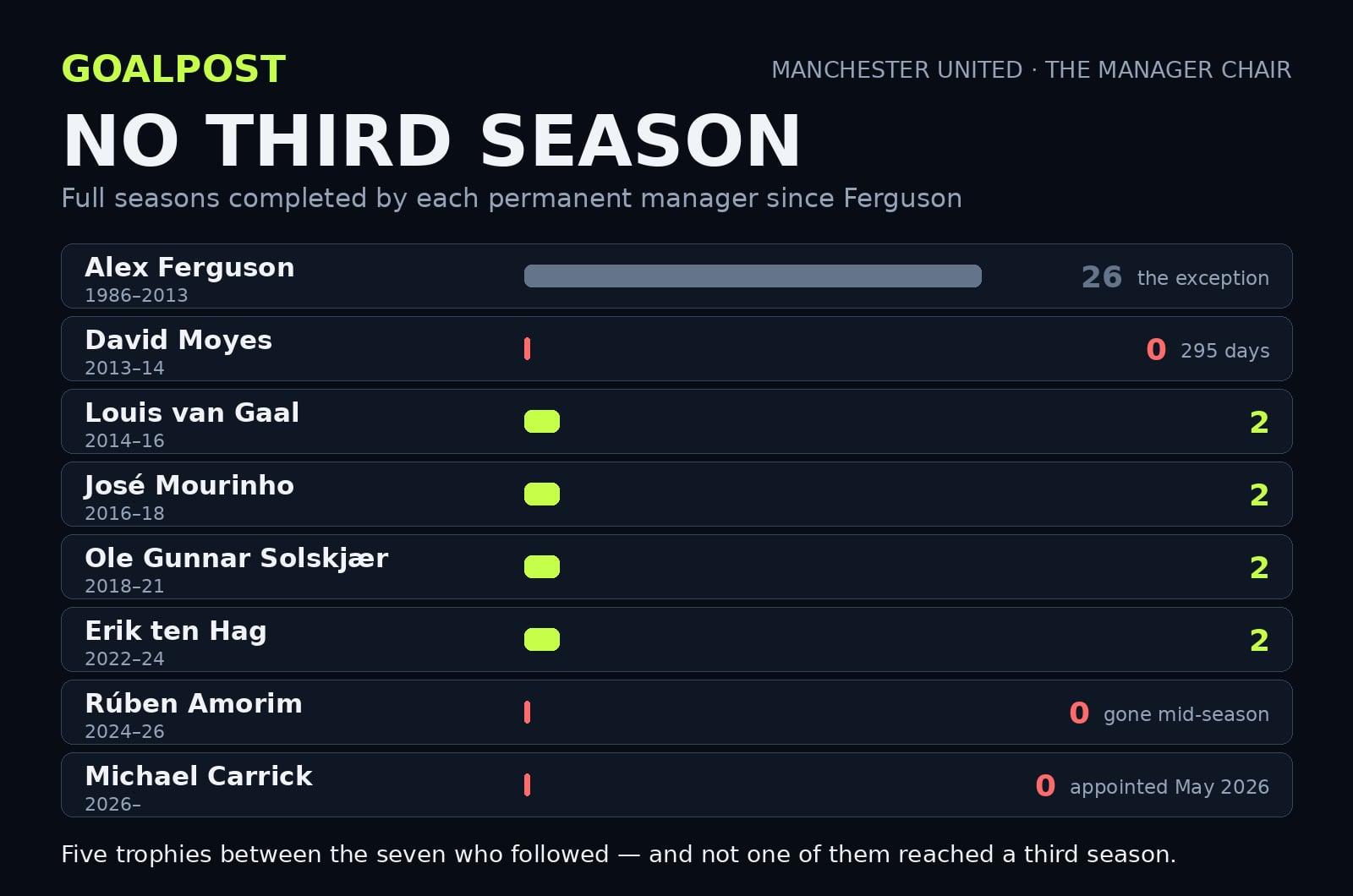
Seven appointments, and no third season
Ferguson left on 19 May 2013, after 1,500 games, 38 major trophies and thirteen league titles. Since then, seven men have held the job permanently — ten men in all, counting caretakers and interims. Not one of the seven has completed three full seasons.
David Moyes lasted 295 days, sacked with four games remaining once Champions League qualification was mathematically gone; the defending champions finished seventh. Louis van Gaal finished fourth and fifth, won the FA Cup in May 2016, and was sacked two days after the final. José Mourinho lasted longest — into December of his third season, with a second-place finish, the League Cup and the Europa League to show for it — and was nineteen points off the top when he went. Ole Gunnar Solskjær, the caretaker made permanent, finished third and second, lost a European final, and fell after a 4–1 defeat at Watford. Ralf Rangnick's interim ended in a 58-point season, the club's lowest Premier League total, and his promised consultancy was abandoned. Erik ten Hag won two cups, survived a review in May 2024, was given a new contract, and was sacked that October. Rúben Amorim took United to fifteenth — their worst Premier League finish — and was sacked last January, The Times noting that on the balance of chances his side had played like a top-six team.
Hold that detail. United sacked Amorim while his underlying numbers argued for patience — and appointed Carrick despite numbers that argued for caution.
By the modern clock, Ferguson is sacked in 1990
Ferguson arrived on 6 November 1986 and lost his first match, 2–0 at Oxford United. His league finishes in his first four seasons were eleventh, second, eleventh, thirteenth. He spent heavily in summer 1989 and the team got worse: a 5–1 defeat at Manchester City in September, seven games without a win by Christmas, a place just outside the relegation zone, and a banner that read "Three years of excuses and it's still crap … ta-ra Fergie." Ferguson later called that December the darkest period he had ever suffered in the game.
On 7 January 1990 he took United to Nottingham Forest, then a great cup side, in the FA Cup third round. Mark Robins scored the only goal. The legend says the goal saved Ferguson's job. The documented record is more precise, and more interesting: defeat at Forest was widely expected to end him, but his chairman, Martin Edwards, maintained in later years that Ferguson's position was not under immediate threat. He was one bad afternoon from a decision the club insists it had never taken. United won the Cup that spring — Ferguson's first trophy, three and a half years in. The league title came in 1993, ending a wait of 26 years, and then twelve more.
Now run that timeline forward. Three and a half years without a trophy. A thirteenth-place finish in the fourth season. By the standards now applied at Old Trafford, Alex Ferguson is a promising coach who was indulged too long, and the most successful career in English management survives as a trivia question about a goal at the City Ground.
The money was spent
None of this is explained by poverty. The Glazer family's leveraged buyout of 2005 — a £790m purchase built on roughly £600m of borrowing against the club itself — made United a financial instrument before it made them a football team. Supporters have protested the ownership for 21 years; this autumn they threw tennis balls onto the pitch in the 21st minute, one for each year. In February 2024 Sir Jim Ratcliffe paid about £1.25bn for 27.7 per cent and, with it, control of football operations. The football decisions are now INEOS's to make and to answer for: Jason Wilcox, the director of football, leads the process on Carrick's future and will recommend to Ratcliffe, consulting chief executive Omar Berrada. The Glazers remain majority owners; they no longer hold the pen.
The new regime has its own revolving door — Dan Ashworth, recruited as sporting director, dismissed inside six months — and more than 500 staff have been made redundant. On the pitch, the spending continued regardless. On Transfermarkt's figures — estimates, used on that single basis throughout — United's net spend since 2016-17 stands at about £1.25bn, the highest in world football; over the last five seasons, at roughly £685m, it is the Premier League's highest, ahead of Arsenal and Chelsea and roughly double Manchester City's. In 2023-24 the wage bill, £360m by UEFA's benchmarking, was Europe's seventh largest, and the team it paid for finished eighth.
The money arrived. What never endured was a footballing plan long enough for anyone to discover whether it worked.
Hired on a one-in-two-hundred
Carrick knows the door from both sides. In November 2021 he was the caretaker who held the team for three games after Solskjær's sacking; last January, after Amorim's dismissal and two matches under Darren Fletcher, he was appointed again, as interim head coach — a former United midfielder who had been sacked by Middlesbrough the previous year.
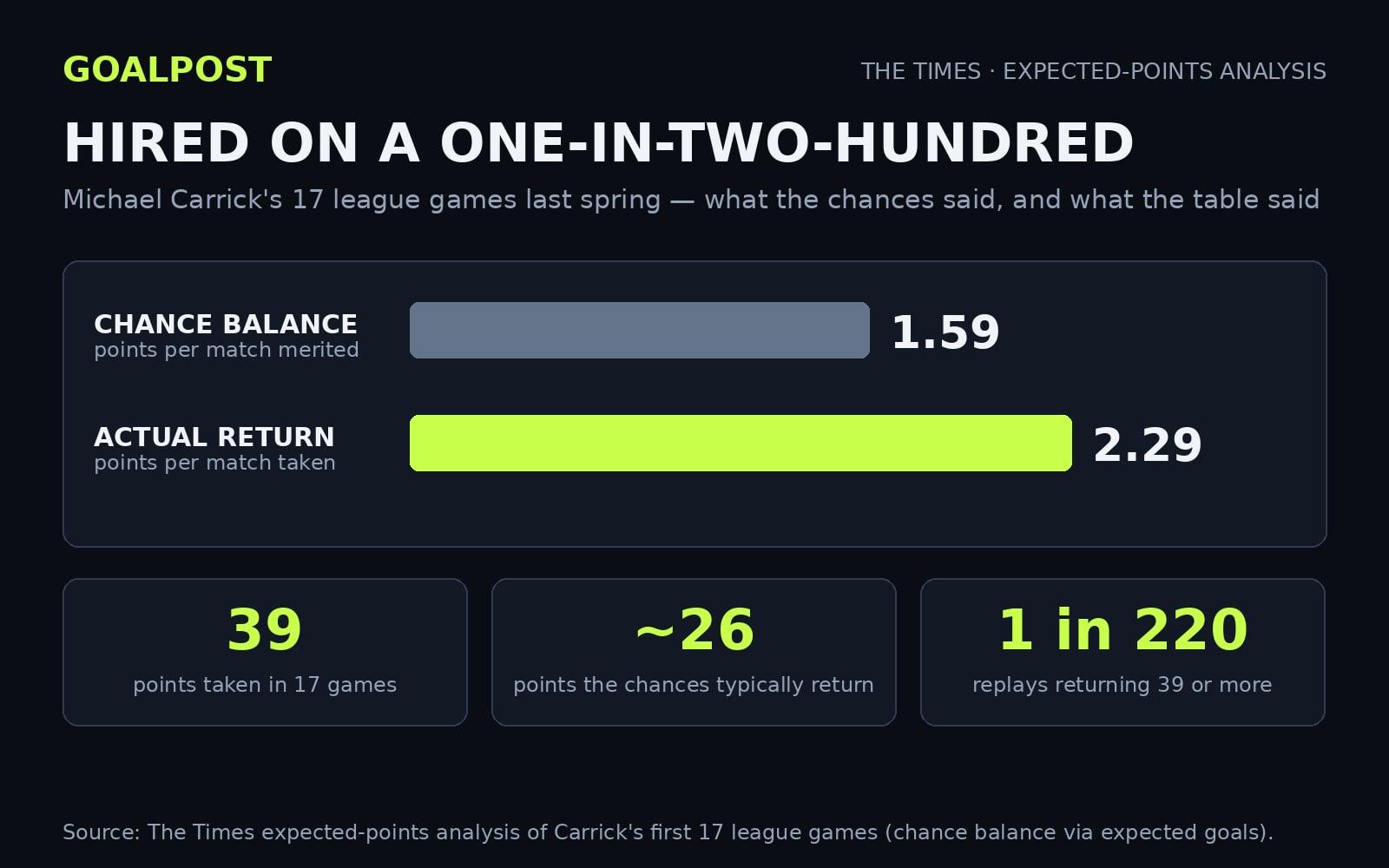
What followed was the best seventeen league games played in England last spring. Twelve wins, three draws, two defeats: 39 points, three more than the eventual champions, Arsenal, took in the same span, and four more than City. United beat City, Arsenal, Villa, Liverpool and Chelsea, finished third, and returned to the Champions League. Bruno Fernandes, restored to his natural position, looked reborn. It did not feel like a mirage. It felt like a team.
Then the asterisk, and it is a large one. The Times calculated that on the balance of chances in those seventeen games, United's performances were worth 1.59 points a match. They took 2.29 — roughly twelve points more than the football merited, the best seventeen-game overperformance of its kind in a decade. The method was not mystical: The Times replayed those seventeen matches from the underlying chance data, over and over — a return of 39 points or more came up roughly once in 220 replays, nearly three standard deviations above the typical outcome. In May, United gave him a two-year contract anyway. They had not appointed the manager of those performances. They had appointed the beneficiary of their variance — and variance, unlike a manager, always resigns.
This season it resigned: the worst start since 1986-87, seven points from eight games, the only win a 5–2 over promoted Ipswich. A 3–0 home defeat by Bournemouth and a 4–1 defeat at Como in the Champions League brought the stay of execution, and the Villa draw closed it with United eighteenth, eight league matches without a win, thirty goals conceded — more, per The Athletic's reporting, than any side in Europe's top five leagues.
It is worth being precise about the asterisk. It said the improvement was unlikely to hold at that rate; it did not say Carrick could not coach, and it could not say what he might have built with a preseason and a squad recruited for him. Those were open questions in May, and they remain open. What the board held was evidence of risk. It wrote the contract as though it held evidence of the opposite — and is now preparing to act as though the risk were proof. The risk was visible in May. The results have made it impossible to ignore.
A word of caution
Because this is where the romance of patience can run ahead of the football. The case for sacking Carrick is not an invention, and it does not rest on nostalgia. A club in the relegation zone, with one league win and the leakiest defence in Europe's major leagues, is not obliged to conduct a seminar on managerial tenure; relegation would cost United more than any severance, and a board looking at The Times' arithmetic can honestly say it is correcting a hiring error rather than committing a firing one. If the standard is the league table, the verdict is already in.
All of that is true. It is also true that the error being corrected was made by the correctors — in May, with a two-year contract, while the same evidence sat before them. A board is entitled to change its mind. What it is not entitled to is amnesia: to present each sacking as a fresh start when the starts keep being written by the same hand, and to call the seventh verse of the song a new composition.
Three hundred and ten days
BBC Sport's analysis of last season put the average tenure of the eleven Premier League managers who lost their jobs at 310 days — the second-shortest figure in the competition's history, above only the 154 days of 1994-95. Postecoglou lasted 39 days at Forest, Tudor 44 at Spurs; across 34 Premier League seasons, almost a third of in-season exits have fallen in November and December, which is precisely where Carrick stands now. There is nothing exceptional about what is happening to Michael Carrick, except the size of the club, and that the club once defined the exception.
Arsenal waited
There is one modern comparison, and it is unflattering. Mikel Arteta took over Arsenal in December 2019 — a first-time head coach, inheriting a side eighth and culturally broken. He won the FA Cup, then finished eighth and eighth. On Christmas Day 2020 Arsenal were fifteenth, four points above the relegation zone, and the noise for his dismissal was deafening; the board backed him, and on Boxing Day his team beat Chelsea. The following August, Arsenal were bottom after three games, with no points and no goals; the board backed him again, having spent some £150m that summer. The finishes then ran fifth, second, second, second — and last season, champions, for the first time since 2004. Six years from appointment to title.
Arsenal did not discover a genius in 2020. They declined, twice, to sack the manager they had while he was losing — at the exact coordinates where United now reach, once again, for the handle of the door.
And they did more than decline. The £150m spent in the summer of 2021 was spent on the manager's team, built in the manager's shape: recruitment organised around the man the board had decided to keep. Patience, there, was not the strategy; it was the protection of one. That is the distinction United keep missing. Time is worth giving to a plan. Without one, it is worth nothing at all.
The trial is held in public
Carrick says he expects to continue and will not resign, though he has been given no assurances (The Sun). David Ornstein reported in The Athletic on 9 November that United are "expected" to relieve Carrick of his duties during this break, with a change anticipated before the trip to Liverpool on 22 November. Sky Sports maintained that no decision had been taken and the break would be used to "fully evaluate". On 11 November the picture hardened: The Guardian reported that Wilcox and Berrada were meeting Ratcliffe in Monaco that day to recommend Carrick's dismissal — and that United were close to agreeing a deal with Mauricio Pochettino to succeed him, conditional on the dismissal being made. Ornstein reported a contract with Pochettino being finalised on the same condition. The decision, formally, remains Ratcliffe's — and, at the time of writing, Carrick remains in post.
Note the order of events. The verdict is being formed in public, in competing briefings, before it is taken anywhere. The modern sacking is not an event; it is a weather system, and the manager coaches inside it — while the crowd that threw tennis balls at the ownership watches one of its employees absorb the weather alone.
Which leaves the succession, and it has moved faster than the dismissal. Pochettino — the bookmakers' favourite since the weekend — is no longer merely a name on a list: a deal close to agreement, on the reporting, priced at a reported release clause of some £7.5m in the United States contract he extended in August, which runs to 2030. Behind him the field stays where it was: Eddie Howe, the i Paper's reported top target, favoured by Wilcox and approved by Ratcliffe; Julian Nagelsmann, admired inside the club by head of recruitment Christopher Vivell; Unai Emery, the dream appointment, and unavailable.
So the charge sheet needs amending. United are not, this time, choosing between a manager and a vacancy — they appear to have chosen the man. What they have not produced is the criterion. What exactly has United decided it needs from Pochettino that it believed Carrick could provide six months ago? A successor is not a plan; a plan is the answer to that question, settled before the appointment rather than discovered after it. It remains the one document Old Trafford has never produced.
Is the job still attractive? It offers one of the largest transfer budgets in English football and the shortest leash in its history: an empire's resources, a caretaker regime's patience. The last seven men through the door collected five trophies between them and not one third season. Every candidate can do that arithmetic, and the dream appointment is, on the reporting, unavailable.
Dorgu's goal bought United a point and Carrick a few days. It cannot buy him the one thing Ferguson was given, because that thing no longer exists: time that is not measured in fixtures. The next man will be welcomed with the usual words about projects and patience, and the words will hold exactly as long as the results allow — the only clause in the Manchester United contract that has been honoured for thirteen years.