The Pochettino Paradox
Priya's Board — the written board.
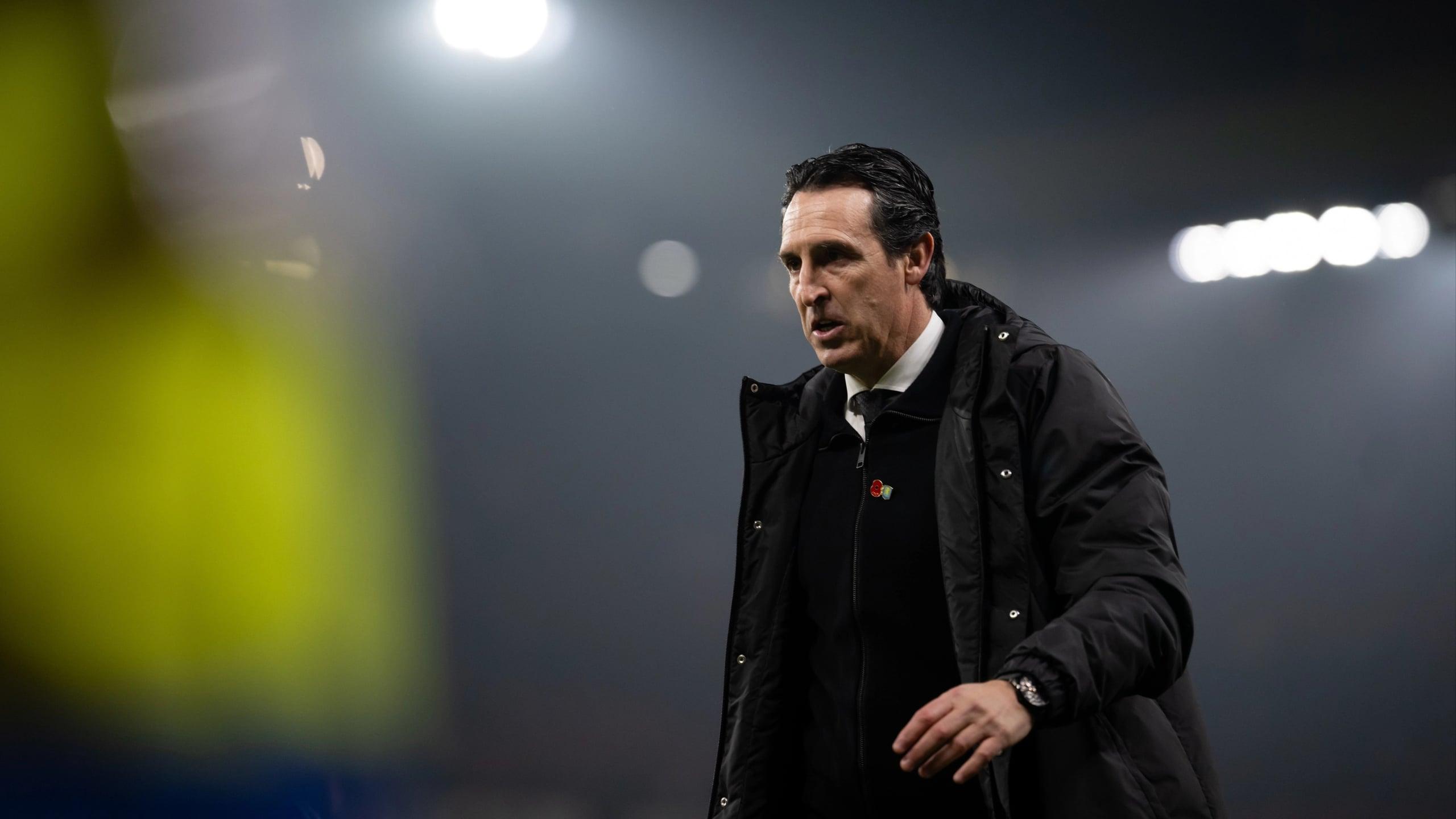
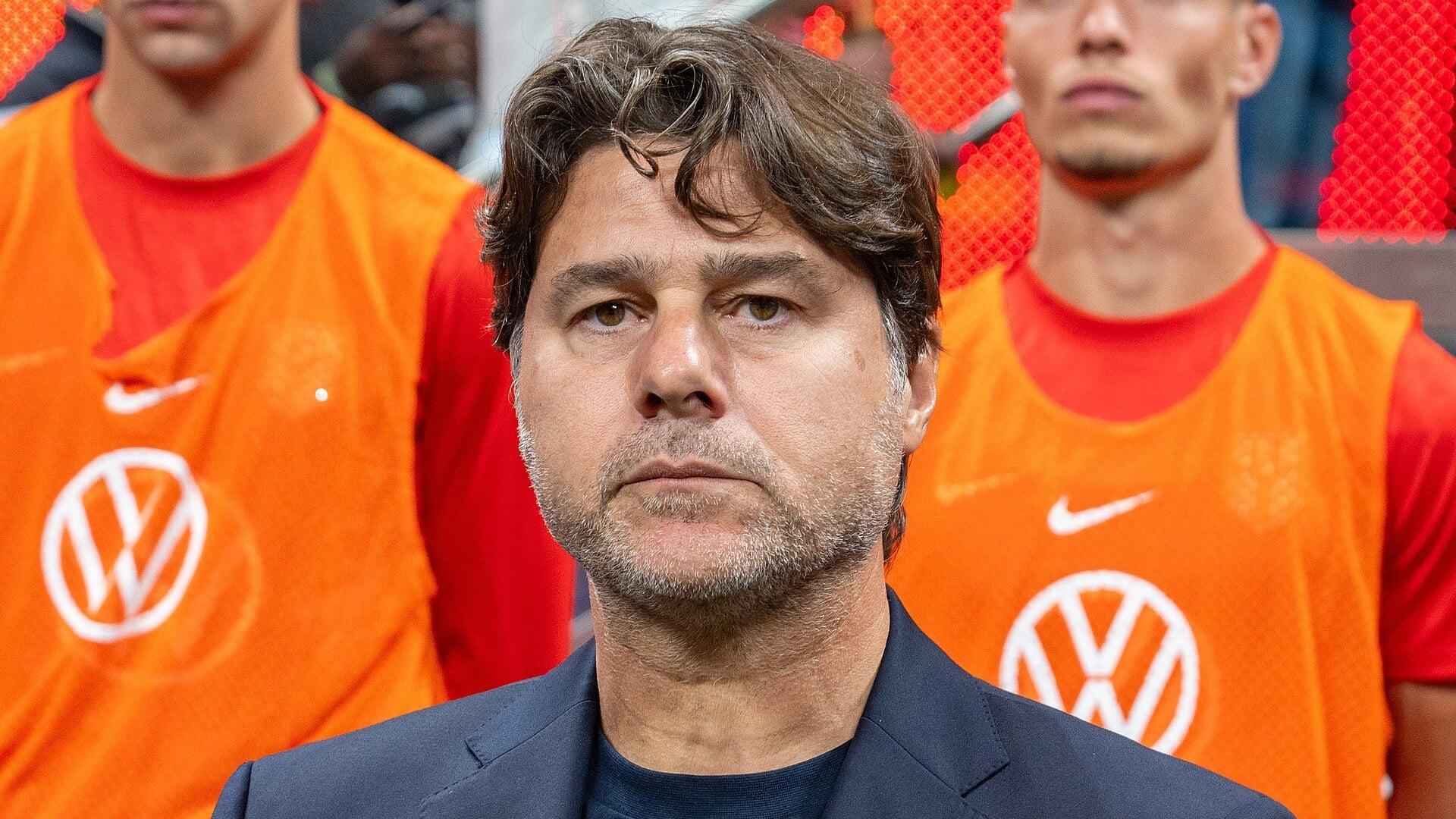
Mauricio Pochettino is Manchester United's coach. He arrived in Manchester this week and took charge on Wednesday, November 18; his first training session follows the next day, and his first match is Liverpool, at Anfield, on Sunday. United are eighteenth, with eight points from ten games, one win, and eight league matches without another one — the club's worst top-flight start since 1986-87. To hire him, United paid the release clause in the United States contract he had signed only in August — reported at £7.4m ($10m) to US Soccer, plus a further $2m for the coaching team he brings with him — on a contract reported at two and a half years, to the summer of 2029.
Start there, because the appointment contains its own question. In 2024, United interviewed Pochettino for this job. The feedback, reported by David Ornstein of The Athletic, was that the club were underwhelmed — by his coaching, his hunger, his work rate. That was United's assessment, and it stays labelled as theirs — a club's reported judgment, not a finding about the coach. Two years on, that same club has paid to appoint him. So what changed in their assessment? And beneath it, the harder question, the one this board exists to examine: can this squad meet the demands his football makes? His methods are not a mystery. They are among the most recognisable in the Premier League — and across his career they have succeeded and failed in conditions that can be named, which is what makes them examinable. United have bought the coach. They have not yet shown they can provide the conditions his football requires — and whether he can adapt when those conditions are not present is the second half of the same question.
Hold one thought while the parts are laid out, because it is where the whole piece lands. Player by player, this squad contains most of the components his football asks for. Components are not a system. Whether United's parts can execute the whole — collectively, consistently — is the question of the week.
Show me the shape, not the score. The shape first.
The making
Begin in Murphy, a farming town in Santa Fe province. In 1986 or 1987 — the accounts differ by a year — Newell's academy director Jorge Griffa and youth coach Marcelo Bielsa arrived at the family home at two in the morning, looked at the sleeping boy's legs, and signed him. The boy became a centre-back: 153 league appearances for Newell's, captain at Espanyol and at Paris Saint-Germain, twenty caps for Argentina, every one of them won under Bielsa.
That biography matters here for one football reason — offered as a reading, not an explanation, because no coach's tactics are settled by where he stood as a player. Pochettino spent seventeen years standing in the space his teams now insure — the ground behind the attack, in front of his own goal. Watch where his structures start, though, and the centre-back's first question is hard to unsee: who is behind the ball when we lose it?
Of Bielsa, he says: "He is like my football father." What he took is precise, and he has always been precise about it — the vocation, the preparation, and the conviction that the ball is recovered, not waited for. What he did not take needs stating just as precisely. Pochettino's press is zonal, set by triggers; it is not Bielsa's man-to-man system, in which every player is assigned a man. That is not the same as saying no Pochettino player ever marks a man: inside the zonal frame there are individual assignments, and a midfielder will lock onto his opposite number when the trigger demands it. The distinction is the architecture. Bielsa builds from the man; Pochettino builds from the zone and borrows the man when he needs him — and his teams will drop into a compact shape in a way Bielsa's will not. Both men refuse the copyist label, from opposite sides. "You can't make a good copy of a Dali," Pochettino says. Bielsa, for his part, insists Pochettino's style is an original one, designed by himself. The inheritance is real. So is the edit. Hold both, because the shape below is exactly that: Bielsa's conviction about recovering the ball, rebuilt by a centre-back who insures first.
The evidence: a career in three acts
Act one: the apprenticeship. Pochettino took Espanyol in January 2009 with the side eighteenth and falling; by mid-February they were bottom. On 21 February 2009 they won 2-1 at Camp Nou — Pep Guardiola's first home league defeat as Barcelona coach, and Espanyol's first win there in twenty-seven years. His stated plan was to press high and to surprise them. Guardiola's verdict has followed him ever since: "There are teams that wait for you and teams that look for you. Espanyol look for you." He kept Espanyol up, taking twenty-five points from the last ten games. At Southampton, who appointed him mid-season in January 2013 to a hostile reception, he finished eighth in his one full season with fifty-six points — then a club record — with a side that paired the division's third-most tackles with its fourth-most fouls. Possession, in his football, has always been something you win back.
Act two: the proof. Tottenham, five full seasons, finishes of fifth, third, second, third and fourth — never lower than fifth, Champions League football four years running. The peak was 2016-17: second place, eighty-six points, twenty-six league goals conceded, the division's best defence. In both peak seasons, Spurs allowed the fewest passes before a defensive action of any side in the Premier League — the press, measured, was the league's most aggressive. The width came from the full-backs: of Tottenham's fifty-nine assists in all competitions that season, 25.8 per cent came from the four full-backs. Ahead of them, Harry Kane dropped to link while Christian Eriksen, Dele Alli and Son Heung-min worked the half-spaces. Kane, Alli and Son are also the development record United's appointment statement now quotes — "an outstanding record of developing individual players" is this section of the career, in the club's own words. Two finals. Both lost.
Act three: the limits. Paris Saint-Germain gave him the only major trophies of his career — three of them, all in France: the Trophée des Champions and the Coupe de France in 2021, and Ligue 1 in 2021-22. The first league, in his opening half-season, was lost to Lille. Chelsea gave him one season: sixth, sixty-three points, seventy-seven league goals scored and sixty-three conceded, and a second half in which only Manchester City, Arsenal and Liverpool took more points — with Cole Palmer, twenty-two league goals and eleven assists, as the development exhibit. The United States gave him thirty-five matches, a Gold Cup final lost to Mexico, and a home World Cup that brought the country's first knockout win since 2002 before Belgium beat them 4-1 in the round of sixteen.
The record, stated once and plainly: nearly seven hundred matches managed, three major trophies, all in France, none in England. That is the whole of the evidence. What it means depends on the mechanism, so walk the mechanism next.
The mechanism, in order
This is one recurring Pochettino structure, in one passage of play. Not United's shape this season, and not a prediction of his first United team. Recurring is the word to hold: it is an option he returns to, not a fixed operating system. He has built with a back three when a match asked for it — the 3-4-2-1 that beat Antonio Conte's Chelsea in January 2017 was a Pochettino side too, and his peak Tottenham team won ten of twelve when it started with three at the back. He has pressed at different intensities in different spells, and sat in a mid-block when a game demanded it. The diagram flexes. The principles are what is being examined.
The base is a 4-2-3-1. In possession, one of the two pivots drops between or beside the centre-backs, and the shape becomes a 3-2-5. Count the ten outfield players, because the count is the argument. The three: the two centre-backs and the dropped pivot, a back line built behind the ball. The two: the remaining pivot, and beside him the number ten — who does not join the last line. He plays at the base of the attack, the link the front five is fed through, close enough to the pivots to keep possession honest and close enough to the striker to become the first pressing piece the moment the ball is lost. The five: both full-backs on the last line, one in each wide lane — they are the width — the nominal wingers tucked inside them into the half-spaces, and the striker through the middle. Five lanes, five players, and nobody unaccounted for — five across the last line, five in the lines beneath it, already standing where the side will defend from. In this variation, the number ten drops to link play beside the remaining pivot. In others, he stays higher — running beyond the striker, or holding the central lane — and the supporting positions are rearranged around him. The three and the two who have not gone forward are in place before the ball is lost, not after. That 3+2 is the rest defence, and it is the first thing to count in any Pochettino side, because everything else is priced against it.
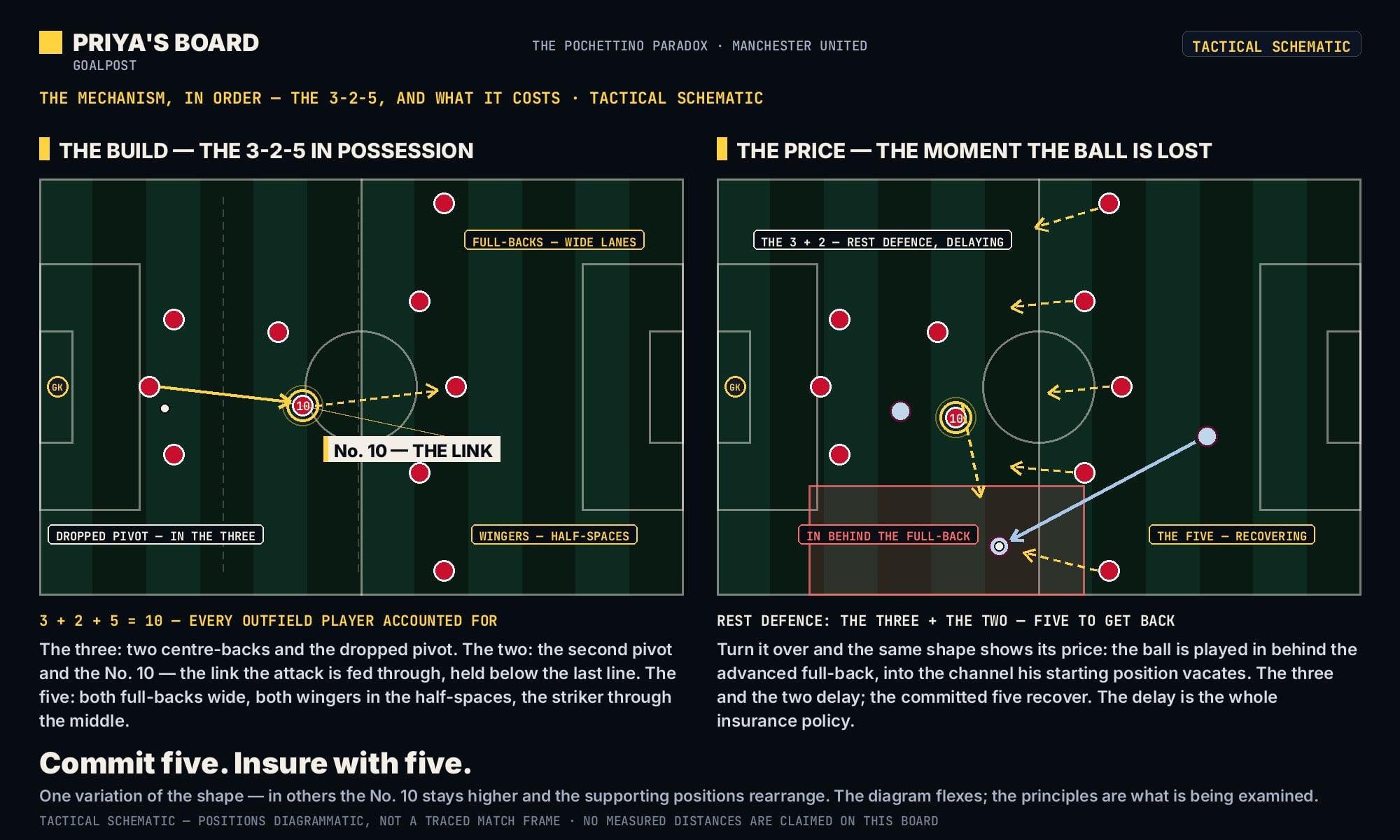
Then the vertical pass is cut out. The ball is lost. The nearest players react immediately, before the opponent can organise — that is the counter-press, pressure in the moment possession changes, rehearsed but distinct from the settled press that follows. Two outcomes live in this picture. If the counter-press wins, possession is recovered and the attack resumes; the shape never has to defend at all. If it fails, the ball comes out behind the advanced full-back, into the space he left when he climbed. That is the moment the 3+2 is for: the covering defender races the ball, delays the attack, and buys the seconds the runners need to recover. The price of the shape is written into the same picture as its strength. The space behind the full-backs is not an accident of this football. It is its standing charge.
If the opponent keeps the ball and builds again, the task changes a third time. Now the side can organise: a 4-4-2 press, the number ten stepping up beside the striker, the striker curving his run to force play one way, the wingers starting narrow. The trap is the pass out to the opposition full-back. When it comes, the winger jumps on a curved run, and the near full-back, the near centre-back and the pivot lock on behind him. The same zone his teams attack — the full-back's channel — is the zone his press is designed to hunt.
One structure, three jobs: insure, recover, hunt. And a fourth question, which belongs to the mechanism rather than to any single match: what does this football need in order to keep working? Not a calendar — a set of conditions. It needs legs that can repeat the running the press charges, week after week. It needs buy-in from the players asked to do that running. And it needs the squad renewed as it ages, because the demand does not fall as the players slow. Where those conditions held — the young, deep, drilled Tottenham side of the peak years — the press was the league's most aggressive and the structure held. Where they frayed, the same structure charged its price without the protection that justifies it. Tottenham's end is the worked example: no signing across two windows in 2018-19, a squad ageing together, and a sacking in November 2019 with the side fourteenth, five months after a European final. Chelsea cuts the other way, and it should be recorded at full strength: in his one season there the side improved as it went and finished with five straight wins — the conditions were being built, not exhausted, when he left. There is no two-season clock on this football. There is a fee, charged in running and belief. The sides that keep paying it keep the shape. The sides that stop paying get the bill.
The fit
Grade the squad he inherits against that demand, not against reputations. The demand is threefold: press as one, recover at pace, and build through a pivot who takes the ball under pressure. The squad, for this purpose, is the last verified board — the side that drew 4-4 with Aston Villa on 8 November, in a 4-2-3-1: Senne Lammens; Noussair Mazraoui, Leny Yoro, Harry Maguire, Diogo Dalot; Youri Tielemans, Kobbie Mainoo; Amad, Bruno Fernandes, Matheus Cunha; Bryan Mbeumo.
Who rises. Patrick Dorgu, first — the left-back as primary width is this shape's oldest role, and against Villa, in some twenty-four minutes from the bench, Dorgu produced a goal and an assist doing exactly the arriving full-back's job, from the position Dalot currently occupies on his weaker side. The geometry of it was measured on this board last week: receiving as a winger stationed at full-back, his nearest defender some ten metres away and wider than him, and the low cross for Zirkzee's 90+2 goal threading the corridor inside the full-back, within two metres of Pau Torres. On the ball, the role fits exactly; the recovery running the position owes, week after week, is what one match cannot prove. Mazraoui rises with him: a two-way right-back whose cutback made the 44th-minute equaliser against Villa, and who can tuck into the back three as readily as he overlaps. Mainoo rises on the first part of the pivot's job — receiving under pressure, which the build-up cannot work without. The other two parts, recognising the transition as it turns and covering the space the press leaves, are his examination. Amad and Cunha rise as the forwards of this system are meant to: narrow, between the lines, where Eriksen and Son once worked.
Who is exposed. Harry Maguire faces two questions that are too often merged. Recovery pace is not his strength; anticipation and positioning are. A high line, with centre-backs defending the channels behind advanced full-backs, charges the first and still uses the second — which of the two this shape needs more from him is genuinely open. Fernandes presses willingly; pressing and freedom are not opposites. His value, though, is the freedom to roam, and in this shape the ten is a structural piece first — the link at the base of the attack while United build, then the man who steps up beside the striker and locks the inside lane when the ball is lost. The question is the space his pressure leaves behind him, and who coordinates it. Tielemans can pass through a press; whether he can run one is open. Dalot, at left-back, conceded the Villa penalty in the very channel this shape must defend — and the isolation that produced it was measured, not imagined. Ninety seconds before the penalty, at 46:25, Dalot stood alone against Alysson with his nearest midfield support, Tielemans, some twenty-one metres away. Twenty-one metres is not cover. The lunge was Dalot's. The earlier distance to his nearest midfield support raises a different question: why was United's left-back defending such a dangerous channel with so little apparent protection? And Lammens must sweep behind a high line: the requirement is certain, and on one match it would be wrong to pretend I know whether he meets it.
And the collective question already has its sharpest evidence from that same match. When Yoro's header came back off his own crossbar at 53 minutes, the ball dropped loose in the six-yard box with Villa's Jackson, on this board's tracing of the frame, some three metres from it, Yoro the only United outfielder goal-side of it, and the next United shirts — Maguire and Mainoo — nine and ten metres away. (The distances in this section are analyst traces on a 105×68 pitch model — approximations, good to a couple of metres either way, not tracking data.) One layer, where this football needs two. No individual grade captures that. It is the space between the components: the second ball nobody owned, the cover that was measured in metres and found absent.
The finding is not a list of fits and misfits. United have players suited to individual components of this approach. What is unproven is whether they can execute its defensive responsibilities collectively, and consistently. Components are not a system.
The opponent
Sunday's opponent sharpens every one of those questions, because Pochettino's record against Liverpool is the worst on his file. In the Premier League he has won three of sixteen meetings, with five draws and eight defeats — his lowest return against any club he has faced more than twice. At Anfield he has won once in nine visits: with Southampton in September 2013, 1-0, the winner a Dejan Lovren header from a corner. He has not won there in eight visits since, losing six.
But this is Andoni Iraola's Liverpool, not Jürgen Klopp's, and the board has to price the side that is actually there. Liverpool are fourth, on eighteen points. Away from home they are the league's best side — thirteen points from five, a joint-best away start in the club's history. At Anfield they have taken five points from five, scored four goals, and only three of those from open play. They are also the league's most direct side — a league-high twenty-five direct attacks on Opta's count. They will not build patiently in front of United's press and offer the full-back trigger on schedule. And one line in Pochettino's favour, stated because it is true: he has never lost to Iraola. A goalless draw at Bournemouth, and a 2-1 win at Stamford Bridge, both with Chelsea in 2023-24. Small numbers. But the opponent in this test is not the opponent in his record, and a fair board says so.
The case against, at full strength
It has two parts, and neither should be softened.
The first is the record already stated: the trophies are three, in France, in the one job where the league title is the expectation rather than the achievement — and even there, the first league was lost. Reuters, on appointment day, called it "a big reputation but precious few trophies." That is a wire service's sentence, not a rival's jibe, and it is fair comment on the numbers.
The second is game management, and two nights carry it. The Bernabéu, 9 March 2022: Paris led Real Madrid 2-0 on aggregate with an hour gone in the second leg, and had been the better side. Madrid pressed higher, Karim Benzema forced an error from Gianluigi Donnarumma and scored three times in seventeen minutes, and Paris went out. Pochettino's own verdict was the shortest one available: "We lost the tie in ten minutes." Wembley, 25 February 2024: Chelsea, against an injury-depleted Liverpool side that finished the match with academy players on the pitch, produced their best chances late in the ninety minutes — and then retreated in extra time. Pochettino admitted afterwards that the team had felt "maybe penalties would be good for us," and that the energy had gone. Virgil van Dijk won it from a set piece at 118 minutes.
Add the personnel condition, because it is the one Anfield can test first. At Paris, the mechanism was never fully installed. The most visible reason stood at the top of the pitch: a front three of Lionel Messi, Neymar and Kylian Mbappé would not run the press as one unit — and behind them, the midfield balance and the defensive organisation were never settled either. And set against it, at full strength, the counterweight: Chelsea, one season, a young squad learning the demands, and a side that improved as it went — five straight wins to finish, sixth place secured late. The conditions this football needs can be built. Whether they can be built in this squad, from eighteenth, is the open question — which is exactly why Sunday is a test and not a verdict.
The correction, aimed at the buyer
The correction in this file is not aimed at the coach. It is aimed at the club that has just hired him, and the timeline is the whole argument.
The turns are a matter of record. 2016: considered, and Mourinho chosen. 2022: in the final two, and Ten Hag chosen. 2024: interviewed, graded underwhelming on his coaching, his hunger and his work rate — and passed over twice, with Amorim preferred that November. This summer he was available without a fee, and United made the interim, Carrick, permanent instead. In November 2026, eighteenth, they sacked Carrick and paid a release fee for the coach they had passed over at every previous turn.
None of that makes the appointment irrational, and the investigation should say so plainly. The affirmative case is real. Few available coaches have a more compelling recent record of building a young Premier League side into sustained contenders: Tottenham went from Europa League regulars to title challengers and a European final, on young players he developed and a pressing system his squads executed as one. He has built in different football environments and adapted in each. Opta's own analysis of the appointment lands in the same place — much to be excited about, and a risk for everyone involved. If United have finally settled on the football they want — built, pressed, young — then Pochettino is the most proven builder of that football on the market, and paying to get him is a coherent act. The question was never whether a case exists.
The story, then, is not that United finally got their man. It is that an institution which graded this coach's coaching inadequate in 2024 has now paid a premium for the same coach. United passed on Pochettino repeatedly, and have now paid to appoint him. There may be sound reasons for that change of mind. What remains unclear is whether the club has developed a settled view of the football it wants — or merely developed a more urgent need for someone who can deliver results. What the club still has to show is a settled answer to the question every one of those earlier decisions dodged: what kind of football does this club actually want, for longer than one bad autumn? A football like Pochettino's cannot be hired by the season. Its returns are built, not bought. Its price is charged from week one.
The test
He took charge on Wednesday, November 18, and takes his first training session the next day. The eleven at Anfield will necessarily resemble Carrick's last eleven. So selection is not the test. Shape is. Three checks, in the order the mechanism runs.
One: the press, in the wide areas. When Liverpool play out to a full-back — if they offer the pass at all — does the United winger jump on the curved run, with the ten screening the inside lane and the far side tucked in behind him? Against the league's most direct side, the trigger may never be offered cleanly. Watch whether United manufacture it, pressing a longer ball or a goalkeeper's distribution instead, or whether the press sits as a passive shape and the whole first job goes unattempted.
Two: the protection. When the press is beaten — and against a direct side it will be, in moments — who is behind the advanced full-back? Count the rest defence while United have the ball: is a pivot dropping to make the three and the two, or is it the open structure of the Villa match, both full-backs gone and the channels bare? Then watch the centre-back asked to defend Alexander Isak's channel run, in the space the shape knowingly leaves. That duel, more than any other, is where this football sends its bill.
Three: adaptation. His career shows a coach who has worked in a 4-3-3, in a back three, and in a mid-block when a match has demanded it. If Liverpool keep escaping the first version, does he change the second half's shape, or hold it and take the price? Either answer tells you something true — and neither convicts or acquits him. A coach three days into a job may hold a familiar shape precisely because it is familiar. The adaptation that matters runs across the coming weeks; Sunday files the first entry, nothing more.
Beyond Sunday, the first five run Sporting away in the Champions League, Brentford at home — his first Old Trafford match — Newcastle away, and Coventry at home. The terms are these: no result passes this test, and no result fails it. A draw played in the Villa shape would prove nothing about Pochettino. A defeat played in his shape, with the press attempted, the 3+2 in place and an adjustment made when it was beaten, would prove a good deal. One match, on three days of training, cannot show a coached team. It will show his immediate priorities — what he has chosen to fix first, in a squad whose last match needed rescuing twice.
Show me the shape, not the score. The shape is the evidence. United have hired a coach whose principles are known, whose demands are known, and whose price is known. What is not known is whether this club can give him the conditions those principles need — and whether he can adapt when it cannot. Anfield starts the answer.
— Priya Shah