Guadalajara hosted the World Cup in 1970. It hosted it again in 1986 — the tournament where Maradona scored both goals against England in the same afternoon, the Hand of God and the Goal of the Century, though those matches were played 440 kilometers northeast in Mexico City. Guadalajara returns for the third time in 2026, and it does so with the particular confidence of a city that has been here before and knows exactly what it is.
Mexico's second city. The capital of Jalisco, the state that gave the world tequila and mariachi and the sombrero and a folk culture so specific and so exported that it has become, for many people internationally, synonymous with Mexico itself. The food here — birria above all, the slow-braised goat or beef in its chile consomé that has spread across the Mexican diaspora worldwide and still tastes best at its source — is among the most distinctive in the country. The neighborhoods of Colonia Americana and Chapultepec carry an evening culture that is genuinely local in a way that tourist districts rarely manage. The Hospicio Cabañas, whose dome ceiling José Clemente Orozco covered in the most powerful mural painting in the Western Hemisphere, is 20 minutes from the stadium by rideshare and should be on every itinerary.
Four group stage matches, including Uruguay vs Spain on June 26 — one of the most anticipated fixtures of the entire tournament — and Mexico vs South Korea on June 18. No knockout games. All knockout rounds move to the United States. For fans following Spain, Uruguay, Mexico, or South Korea into the knockout stages, a US entry requirement will need to be sorted before departure.
The Stadium
Estadio Guadalajara — Estadio Akron in everyday use, home of Club Chivas, the most popular football club in Mexico — sits in Zapopan, northwest of the city center. It holds 49,850, built to FIFA standards from its 2010 opening rather than retrofitted from another use. The steep enclosed bowl amplifies sound in a way that open or partial-canopy stadiums do not. On a Mexico match day, or on the June 26 match between Uruguay and Spain, the atmosphere at Estadio Akron will be one of the loudest experiences available at this World Cup.
Chivas — Club Deportivo Guadalajara — are the team with the largest fanbase in Mexico, with the policy of fielding only Mexican-born players, which connects them to the national team identity in a way that no other Mexican club does. The stadium was built for them. The World Cup arrives in their house.
Getting There
Do not drive on match days. Traffic around Zapopan gridlocks completely in the hours before and after kickoff. Shuttle buses run from Centro Histórico and Avenida Chapultepec directly to the stadium on match days — the most reliable option for visitors staying in the central neighborhoods. Uber and DiDi operate freely but plan to leave at least three hours before kickoff to account for traffic. After the match, the post-match rideshare surge is intense — walk 10 to 15 minutes from the stadium gates before requesting a pickup.
Mi Tren, the city's light rail system, covers the central corridors; MiBici bike share operates stations throughout Colonia Americana and the Centro for trips between neighborhoods. Both the Chapultepec corridor and the Centro Histórico are walkable.
🏨Find Hotels
Book on Hotels.com
Hotel links are affiliate links. We earn a commission on completed stays at no extra cost to you.
The Food
Birria is not just a dish in Guadalajara. It is a social practice, a Sunday ritual, an argument, a point of civic pride. Slow-braised goat or beef, cooked for hours in a deeply spiced chile consomé until the meat dissolves, served as a stew alongside the cooking broth, or as tacos — the tortillas dipped in the red fat rendered off the braising liquid and griddled crispy — or as quesabirria with melted Oaxacan cheese. The birria that went viral internationally and produced birria tacos on every food trend list of the last five years originates here, in Jalisco, and what you eat at the source tastes different from what you eat anywhere else.
La Birriería de Don Lupe and El Güero are the institutions. Eat it on a Sunday morning when the restaurants that have been slow-cooking through the night are at their fullest expression. Order the consomé alongside the tacos. Drink it from the cup between bites — this is what it is for.
The torta ahogada — a pork sandwich on a bolillo roll, drowned in a thin chile de arbol sauce, the bread softening as it absorbs the liquid — is the other Guadalajara essential. The sauce is not mild. The most famous version is at El Güero on Avenida Enrique González Martínez, a counter operation with no seating where the correct response to the question "picante o suave?" is picante.
Tequila is from here. Not from Mexico in general — from Jalisco specifically, from the red volcanic soil of the Tequila region 60 kilometers west of the city, where the blue agave has been grown and distilled since the 16th century. The tequila served in Guadalajara is not the same product as the tequila served in a hotel bar in Cancún. Order blanco or reposado neat. The mezcalerías on Avenida Chapultepec carry Jalisco mezcal alongside the Oaxacan bottles — the regional spirits have a different profile, lighter and less smoky, reflecting the terroir of the Jalisco highlands.
The cantinas operate on the northern Mexican tradition of free botanas — small plates of food included with every drink ordered. In a proper Guadalajara cantina, you do not need to order food separately. Sit down, order drinks, eat what comes. The portions will be more than adequate.
The City
Centro Histórico
The Centro Histórico is organized around the Plaza de Armas and the Plaza Tapatía, both dominated by the Guadalajara Cathedral — a building that has been under some form of construction or repair since 1618 and carries that layering in its façade. The Palacio de Gobierno contains a mural by José Clemente Orozco on the main staircase: a figure of Miguel Hidalgo, the independence leader, looming over a sea of fire and conflict. The bullet hole from the Mexican Revolution is still visible in the tower clock. History in Mexico does not always stay behind glass.
The Hospicio Cabañas, two blocks from the cathedral, is a UNESCO World Heritage Site — a neoclassical orphanage from 1810, now a cultural center, whose chapel dome Orozco covered with The Man of Fire between 1938 and 1939. The mural, which covers the entire interior of the dome in a swirling composition of figures consumed and transcending fire, is the finest work of Mexican muralism after Rivera's UNAM stadium mosaic. Open Tuesday through Sunday. Plan two hours minimum. Do not look at it briefly.
Colonia Americana and Avenida Chapultepec
Avenida Chapultepec is Guadalajara's Roma Norte equivalent — a 1.5-kilometer stretch of outdoor terraces, craft beer bars, specialty restaurants, and mezcal spots where the city's professionals actually go out. On Saturday mornings, the avenue closes to cars for Bici-Ruta cycling and a flea market. On match evenings, it is the correct place to be in the hours before the shuttle. La Cantina de La O for craft cocktails. Pare de Sufrir next door for mezcal and a quieter room. Cerveza Loba's taproom a few blocks south for the local craft beer.
Colonia Americana, the neighborhood surrounding the Chapultepec strip, contains blocks of converted colonial houses holding restaurants, design studios, and independent coffee shops. It is where tapatíos — the local word for Guadalajarans — eat and drink, which is the most reliable indicator of quality available.
Tlaquepaque
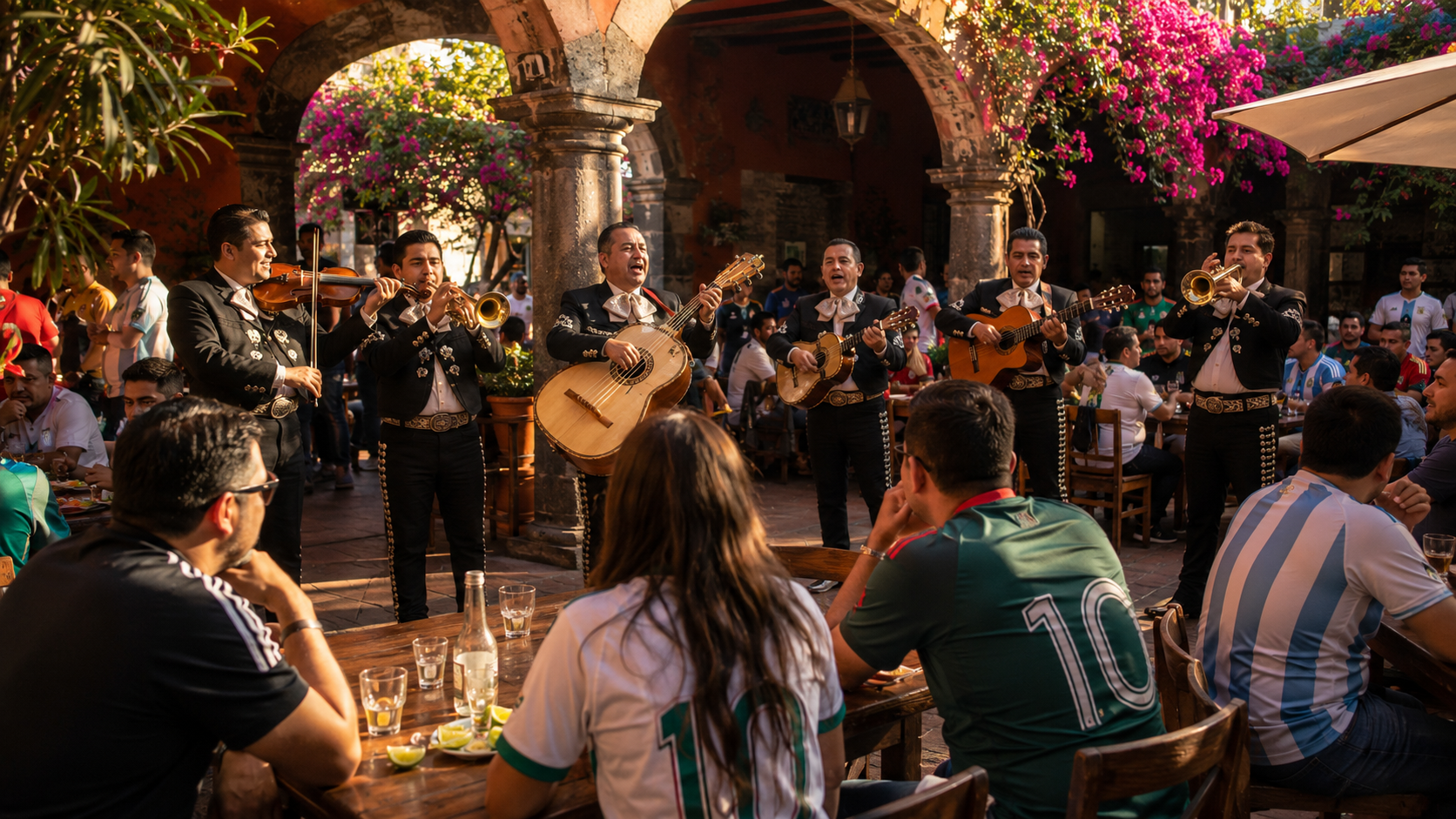
Tlaquepaque is a pueblo mágico that the city absorbed as it grew — five miles from the centro, entirely different in character, its cobblestoned streets and colonial buildings housing artisan workshops, galleries, and restaurants. On Sunday afternoons, mariachi bands circulate between the restaurants and the central plaza, the traditional performance context that preceded the staged version. El Parián, the covered market at the center of Tlaquepaque, has been the Sunday mariachi gathering point for decades. Arrive at noon. Order food. Let the music come to you.
The Fan Festival
The official FIFA Fan Festival is expected at Plaza Liberación near the Cathedral in the Centro Histórico, with satellite programming along Avenida Chapultepec. The Plaza Liberación space, flanked by the Cathedral and the Palacio de Gobierno with Orozco's murals visible through the entrance, is among the more architecturally imposing fan festival locations in the tournament. Confirm at fifaworldcup.com/guadalajara as the tournament approaches.
Plaza de Mariachis, near Mercado San Juan de Dios in the Centro, is the essential evening stop — mariachi bands gathering from around 9PM onward, playing for tables in the surrounding cantinas and for the plaza crowd through midnight and beyond. The cost is a drink and whatever you choose to tip the musicians. Go once. Go late.
The Tequila Route
Tequila, the town, is 60 kilometers west of Guadalajara on a road that passes through the agave fields — row upon row of blue agave on the red volcanic slopes of the Jalisco highlands, the landscape that produces the only spirit that can legally be called tequila. The town itself is small, touristy in the honest sense of a place that knows why people come, and worth the half-day trip for the distillery tours, the agave fields seen at scale, and the product tasted in the place that made it. Jose Cuervo, Herradura, and Patrón all operate tours from Tequila town. Book ahead for the higher-end distillery experiences.
The full Tequila Route extends north and south from the town, and the José Cuervo Express — a train from Guadalajara — runs weekend round trips with tastings included.
A Note on Knockout Rounds
Guadalajara hosts group stage matches only. All Round of 32 and subsequent fixtures take place in the United States. If you are following Spain, Uruguay, Mexico, or South Korea beyond the group stage, you will need to cross the US border to continue — ESTA or visa depending on nationality. Sort this before you leave home.
What It Costs
Guadalajara is the most affordable of the three Mexican host cities for international visitors, with a lower hotel and restaurant price floor than Mexico City and prices comparable to Monterrey.
| Mi Tren/Mi Macro fare | |
| Uber/DiDi, Centro to stadium | |
| Birria tacos (4), street counter | |
| Torta ahogada, El Güero | |
| Tequila or mezcal, Chapultepec bar | |
| Hotel, Colonia Americana (mid-range) | $70–150 USD/night |
Find Hotels
Book on Hotels.com
Hotel links are affiliate links. We earn a commission on completed stays at no extra cost to you.
Essential Information
Stadium Estadio Guadalajara (Akron), Zapopan. 49,850 capacity. 4 group stage matches: Mexico vs South Korea June 18, Uruguay vs Spain June 26, plus two further group games. No knockout rounds.
Transport Shuttle buses from Centro and Chapultepec on match days — most reliable option. Uber/DiDi — leave 3+ hours early, walk 10-15 mins from stadium before requesting post-match rideshare. Do not drive. Mi Tren for central neighborhood transit.
Fan Festival Plaza Liberación, Centro Histórico (expected — confirm fifaworldcup.com/guadalajara). Chapultepec corridor satellite events.
Neighborhoods Colonia Americana/Chapultepec (local scene, terraces, craft beer, mezcal, the city's best bars). Centro Histórico (cathedral, Hospicio Cabañas, Palacio de Gobierno, Plaza de Mariachis). Tlaquepaque (pueblo mágico, artisan, mariachi on Sundays). Zapopan (stadium adjacent, modern).
Food Birria — La Birriería de Don Lupe (Sunday morning, stew and tacos). Torta ahogada — El Güero (counter, no seating, order picante). Tequila and mezcal in Chapultepec mezcalerías. Cantinas with free botanas anywhere in the centro.
Culture Hospicio Cabañas (UNESCO World Heritage, Orozco's The Man of Fire dome mural — do not miss). Palacio de Gobierno (Orozco's Hidalgo mural, bullet hole in the clock). Plaza de Mariachis, nightly from 9PM.
Tequila Route 60km west. José Cuervo Express weekend train from Guadalajara with tastings included. Distillery tours in Tequila town — book ahead.
Knockout rounds All in the US. Check US ESTA or visa requirements if following your team beyond the group stage.
Weather Hot. June highs ~88°F (31°C), cooler evenings. Afternoon rainstorms. Match kickoffs timed for the evening. Carry water.
Currency Mexican peso (MXN). ATM withdrawals from BBVA or Santander. Cash essential for street food, cantinas, market stalls.