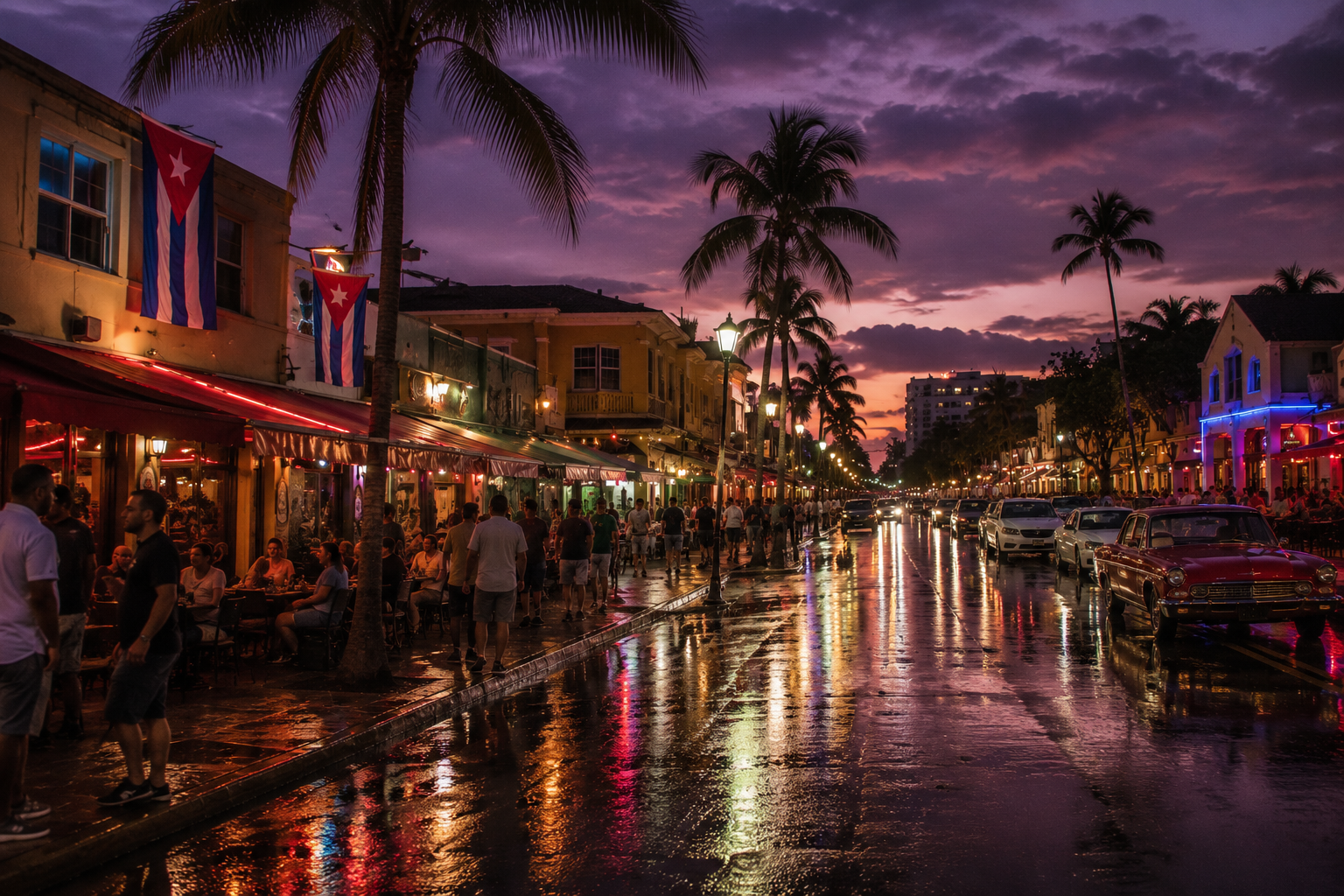
The heat in Miami is a different animal from the heat in Dallas or Houston. In Texas, the summer is dry and relentless and comes at you directly. In Miami, it wraps around you — the Atlantic humidity settling over the city like a second skin, the air thick with salt and the particular smell of rain that has already fallen somewhere nearby. By June, the daily high sits at 87°F (31°C) and the afternoon thunderstorms arrive on schedule, typically between 3 and 6PM, lashing the palm trees for twenty minutes and then clearing as if nothing happened. The city is used to this. Most visitors are not, but they adapt quickly, because there is too much else to pay attention to.
Miami does not become a football city for the World Cup. It already is one. The Argentine community in Doral, the Colombian community in Brickell and Doral, the Venezuelan community throughout the county, the Cuban community anchoring Little Havana — these are not fan bases that the tournament has assembled. They have been here for decades, watching the game with the intensity of people for whom it carries national identity, family memory, and the particular emotional weight of distance from home. When Argentina plays and Doral erupts, it is not the World Cup producing that reaction. The World Cup is simply providing the occasion.
Seven matches at the stadium. One quarterfinal. The 3rd place match on July 18, the day before the Final at MetLife. Miami is where the tournament's last act of consolation happens, and where the party before the Final will be.
The Stadium
Miami Stadium — Hard Rock Stadium in its everyday life, home of the Miami Dolphins and Inter Miami CF — sits in Miami Gardens, a residential suburb approximately 25 kilometers north of South Beach. It holds around 65,000 people and hosts seven World Cup matches, culminating in the 3rd place match on July 18. A canopy covers the seats, which matters for the afternoon heat, but the walk in from shuttle stops and rideshare drop-off zones is not covered. Arrive prepared.
Miami Gardens is not a neighborhood with much to offer before or after a match. There are no bars at the stadium gates, no restaurants within easy walking distance. Eat and drink before you go. The food and drink inside the stadium will be expensive and the options limited.
Getting There
Hard Rock Stadium has no direct rail connection. Getting there requires a plan.
The best option for most visitors is Brightline — Florida's intercity rail service — which runs from West Palm Beach, Boca Raton, Fort Lauderdale, and Orlando to Aventura Station. From Aventura, free match-day shuttles run directly to the stadium in approximately ten minutes. Brightline seats are bookable in advance, the trains are air-conditioned, and the journey from downtown Fort Lauderdale takes around twenty minutes. If you're flying in, Fort Lauderdale-Hollywood International Airport is actually closer to Hard Rock Stadium than Miami International, and often offers cheaper fares on domestic connections.
From Miami itself: the Metrorail Orange Line runs from Miami International Airport to Palmetto Station and Golden Glades, both of which serve as shuttle transfer points on match days. The journey from downtown Miami to the stadium, including the shuttle, runs 45 to 60 minutes.
Free game-day shuttles operate from four designated hubs across Miami-Dade: NW 2nd Avenue, the Brickell area, the Miami Beach Convention Center, and major Metrorail stations. Shuttles begin running three hours before kickoff. These are free with a match ticket and represent the most stress-free option for fans based in central neighborhoods.
Driving: approximately 27,000 parking spaces are available near the stadium, starting at around $50. Pre-purchase. Post-match departure from a full parking footprint in July heat is its own experience. Rideshare drops off on NW 199th Street, a walk from the gates.
Arrive at least 90 minutes before kickoff. The security lines, the shuttle queues, and the afternoon heat will all conspire against anyone who arrives at the last minute.
🏨Find Hotels
Book on Hotels.com
Hotel links are affiliate links. We earn a commission on completed stays at no extra cost to you.
The Fan Festival and Where the Tournament Lives
The official FIFA Fan Festival runs at Bayfront Park in downtown Miami for 23 days — free entry, match broadcasts on large screens, food, drink, and live performances. Bayfront Park is accessible by public transit in a way the stadium is not, which makes it the practical fan zone for visitors without match tickets and a useful second venue for those who have them. The waterfront setting along Biscayne Bay is genuinely attractive.
Skip Bayfront Park if you want something more local — the North Beach watch parties offer a neighborhood atmosphere that the official fan zone can't replicate. The distinction between the official and unofficial World Cup in Miami is the distinction between Miami as it presents itself and Miami as it actually is. The latter is more interesting.
The Neighborhoods
Little Havana / Calle Ocho
Calle Ocho is the main artery of Miami's Cuban community — one of the largest Cuban communities outside Cuba — and during the World Cup it will be the most atmospherically dense street in the city for South American football. The heat does not leave with the sun here; it settles into the pastel pavement, thick with the salt of the Atlantic and the smell of coffee that has been brewing since before dawn. The ventanitas — small walk-up windows cut into cafés and restaurants — sell cafecito for a dollar. Versailles, the neighborhood's most famous restaurant, serves Cuban food to a room that has been full since 1971. The ropa vieja is what to order; expect a thirty-minute wait on match days, which is time well spent at the counter with a cortado.
For Argentine, Colombian, and South American fan bases, Little Havana carries a community investment in the game that no sports bar in Brickell can replicate. On a night when Argentina plays anywhere in the tournament, Calle Ocho announces the result before the final whistle blows.
Wynwood
Wynwood is Miami's arts district — murals covering every available surface, the Wynwood Walls turning the neighborhood into an open-air gallery, bars and restaurants operating from converted warehouses. The energy here skews younger and more international than Little Havana, with a creative food scene that reflects the city's Venezuelan and Colombian communities through arepas, empanadas, and the full range of what South American cooking looks like outside tourist-facing Tex-Mex.
Cervecería La Tropical, the Wynwood outpost of Cuba's oldest brewery and the official brewery of Inter Miami CF, has a tropical beer garden, live music, and a taproom that runs late. On a match night it is exactly what it should be. Canta Corazón, partnering with Mexicanos en Miami, is running official Mexico watch parties with sound, giveaways, and the kind of crowd that already knows the words to every chant. Grails hosts lively watch parties for the full tournament.
Brickell
Brickell is Miami's financial district — glass towers above the Miami River, waterfront restaurants with skyline views, the most transit-connected neighborhood for stadium shuttles. American Social Bar & Kitchen, on the river, has the views and a crowd that understands how to watch a match. Cantina La Veinte, with twelve TVs and a giant projector screen, mariachi performances, and handcrafted cocktails, turns match nights into something closer to a celebration than a viewing. 305 Sports Bar on Brickell Avenue has a South American menu — Venezuelan tequeños, arepas, Colombian pabellón — and a crowd described accurately as hinchas on fire.
For fans who want proximity to the Bayfront Park fan zone and shuttle access to the stadium, Brickell is the most practical base in the city.
South Beach / Ocean Drive
The Clevelander on Ocean Drive is transforming into a full-scale FIFA World Cup hub: more than twenty viewing screens, a twenty-foot LED display, and the particular energy of South Beach when it decides to take something seriously. Ocean Drive on a match night involving a South American team will be flags from every building and noise that carries across the water. South Beach is the furthest neighborhood from Hard Rock Stadium, but it is also the version of Miami that the world recognizes, and during the World Cup it will deliver.
Doral
Doral, west of Miami, is where the South American communities are most concentrated — the Argentine, Colombian, Venezuelan, and Ecuadorian fan bases that give Miami its particular football culture. It is not a tourist destination. The restaurants are less polished and more genuine, the bars are watching the game rather than performing it, and on a night when Colombia or Argentina is playing, Doral produces an atmosphere that the more photogenic neighborhoods cannot manufacture.
The Weather, Again
The afternoon thunderstorms deserve specific mention. They arrive almost every day between June and July, typically mid-to-late afternoon, last twenty to thirty minutes, and clear completely. They are not an obstacle — they are the city's daily rhythm. The risk for match days is the timing: a 5PM kickoff with a 3PM storm is fine; a 3PM storm that delays your shuttle departure to the stadium requires flexibility. Build extra time into your match-day schedule.
June average: highs 87°F (31°C), lows 76°F (24°C). July average: highs 89°F (32°C), lows 77°F (25°C). Hurricane season begins June 1, though the 2026 Atlantic season is forecast below average. Monitor the National Hurricane Center if you're in the city for an extended stay.
The Food
Miami's food culture is one of the most genuinely diverse in the United States, shaped by Cuban, Colombian, Venezuelan, Haitian, and Caribbean communities that have been cooking here for generations rather than presenting their cuisines as an attraction.
Start with Little Havana and the ventanitas. A cafecito and a croqueta in the morning, standing at the counter, is the correct way to begin a day in this city. Versailles on Calle Ocho for Cuban lunch or dinner — ropa vieja, lechón, black beans and rice, the room full of regulars who have been eating there for decades. LC's Roti Shop, twelve kilometers from the stadium and worth the trip, does a goat roti for twelve dollars that easily feeds two.
In Wynwood, the arepas and Venezuelan street food. In Brickell, Komodo for upscale Asian fusion with a rooftop, Cantina La Veinte for Mexican on match nights. In the Design District, Cote Miami for a steakhouse that has earned its reputation.
Joe's Stone Crab, operating since 1913 on Miami Beach, is a Miami institution in the fullest sense — the stone crab season runs October through May, so the crabs will not be in season during the World Cup, but the fried chicken and key lime pie run year-round and are not to be skipped.
What It Costs
Miami is one of the more expensive US host cities, with South Beach and Brickell pricing reflecting their reputations. Basing in Wynwood or Little Havana brings costs down significantly.
| Cafecito, Little Havana ventanita | $1 |
| Shuttle to stadium (with match ticket) | Free |
| Brightline, Fort Lauderdale to Aventura | ~$15–20 |
| Group stage ticket, mid-tier | $250–$500 |
| Quarterfinal ticket, mid-tier | $500–$1,200+ |
| Meal, Versailles | $20–$35 |
| Drinks, Wynwood bar | $10–$16 |
| Hotel, Brickell (mid-range per night) | $180–$350 |
| Hotel, South Beach (mid-range per night) | $250–$500+ |
Find Hotels
Book on Hotels.com
Hotel links are affiliate links. We earn a commission on completed stays at no extra cost to you.
Essential Information
Stadium Miami Stadium (Hard Rock Stadium), Miami Gardens. 7 matches including quarterfinal and 3rd place match, July 18.
Transport to stadium Brightline to Aventura Station, then free 10-min shuttle — book in advance. Metrorail Orange Line to Palmetto/Golden Glades, then shuttle. Free shuttles from Brickell, NW 2nd Ave, Miami Beach Convention Center, and major Metrorail stations — 3 hours before kickoff. Parking ~$50+, pre-purchase. Rideshare to NW 199th St.
Fan Festival Bayfront Park, downtown Miami. 23 days, free. Accessible by public transit.
Neighborhoods Brickell (shuttle access, transit, waterfront bars). Little Havana/Calle Ocho (Cuban community, South American energy, best food). Wynwood (arts, younger crowd, Cervecería La Tropical). South Beach (Clevelander, Ocean Drive, furthest from stadium). Doral (concentrated South American fan bases, most authentic).
Food Versailles, Calle Ocho (Cuban, queue for it). LC's Roti Shop (goat roti, $12). Cafecito from any Little Havana ventanita ($1). Komodo (Brickell, rooftop). Joe's Stone Crab (Miami Beach, institution).
Bars Cervecería La Tropical (Wynwood, Inter Miami brewery). American Social (Brickell, waterfront). Clevelander (South Beach, 20+ screens). 305 Sports Bar (Brickell, South American menu). Grails (Wynwood, watch parties). Cantina La Veinte (Brickell, mariachi, match nights).
Weather Afternoon thunderstorms daily, 3–6PM. Build extra time into match-day schedules. Highs 87–89°F (31–32°C). Hurricane season June 1 — monitor NHC for extended stays.
Airport Fort Lauderdale-Hollywood (FLL) is closer to the stadium than Miami International (MIA) and often cheaper on domestic routes.