Los Angeles does not have a center. It has forty neighborhoods, each operating as its own city, connected by freeways and Metro lines and the particular logic of a place that grew without a plan and arrived at something vast and genuinely extraordinary as a result. The morning marine layer burns off by noon. The evenings are mild. The traffic and the distances are real and both require a strategy — but the reward, for a football fan willing to move through the city rather than stay in one corner of it, is access to a diaspora culture more varied and more authentically invested in this game than almost any other city in the United States.
Los Angeles has the largest Mexican community outside Mexico. It has one of the largest Korean communities outside Korea, and the only official Thai Town in the United States. It has Ethiopian, Armenian, Central American, Japanese, Filipino, and Chinese communities that have been shaping the city's culture for generations. Every one of them has a team in this tournament. When Mexico plays, East LA and Boyle Heights announce it before the final whistle. When South Korea plays, Koreatown handles the early-morning kickoffs with a matter-of-factness that comes from decades of doing exactly this.
Eight matches at SoFi Stadium, including the US Men's opening game against Paraguay on June 12 and a quarterfinal. The World Cup in Los Angeles is, in the most literal sense, a tournament within a tournament.
The Stadium
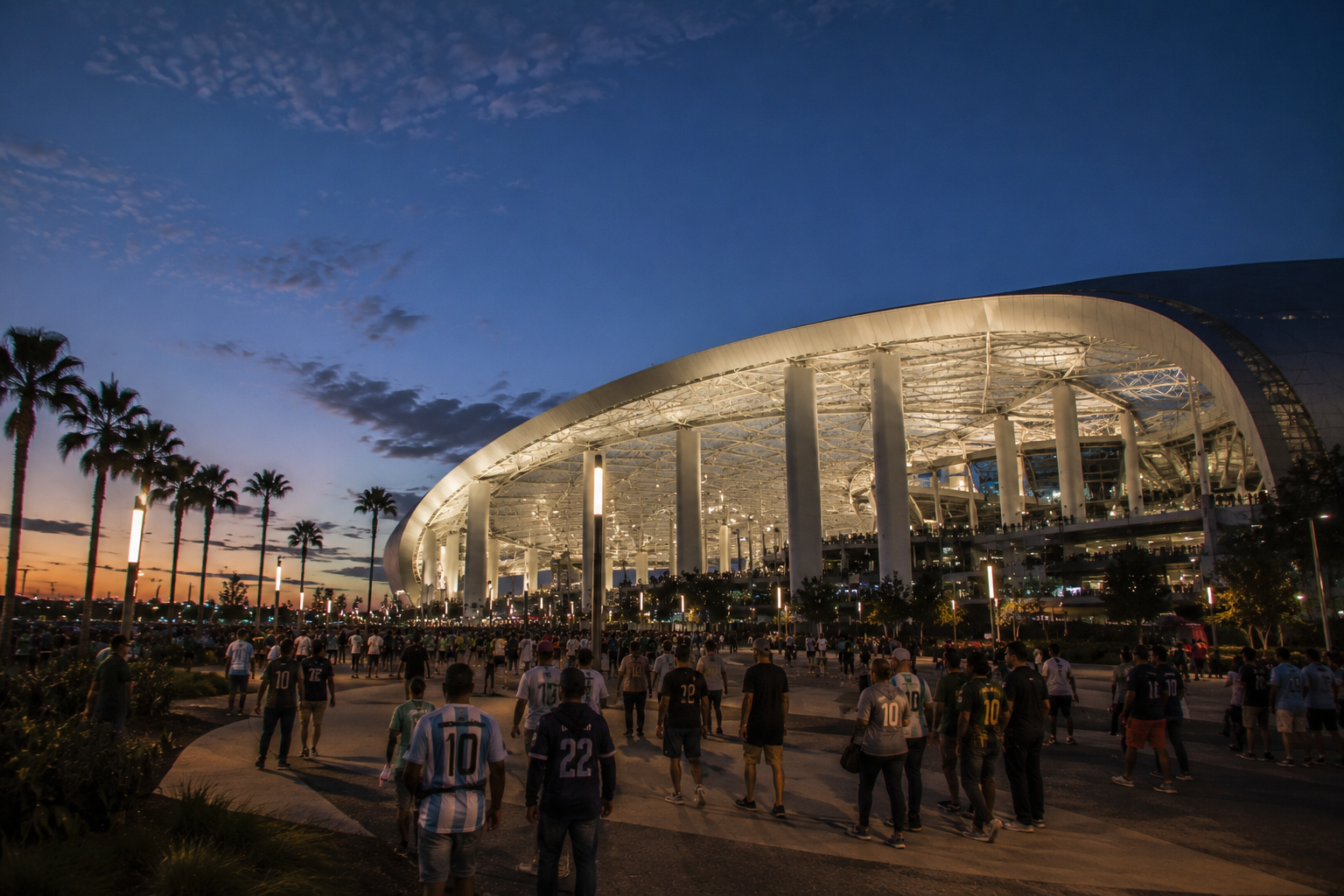
Los Angeles Stadium — SoFi Stadium in its everyday life — hosts eight World Cup matches in Inglewood, including the USMNT's opening match against Paraguay on June 12 and a quarterfinal. The stadium is one of the most technically advanced in the world: a partially covered design with a steep seating bowl and a double-sided "Infinity Screen" suspended over the pitch. The screen is genuinely impressive on first encounter. The stadium feels purpose-built for exactly this kind of occasion.
Inglewood itself has a long history as a center of Black culture and entertainment, with the Kia Forum nearby, and the Hollywood Park development around SoFi has added hotels, restaurants, and a lakefront promenade that activates significantly on match days. Cork & Batter is the closest real sports bar to the stadium gates — useful to know for the hours immediately before and after a match when the surrounding area is busy and a seat with a screen has value.
Getting There
Los Angeles runs a hub-and-spoke transit model for the World Cup. Rather than a single rail line to the stadium, fourteen direct-service locations across the county funnel fans to SoFi on match days, turning neighborhoods miles from Inglewood into primary transit hubs.
The most straightforward route from most central neighborhoods: Metro Purple/D Line to 7th Street/Metro Center in downtown, then transfer to the C Line (Silver) westbound to Hawthorne/Lennox Station, where free shuttles run to the stadium. From Koreatown, the Purple Line is a short walk from most of the neighborhood's main streets. From Santa Monica, the E Line (Expo Line) connects to the same downtown transfer point.
Shuttle hubs also operate from North Hollywood, Woodland Hills, Culver City, and Union Station, with 15 park-and-ride lots across the county. Check the LA World Cup transport page — losangelesfwc26.com — for confirmed schedules and any route updates as match dates approach.
Rideshare and driving: SoFi has substantial parking, but on a USMNT matchday or the quarterfinal, the parking footprint fills fast and the post-match exit takes time. The Metro route is faster and considerably less stressful.
🏨Find Hotels
Book on Hotels.com
Hotel links are affiliate links. We earn a commission on completed stays at no extra cost to you.
The Fan Festival and Fan Zones
The LA Memorial Coliseum in Exposition Park hosts the official FIFA Fan Festival from June 11 to 15, the tournament's opening week, with live match broadcasts, concerts, food vendors, and cultural programming. The Coliseum is a ten-minute drive from Koreatown and accessible by Metro. It is free. For the opening week of the tournament, this is where the city's energy concentrates.
Beyond the Coliseum, ten fan zones operate across LA County for 39 days: Venice Beach, the Original Farmers Market at 3rd and Fairfax, Hansen Dam, Union Station, Downtown Burbank, West Harbor, and Magic Johnson Park, which hosts a July 4-5 event during the Round of 16 window. The Farmers Market fan zone — accessible via Metro D Line to Fairfax Station — features the Market's forty-plus eateries alongside match screenings. It is, by some distance, the best-located fan zone in the city for eating well while watching football.
The Neighborhoods
Koreatown
Koreatown, on the footprint of old Hollywood, has more 24-hour businesses and nightclubs than anywhere else in the country. For the World Cup, this makes it the most practically useful neighborhood in Los Angeles: it handles early-morning Asian-timezone kickoffs better than anywhere else in the city, stays open after late-night matches without exception, and sits on the Metro Purple Line for direct access to the C Line stadium transfer.
Start around the intersection of 6th Street and Alexandria Avenue, where the best late-night spots are clustered — Korean barbecue, fried chicken, noodle houses, karaoke rooms — and wander from there. Biergarten, a German pub in Koreatown, draws a genuinely diverse crowd and pairs cold beer with Korean fried chicken, which turns out to be the correct way to watch a World Cup match. Cham Gastropub is the more elevated option.
When South Korea plays — and they are in the tournament — Koreatown will be operating at a different frequency. The bars fill before the game, the streets fill after it, and the karaoke rooms stay busy until morning.
East LA and Boyle Heights
The Mexican community in East LA will be fully activated during any Mexico match. This is authentic supporter culture — not tourist-facing. The celebrations happen on the street, not just in bars. La Chuperia is the El Tri hub: soccer memorabilia on every wall, commentary in Spanish, micheladas with tajin rims, a crowd described accurately as hinchas. Mariscos Jalisco does traditional street tacos from a truck that has earned its reputation over decades.
Mexico plays its group stage at the Azteca, but the LA community's investment in El Tri does not require Mexico to be playing in Inglewood. When Mexico loses, East LA feels it. When Mexico wins, East LA lets the city know.
Downtown
Downtown is the transit hub and the gateway to the fan festival. Walking access from downtown puts you within reach of LA Live, Grand Central Market, The Broad contemporary art museum — which offers free general admission with timed tickets booked at thebroad.org — and Union Station, from which Metro rail and regional trains depart across the county.
Grand Central Market is the correct answer to the question of where to eat between matches without a plan — a historic downtown food hall with vendors covering every culinary tradition the city contains, open from early morning, and requiring no reservation and no decision more complex than which direction to walk.
Tom's Watch Bar downtown has extensive screens and a crowd that shows up for everything. For the USMNT opening match on June 12, every bar in LA with a screen will be full. Downtown's volume and variety give you the best chance of finding a room.
Culver City
Culver City has become a popular base due to its growing restaurant scene and central location between downtown, the beach, and Inglewood. The C Line stops here, which puts the stadium transfer within reach, and the neighborhood's bars and restaurants are good enough to spend time in between matches without feeling like you've retreated from the city. The historic Culver Hotel, built in 1924, is worth knowing about if you want a base with character rather than just convenience.
Santa Monica and Venice
The beach is forty-five minutes from the stadium and worth every minute of the journey. The E Line from downtown reaches Santa Monica directly. The beachfront path between Santa Monica and Venice, running along the Pacific, is the correct venue for the morning before a match and the evening after one. The Santa Monica Pier has been there since 1909 and remains exactly what it was: a pier above the Pacific with rides and food and the particular quality of light that happens when the marine layer clears by noon.
Little Ethiopia on Fairfax Avenue offers family-run restaurants, coffee ceremonies, and small markets that speak to the Ethiopian and Eritrean communities in the city. Thai Town, on Hollywood Boulevard, has the largest Thai community outside Thailand — Friday and Saturday nights bring a street food market to the area, and Ruen Pair has been the neighborhood's best restaurant for long enough to be trusted. Surfing, which happens at every Los Angeles beach every day regardless of season, is worth watching even if you have no intention of participating.
The Weather
Los Angeles in June and July is Mediterranean: mild, dry, and genuinely pleasant. Daytime highs run around 75°F (24°C), evenings cooler. The June Gloom — the marine layer that keeps mornings overcast along the coast — burns off by noon most days and doesn't affect inland neighborhoods at all. There is no heat advisory here, no humidity warning, no afternoon thunderstorm to factor into your schedule. Of the US host cities, Los Angeles has the most forgiving summer weather for football fans spending time outdoors.
The Pacific is cold. Not San Francisco cold, but colder than most visiting fans expect. Swimming is possible and not unpleasant.
What It Costs
Los Angeles is expensive. This is not a surprise, and it is not exclusively a World Cup phenomenon. The cost of a coffee, a meal, a hotel room, and a parking space in LA reflects the permanent cost of living in one of the most expensive cities in the United States, and the World Cup will add pressure to every line.
| Metro ride (any distance) | $1.75 |
| Street tacos, Mariscos Jalisco | $4–$8 |
| Meal, Grand Central Market | $12–$20 |
| Drinks, Koreatown bar | $10–$16 |
| USMNT group stage ticket | $300–$700 |
| Quarterfinal ticket, mid-tier | $600–$1,500+ |
| Hotel, Koreatown/Culver City (mid-range) | $180–$320/night |
| Hotel, Santa Monica (mid-range) | $300–$600/night |
The Metro is the single best value in the city at $1.75 for any journey. Use it.
🏨Find Hotels
Book on Hotels.com
Hotel links are affiliate links. We earn a commission on completed stays at no extra cost to you.
Essential Information
Stadium Los Angeles Stadium (SoFi Stadium), Inglewood. 8 matches including USMNT opener June 12 (vs Paraguay) and quarterfinal.
Transport Metro Purple/D Line → 7th/Metro Center → C Line to Hawthorne/Lennox → free shuttle to stadium. Shuttles also from North Hollywood, Woodland Hills, Culver City, Santa Monica, Union Station. 15 park-and-ride lots. Check losangelesfwc26.com for confirmed routes.
Fan Festival LA Memorial Coliseum, Exposition Park. June 11–15, opening week. Free. 10 fan zones across LA County for 39 days: Venice Beach, Original Farmers Market (D Line to Fairfax), Hansen Dam, Union Station, Downtown Burbank, West Harbor, Magic Johnson Park (July 4–5).
Neighborhoods Koreatown (late-night, 24-hour, Metro Purple Line direct, early Asian kickoffs). East LA/Boyle Heights (Mexican community, El Tri culture). Downtown (transit hub, Grand Central Market, fan festival access). Culver City (central, C Line connected). Santa Monica/Venice (beach, E Line terminus).
Food Grand Central Market, downtown (everything, no reservation). Mariscos Jalisco, East LA (street tacos, cash). Biergarten, Koreatown (diverse crowd, Korean-German pairing). Ruen Pair, Thai Town (neighborhood institution).
Bars La Chuperia (East LA, El Tri hub). Biergarten (Koreatown, 24-hour energy). Cham Gastropub (Koreatown, elevated). Tom's Watch Bar (Downtown, screens). Cork & Batter (Inglewood, closest to stadium).
Weather Mediterranean. June highs ~75°F (24°C). No humidity. June Gloom marine layer clears by noon. The best weather of any US host city.