The fog comes in off the Pacific without announcing itself — one moment the bay is clear and the bridge is visible in full, and then the marine layer rolls through the Golden Gate and the city changes character entirely. June mornings in San Francisco are frequently cool and overcast. By early afternoon, depending on the neighborhood, they are not. The city is hilly, dense, expensive, and genuinely unlike anywhere else in the United States — the Victorian houses stacked up the slopes, the cable cars still functioning as actual transit, the bay glittering between the buildings on the days it chooses to. The stadium is in Santa Clara, forty-five miles south in Silicon Valley, and the drive on a match day, with traffic, can take two hours or more each way.
Six matches will be held at San Francisco Bay Area Stadium, including the USMNT group stage fixture on June 19, Japan vs Germany on June 22, and a Round of 32 on July 1. Plan the match days around the transit. Use everything else for the city.
The Stadium
San Francisco Bay Area Stadium sits in Santa Clara at the heart of Silicon Valley, approximately 45 miles south of San Francisco and less than 5 miles from San José Mineta International Airport. It holds 69,391 for World Cup matches on a natural Bermuda grass pitch — no artificial surface conversion required, which is not true of every venue in this tournament. The open-air bowl means afternoon kickoffs in Santa Clara run 15-20°F (8-11°C) warmer than San Francisco. Evening matches cool quickly once the marine layer comes in from the coast. Bring a layer regardless of the kickoff time.
The Gilroy Garlic Fries are a stadium staple — a tray of them while watching a World Cup match at Levi's Stadium is a regional experience specific to this venue. Order them. The garlic is from Gilroy, California, the self-declared Garlic Capital of the World, sixty miles south. This is the kind of specific local detail that stadium food at most venues cannot offer.
Getting There
The stadium has no direct rail connection from San Francisco. The journey requires a combination of transit systems and rewards planning.
From San Francisco: Caltrain south from any Caltrain station in the city to Mountain View Station, then transfer to VTA Light Rail directly to Great America Station, adjacent to the stadium gates. The total journey from downtown San Francisco takes approximately 90 minutes. Buy a Clipper card — it works across BART, Caltrain, Muni, and VTA, and loading value onto it is faster than buying individual tickets at every transfer.
For domestic travelers, San José Mineta International Airport (SJC) is dramatically closer than SFO — 4 miles from the stadium, 15 minutes by rideshare or VTA bus. Check SJC first when booking flights. Oakland International (OAK) is another option: BART from Oakland Airport to Milpitas Station, then VTA Orange Line direct to Great America Station — approximately 60 minutes, no Caltrain transfer needed.
Driving is strongly discouraged. Parking is limited and must be pre-booked. Post-match traffic on Tasman Drive and Great America Parkway can be severe. The transit combination, planned in advance, removes all of that.
🏨Find Hotels
Book on Hotels.com
Hotel links are affiliate links. We earn a commission on completed stays at no extra cost to you.
The Fan Zones
The Bay Area replaced a single centralized fan festival with BAHC Live! — a network of fan zones at 30-plus venues across the region, free and open without registration. Thrive City at Chase Center and San Pedro Square Market in San Jose are among the confirmed anchor locations. The distributed approach suits the Bay Area's geography: the region does not have a single center of gravity, and spreading the fan zone network across neighborhoods and cities reflects how people here actually move.
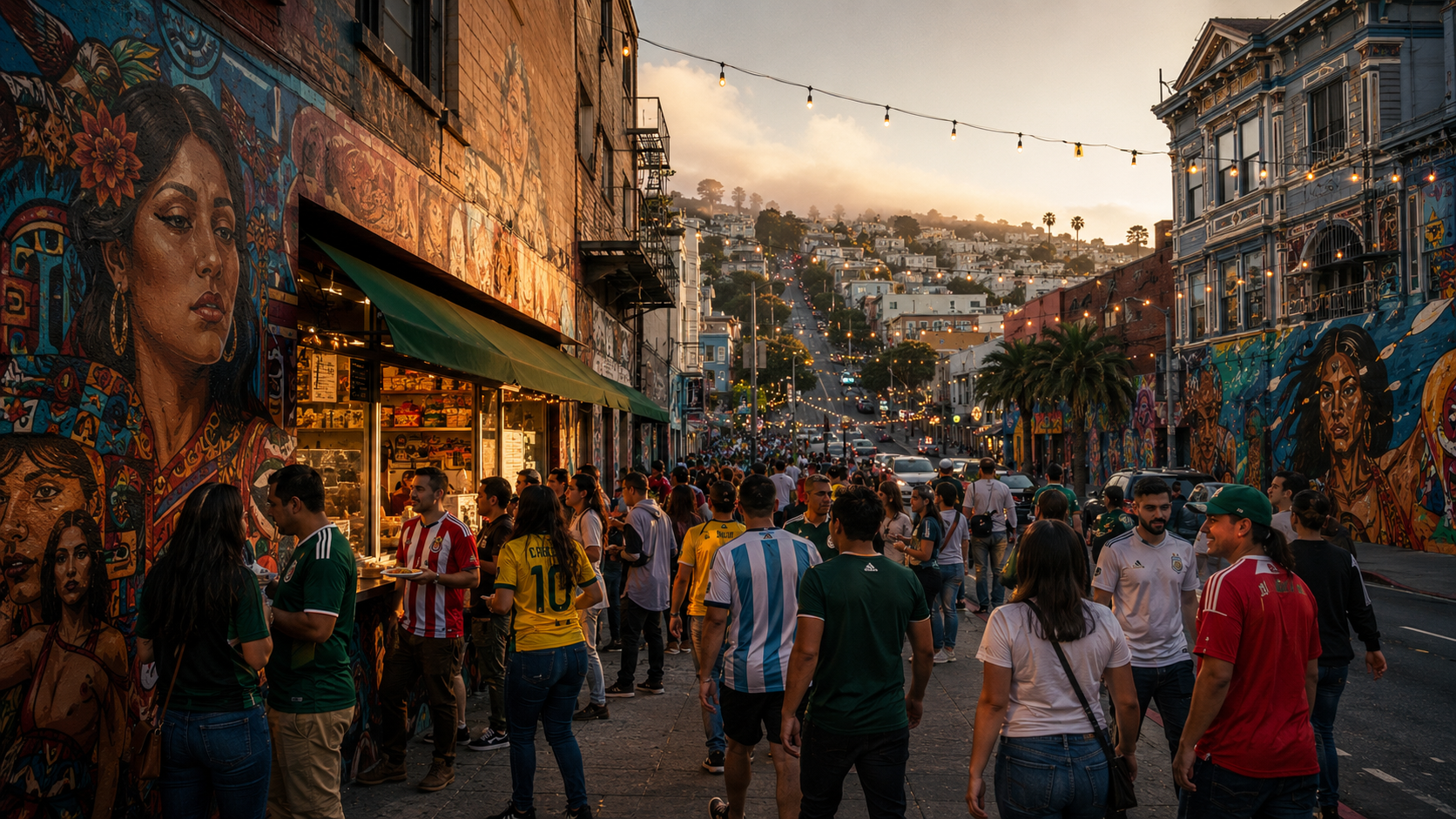
For fans in San Francisco without match tickets, the Mission District on a night when a Latin American team is playing is the most atmospheric alternative. On a match evening when you don't have a ticket, find a bar in the Mission showing the game. The neighborhood will tell you which one.
San Francisco's Neighborhoods
The Mission District
The Mission is San Francisco's most vivid neighborhood — a dense grid of taquerias, murals, bars, and restaurants that runs along Mission Street and Valencia Street and spills outward in every direction. La Taqueria on Mission Street is frequently cited as the best burrito in the United States. The Mission-style burrito — rice, beans, meat, sour cream, guacamole, wrapped in a large flour tortilla and foil — was invented here, in this neighborhood, and La Taqueria and El Farolito represent the form at its clearest. On a night when Mexico, Argentina, Colombia, or any of the Latin American teams in the tournament is playing, the Mission generates an atmosphere that no official fan zone can approximate.
The murals on every available wall have been accumulating since the 1970s, when Chicano artists began using the neighborhood's building facades as the canvas for a visual tradition rooted in Mexican muralism, civil rights, and community identity. Balmy Alley and Clarion Alley are the densest concentrations — walking them is reading a fifty-year political and cultural document written by a community that has been in this neighborhood long enough to have watched the city change around it repeatedly. That tradition is inseparable from the neighborhood's football culture. The same walls that carry Diego Rivera's influence carry the flags of the teams playing in Santa Clara this summer.
Chinatown and North Beach
San Francisco's Chinatown is the oldest in North America — Grant Avenue and the surrounding blocks carrying the full weight of that history in herbal shops, dim sum restaurants, and a density of community that has survived everything the city has thrown at it, which has been considerable. Weekend dim sum at Good Mong Kok Bakery or City View Restaurant is the correct way to spend a morning between matches. North Beach, immediately adjacent, is San Francisco's Italian neighborhood — Vesuvio, City Lights Bookstore, the ghost of the Beat Generation, and Maggie McGarry's, a legendary North Beach pub known for opening early for global soccer matches.
Japantown
Japantown and Western Addition/Fillmore are important cultural enclaves in the western neighborhoods of the city. For the Japanese fan base following Japan's group stage match against Germany on June 22, Japantown offers a neighborhood with genuine community roots — the Japan Center mall, ramen restaurants, Japanese grocery stores, and the Peace Plaza. Wako, in the nearby Richmond District on Clement Street, has a Michelin star for Japanese omakase that represents the upper register of what the Bay Area's Japanese culinary tradition produces.
The Richmond District
The Richmond, running west toward Golden Gate Park, carries a mix of Chinese, Russian, and Southeast Asian communities that the tourist map of San Francisco largely ignores. Clement Street is the neighborhood's main commercial artery — dense with restaurants, bakeries, and the kind of local commerce that has been here long enough not to need explaining. Golden Gate Park, which runs the full width of the neighborhood, contains the Japanese Tea Garden, the de Young Museum, and the California Academy of Sciences within its 1,017 acres. It is, on any afternoon between matches, the best place in the city to be.
Oakland
Oakland, across the bay, is more affordable and has a cultural identity that San Francisco's tech-money era has not absorbed or softened. BART connects it to San Francisco in twenty minutes. The city's foundational role in West Coast hip-hop — Too Short, MC Hammer, E-40, the years Tupac spent here before Los Angeles claimed him — runs through Oakland's self-understanding in a way that visitor guides rarely acknowledge but locals never forget. The music is not nostalgia here. It is provenance. The Temescal neighborhood has become one of the Bay Area's most interesting dining corridors — Ethiopian, Eritrean, Korean, and Japanese restaurants alongside breweries and natural wine bars that have arrived in the last decade. Oakland's visual arts scene and its relationship to the Bay Area's transformation are genuinely different from San Francisco's — grittier, more contested, more honest about what has been lost.
The Food
The Bay Area's food reputation is deserved and specific. It is not the same food culture as Los Angeles or New York — it is California produce, Japanese technique, Mexican community cooking, and the particular willingness to take ingredients seriously that comes from being surrounded by some of the best farmland in the world.
The Ferry Building Marketplace, on the Embarcadero, is the organizing principle. Saturdays bring the full farmers market to the plaza outside — producers from across Northern California selling directly to the public. Inside, artisan food vendors operate year-round. The sourdough, the oysters from Hog Island (which operates a full oyster bar inside the building), the local cheeses, the Dungeness crab in season — the Ferry Building is the correct first stop for any visitor trying to understand what Northern California tastes like.
Cioppino — the Italian-American seafood stew that originated in San Francisco, built around Dungeness crab, clams, mussels, and shrimp in a tomato broth — is the dish most specific to this city. Scoma's at Fisherman's Wharf has been doing it since 1965. Clam chowder in a sourdough bread bowl at Boudin Bakery near Fisherman's Wharf is the more accessible version of the same Pacific tradition.
For the full Bay Area picture: La Taqueria in the Mission (burritos). Wako in the Richmond (omakase, book weeks ahead). Any dim sum on a weekend in Chinatown (arrive at opening). Chez Panisse in Berkeley — Alice Waters's restaurant, which has been defining California cuisine since 1971 — for anyone willing to make the BART trip across the bay and plan a week in advance for a reservation.
The Bay and Beyond
The Golden Gate Bridge is not primarily a tourist attraction. It is infrastructure — a working bridge carrying 100,000 vehicles a day — that happens to be one of the most beautiful things ever built. Walk across it. The 1.7-mile crossing takes approximately 45 minutes and provides views of the bay, the Marin Headlands, and the city that no observation deck can replicate. The bridge has a free walking path on the east side. Go in the morning before the fog burns off entirely and the light is still doing what it does at that hour over San Francisco Bay.
Alcatraz requires advance booking — the ferry sells out weeks ahead during summer. The island is worth the plan: the prison tours narrated by former inmates and guards are among the most unusual audio experiences available at any tourist site in the United States, and the views of the city from the island are the best available from the water.
Napa Valley is 90 minutes north. If you have a day between matches, rent a car or take the BART and ferry combination to Vallejo and bus from there. June and July are warm and dry in wine country — the best time of year to be there.
What It Costs
San Francisco is one of the most expensive cities in the United States. Accommodation costs reflect that. Oakland and San Jose are the affordable alternatives that do not compromise transit access.
| Clipper card (one-time) | $3 |
| Caltrain + VTA to stadium | ~$12–$18 round trip |
| Mission burrito, La Taqueria | $12–$16 |
| Dim sum, weekend Chinatown | $20–$30/person |
| Group stage ticket, mid-tier | $250–$500 |
| Hotel, San Francisco (mid-range) | $250–$450/night |
| Hotel, San Jose/Santa Clara | $150–$280/night |
Hotels near the stadium triple rates during FIFA World Cup matches. Staying in San Francisco gives you better dining, nightlife, and easier access to soccer bars where fans gather before and after games. San Jose splits the difference — closer to the stadium and cheaper than the city.
🏨Find Hotels
Book on Hotels.com
Hotel links are affiliate links. We earn a commission on completed stays at no extra cost to you.
Essential Information
Stadium San Francisco Bay Area Stadium (Levi's Stadium), Santa Clara. 69,391 capacity. 6 matches: 5 group stage (including USMNT June 19, Japan vs Germany June 22), Round of 32 July 1.
Transport Caltrain from San Francisco to Mountain View → VTA Light Rail to Great America Station. ~90 mins from downtown SF. Clipper card for all transit. SJC airport is 4 miles from stadium — check before booking SFO. OAK: BART to Milpitas → VTA Orange Line, ~60 mins.
Fan zones BAHC Live! at 30+ venues across the Bay Area. Thrive City at Chase Center, San Francisco. San Pedro Square Market, San Jose. No registration required.
Neighborhoods Mission District (Latin community, best burritos, match-night atmosphere). Chinatown/North Beach (oldest Chinatown in North America, dim sum, Maggie McGarry's). Japantown/Richmond (Japanese community, Golden Gate Park). Oakland (affordable, BART-connected, Temescal dining).
Food La Taqueria, Mission (best burrito in the US). Ferry Building Marketplace, Embarcadero (Saturday farmers market, Hog Island oysters). Wako, Richmond District (Michelin-starred Japanese omakase, book ahead). Scoma's, Fisherman's Wharf (cioppino since 1965). Good Mong Kok Bakery, Chinatown (weekend dim sum). Chez Panisse, Berkeley (California cuisine, book weeks ahead).
Bars Maggie McGarry's, North Beach (opens early for soccer). Mission District broadly for Latin match nights. Temescal, Oakland for post-match neighborhood feel.
Between matches Golden Gate Bridge walk (free, east walkway). Alcatraz (book weeks ahead). Ferry Building Saturday market. Golden Gate Park (Japanese Tea Garden, de Young, Cal Academy). Napa Valley day trip (90 mins, rent a car or BART/ferry to Vallejo).
Weather June mornings cool and foggy, clearing by afternoon — bring layers. Stadium in Santa Clara runs 15-20°F (8-11°C) warmer than the city. No rain expected in July. Evenings cool quickly after sundown.
Airports SJC (4 miles from stadium, best for match days). SFO (BART to Millbrae → Caltrain → VTA, ~90 mins to stadium). OAK (BART → VTA, ~60 mins to stadium).