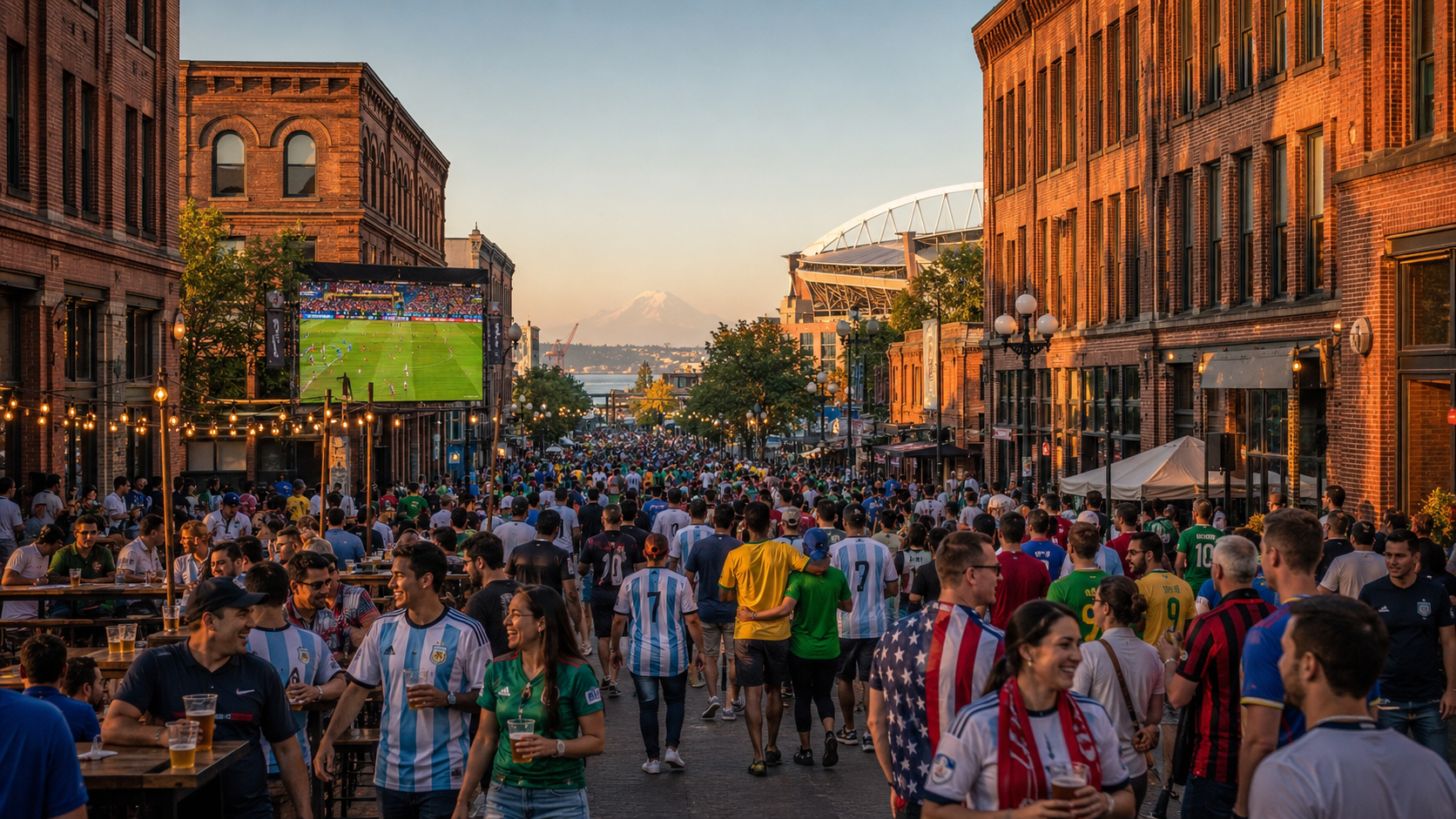
July in Seattle is the city at its best. The rain that defines the other nine months of the year retreats, the skies clear, and the light over Puget Sound and Elliott Bay has a quality that photographers from other cities spend entire careers trying to replicate elsewhere. Mount Rainier — 14,411 feet of glaciated volcano rising southeast of the city — appears on the horizon on clear days, a reminder that the Pacific Northwest exists at a different scale from the places most of the visiting fans will have come from. The city is compact, walkable, and genuinely beautiful in ways that its coffee-and-tech reputation does not quite capture.
Seattle also has one of the most authentic football cultures in the United States. The Seattle Sounders are not a franchise built to absorb a World Cup. They are a club with genuine roots, one of the best-supported in MLS, with supporter groups — ECS, Gorilla FC — that have been standing, singing, and creating atmosphere at Lumen Field for years. When the World Cup arrives at the same ground, it inherits an infrastructure of football passion that most host cities in this tournament cannot claim.
Six matches. Four group stage. A Round of 32. A Round of 16. The stadium is ten minutes on the light rail from anywhere in downtown. The seafood is as good as it gets in the United States. The coffee was never just a Starbucks story.
The Stadium
Seattle Stadium — the tournament name for Lumen Field — sits in the SoDo district, just south of downtown, beside T-Mobile Park where the Mariners play. It holds approximately 69,000 for World Cup matches on a purpose-installed natural grass pitch — laid over a specialized 12-inch sand base, which tells you something about the care Seattle has taken with this. One of the loudest stadiums in North American sports in its regular configuration as an NFL and MLS venue. Six World Cup matches, including the USMNT group stage fixture and knockout rounds on July 2 and July 7, will test that reputation at a different frequency.
The stadium's location is an asset. It is not in a suburb or a stadium complex isolated from the city. It is south of downtown, adjacent to Pioneer Square, a ten-minute walk from hotels, and directly on the Link Light Rail line. Arriving by train and walking to the ground through Pioneer Square's historic brick streets is, by most measures, the best pre-match experience of any US host city.
Getting There
The Link Light Rail's 1 Line stops at Stadium Station, steps from the gates. The journey from downtown Seattle takes approximately ten minutes. From Seattle-Tacoma International Airport, the 1 Line runs directly to Stadium Station — no transfers, around forty minutes, $3.25. Buy an ORCA card at SEA-TAC on arrival ($5 card fee, then load value as needed) — it works across the entire Sound Transit network: light rail, buses, the streetcar, and the Washington State Ferries.
Light rail is the overwhelming recommendation for all Seattle World Cup matches. Parking exists but adds cost, stress, and significant post-match delay that is completely avoided by taking the 1 Line. Pioneer Square's streets around the stadium will be pedestrianized on match days, with large-screen watch parties and a beer garden operating in the open air. The walk from Stadium Station through that pedestrian zone is itself part of the experience. It is transport that happens to be spectacular.
🏨Find Hotels
Book on Hotels.com
Hotel links are affiliate links. We earn a commission on completed stays at no extra cost to you.
Pioneer Square and the Match-Day District
Pioneer Square is Seattle's oldest neighborhood — Richardsonian Romanesque brick buildings, art galleries, underground passages from before the Great Seattle Fire of 1889, and a relationship to sport that comes from decades of sitting between two professional stadiums. On World Cup match days it becomes a pedestrian zone: large screen, stage, beer garden, street closures designed to keep fans in the neighborhood rather than simply passing through on the way to their seats.
The neighborhood has built a QR code ordering system for match days, allowing visitors to order food from Pioneer Square and Chinatown-International District restaurants without leaving the fan zone. Café Hitchcock for breakfast before an early kickoff. Top Pot Doughnuts for the morning crowd. Taylor Shellfish Oyster Bar for Pacific Northwest seafood at its most direct — the oysters come from Taylor's own farms and arrive at the bar fresher than anywhere else in the city.
The adjacent Chinatown-International District (C-ID), one stop on the Link from Stadium Station, is where Seattle's Vietnamese, Japanese, Chinese, Korean, and Filipino communities have been concentrated for over a century. For the South Korean, Japanese, and Australian fan bases in particular — all of whom play matches in Seattle — the C-ID offers a neighborhood whose food and culture reflects a genuine connection to the game's most passionate Asian communities. The food there does not require a World Cup to be good. It has been good for decades.
The City's Fan Zone Network
Seattle replaced a single centralized fan festival with the Unity Loop — a network of fan zones spread across the city's neighborhoods, intended to bring the tournament's energy into the urban fabric rather than concentrate it in one official site.
Seattle Center hosts the main fan celebration — the Let's Play SEA '26 hub, with large-screen broadcasts, cultural performances, and food vendors throughout the tournament. Seattle Center is also where the Space Needle is, where the Chihuly Garden and Glass is, and where the Pacific Science Center sits. Getting there from downtown takes the Seattle Monorail from Westlake Station — two minutes, $3.50 each way, one of the more charming transit options available at any World Cup.
Beyond Seattle Center: Waterfront Park along Elliott Bay for outdoor screenings, Pacific Place in downtown (Seattle Soccer House), and Victory Hall in SoDo for the match-day pre and post atmosphere nearest the stadium.
The Neighborhoods
Capitol Hill
Capitol Hill is Seattle's most vibrant neighborhood — LGBTQ+ culture, independent bookstores, some of the city's best coffee, and a nightlife infrastructure that stays busy well after any match ends. The Starbucks Reserve Roastery on Pike Street is the full expression of what Seattle's coffee culture is when it takes itself seriously — single-origin sourcing, elaborate brewing methods, a building designed around the process. It is, whatever you think of the corporation, genuinely impressive as a coffee experience. Link light rail stops at Capitol Hill Station and connects directly downtown and to the stadium.
Ballard
Ballard, northwest of downtown, has Scandinavian heritage roots and a neighborhood character that has survived the tech-money transformation better than many Seattle districts. Norway and Sweden are both in this tournament. Ballard's seafood restaurants and breweries — Stoup Brewing, Reuben's Brews, Populuxe Brewing — carry a neighborhood feel that SoDo and Pioneer Square do not have on match days. The Burke-Gilman Trail runs through it. The farmers market on Sunday mornings is one of the better ones in the Pacific Northwest.
South Lake Union
Tech money has changed South Lake Union thoroughly, but the waterfront walking along Lake Union and the seaplanes taking off from the water remain genuine. The Seattle Streetcar connects it to Capitol Hill and downtown. Worth knowing as accommodation territory if central hotels are sold out.
The Food and the Water
Pike Place Market is not primarily a tourist attraction. It is a working public market that has been operating since 1907, where farmers, fishmongers, and craftspeople sell directly to the public. The fish-throwing is real and has been going on since the 1980s. The original Starbucks — a small, crowded shop at 1912 Pike Place — is real and worth a brief visit for the context, not the coffee. The oysters, the Dungeness crab, the salmon, and the halibut are the reasons to go.
Seattle's seafood claim is not hyperbole. The city sits at the intersection of Pacific salmon, Puget Sound shellfish, and Dungeness crab season, and the quality difference between eating seafood here and eating it anywhere inland is significant. Ivar's on the waterfront, established in 1938, serves fish and chips directly on the pier with seagulls performing their own commentary overhead. It is not a fine dining experience, and that is entirely the point.
For something more deliberate: Communion Restaurant & Bar brings soulful, globally-inspired cooking to the Capitol Hill neighborhood. Café Selam for Ethiopian on Capitol Hill. Nirmal's for upscale Indian in Pioneer Square, with strong vegan options. Ezell's Famous Chicken, a Seattle institution, for the quick meal between matches that requires no decision more complex than which piece.
On the Water
The Washington State Ferry system is the largest in the United States, and riding it is free in the direction toward the islands — you pay on the return. The Bainbridge Island crossing takes thirty-five minutes each way across Elliott Bay, with the Seattle skyline receding behind you and the Olympic Mountains appearing ahead. It is not a tourist activity dressed as transport. It is transport that happens to be spectacular.
Between matches, if you have a day, Mount Rainier National Park is two hours southeast. The park entrance alone — the mountain filling the windshield, the alpine meadows at Paradise, the glaciers visible at elevation — justifies the drive. Seattle sits inside a geography that rewards anyone willing to leave the city for half a day.
What It Costs
Seattle is mid-range among US host cities — more expensive than Kansas City and Atlanta, less expensive than New York and Los Angeles.
| Link Light Rail, airport to stadium | $3.25 |
| ORCA card (one-time) | $5 |
| Oysters, Taylor Shellfish | $3–$5 each |
| Meal, Pike Place Market area | $15–$25 |
| Drinks, Capitol Hill bar | $10–$15 |
| Group stage ticket, mid-tier | $250–$500 |
| Hotel, Downtown/Pioneer Square | $180–$320/night |
Find Hotels
Book on Hotels.com
Hotel links are affiliate links. We earn a commission on completed stays at no extra cost to you.
Essential Information
Stadium Seattle Stadium (Lumen Field), SoDo district. ~69,000 capacity. 6 matches: 4 group stage including USMNT, Round of 32 (July 2), Round of 16 (July 7).
Transport Link Light Rail 1 Line to Stadium Station — 10 mins from downtown, 40 mins from SEA-TAC, $3.25. ORCA card for all Sound Transit services. No driving on match days.
Fan zones Unity Loop: Seattle Center (Let's Play SEA '26, main fan hub, Space Needle adjacency). Waterfront Park. Pacific Place/Seattle Soccer House. Victory Hall, SoDo. Pioneer Square pedestrian zone (large screen, beer garden, match days only).
Neighborhoods Pioneer Square/SoDo (stadium adjacency, historic streets, match-day hub). Chinatown-International District (Asian food, adjacent to Pioneer Square). Capitol Hill (nightlife, coffee, Link connected). Ballard (breweries, seafood, Scandinavian character). South Lake Union (waterfront, accommodation overflow).
Food Pike Place Market (seafood, produce, working market since 1907). Taylor Shellfish Oyster Bar, Pioneer Square (direct from the farm). Ivar's Acres of Clams, waterfront (fish and chips on the pier since 1938). Communion, Capitol Hill (globally-inspired). Café Selam, Capitol Hill (Ethiopian). Ezell's Famous Chicken (Seattle institution).
Bars Pioneer Square broadly (match-day hub). Gorilla FC and ECS supporter groups active at Lumen Field. Stoup Brewing and Reuben's Brews, Ballard. Firn, rooftop, Populus Hotel (panoramic skyline views).
Between matches Washington State Ferries to Bainbridge Island (35 mins, pay return only). Mount Rainier National Park (day trip, 2 hrs). Underground Tour, Pioneer Square. Space Needle and Seattle Center.
Weather July is Seattle's driest and sunniest month. Highs around 75°F (24°C), low humidity. No afternoon thunderstorms. The best weather in the Pacific Northwest all year. Bring a light layer for evenings.