Most football cities have a derby. Liverpool has a family argument that happens to be scheduled twice a season.
There were not always two clubs. There was one — Everton, founded in 1878, playing first on Stanley Park and then at a ground on Anfield Road — until a rent dispute in 1892 split it in two. Everton walked away to build Goodison Park. John Houlding, the brewer left holding an empty ground, founded a new club to play in it, and Liverpool FC began. Every Merseyside derby since is a rematch of that divorce, which may be why it has historically been the friendliest one in England: red and blue in the same families, the same streets, sometimes the same houses. The split runs through households, not between neighbourhoods.
For 133 years the geography expressed it perfectly. Anfield and Goodison Park stood on either side of Stanley Park, a short walk apart — two grounds close enough that you could hear the other one's crowd. Derby day was a park crossed in both directions, mixed scarves on the same paths, and then home again to relatives who supported the other lot.
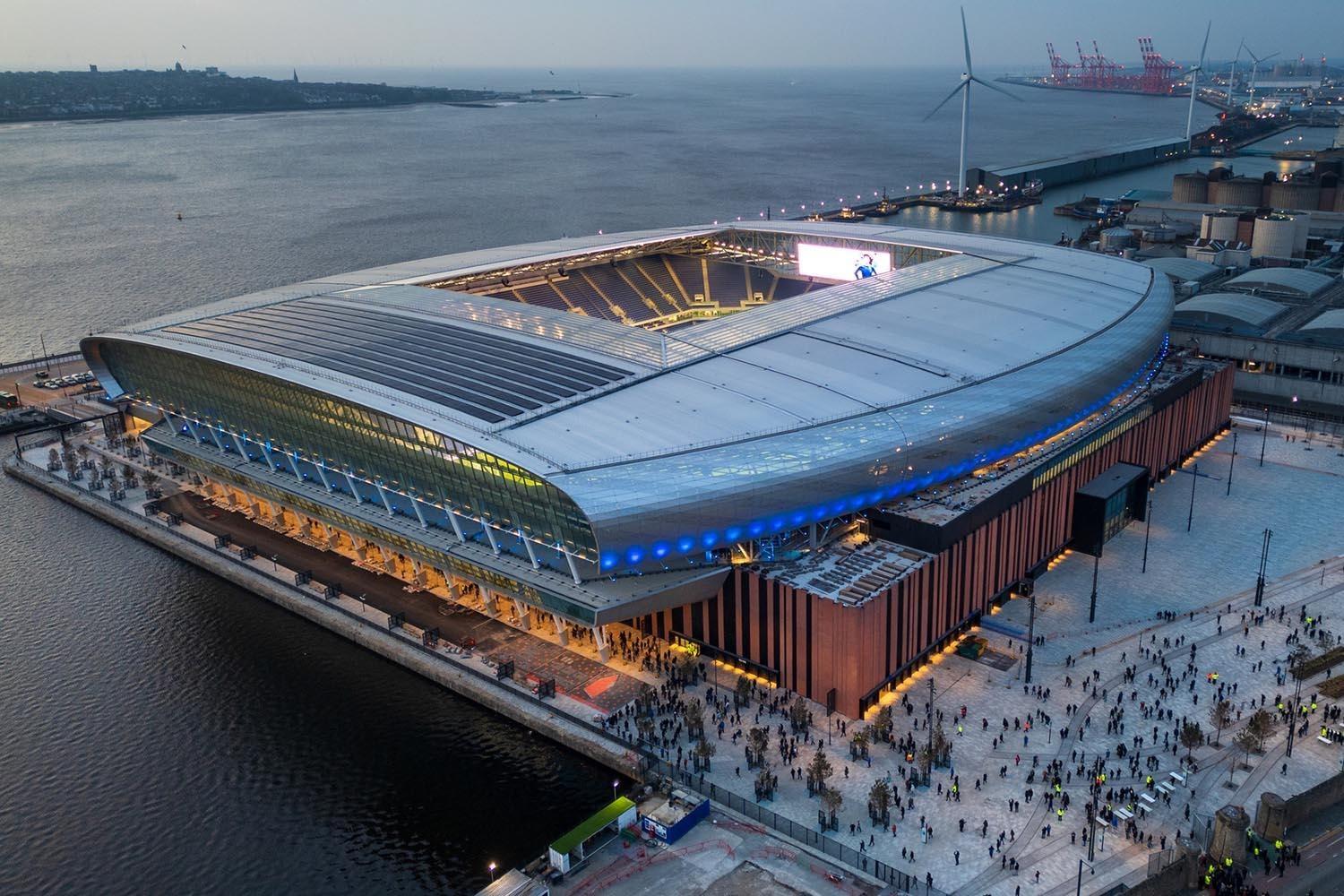
That geography ended in 2025. Everton left Goodison — the men's team played its last match there in May of that year, a 2–0 win over Southampton, and the ground is now the home of Everton Women — and moved two miles north to a new stadium on Bramley-Moore Dock, on the waterfront. This Sunday's derby, Everton at home to Liverpool with a noon kickoff, is played at the dock, not across the park. The derbies have always alternated between the two grounds; what has changed is that Everton's home derby has moved house — the fixture's centre of gravity has travelled, down to the water.
So the map a visitor needs has changed. Anfield's hill still works the way it always has. The dock is building its own matchday culture from near-scratch, around a handful of old dock pubs suddenly standing opposite a 52,769-seat stadium. And the city centre — Dale Street, the old commercial quarter — is where the two tribes have always mixed, and where Evertonians now begin and end the walk to the water.
What follows is arranged as a route, not a ranking: from Anfield, where the whole story started, down to the dock, and back into town.
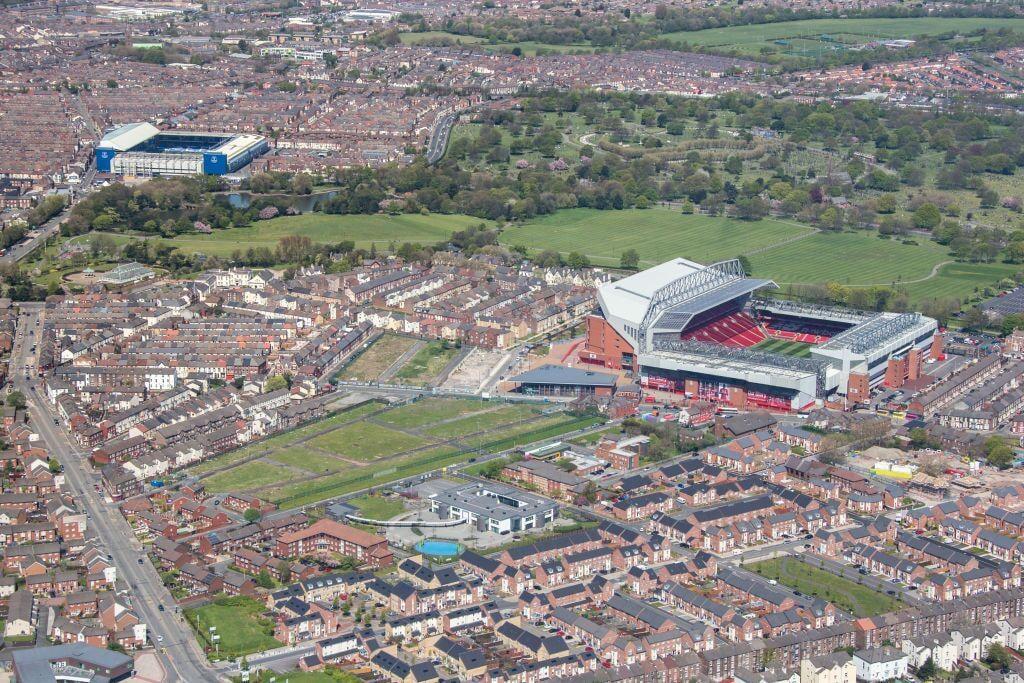
Anfield is the older world and the denser one. The streets around the ground are terraced, residential and entirely given over to football on a matchday; the pubs here are not sports bars that happen to be near a stadium, they are the stadium's outer rooms. Expect them full two to three hours before kickoff, and expect them red.
The dock is the opposite: an industrial waterfront that until recently had almost no football culture at all, because it had almost nothing at all. Regent Road, the old dock road, is where the new one is forming — a short strip of pubs and fan spaces facing the stadium, filling earlier every month as the routines set in.
The city centre is neutral ground in the way only a commercial district can be. The pubs off Dale Street serve office workers in the week and both tribes at the weekend, and for a visitor without a ticket — which, as we will come to, is most visitors — they are the most reliable football rooms in the city.
The Sandon
Oakfield Road, Anfield — Supporters' gathering place
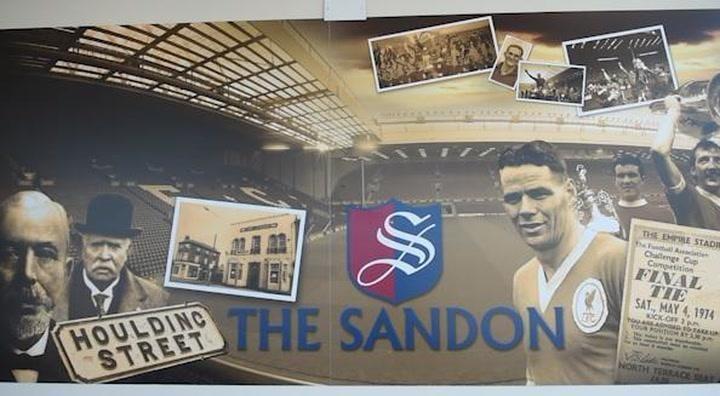
Start where the clubs did. The Sandon is John Houlding's old hotel, built in 1870 on Oakfield Road, a few minutes' walk from Anfield. Everton held their meetings here in the 1880s; the players changed here before matches; and when the split came in March 1892, it was here that Houlding set about founding the club that became Liverpool FC. There is a function room named the Houldings Suite, and there is no other pub in England where you can drink in the room a football club was argued into existence.
Today it is a big, practical matchday operation — several bars and function rooms, crowds arriving in waves off the buses — and it is routinely voted among the best Liverpool matchday pubs by the people who use it. Come for the history, stay because it is genuinely good at handling a crowd. It is a home-fans' room, and on the biggest fixtures the Anfield pubs can ask to see a home ticket; plan accordingly.
The Albert
Walton Breck Road, alongside the Kop — Pre-match atmosphere
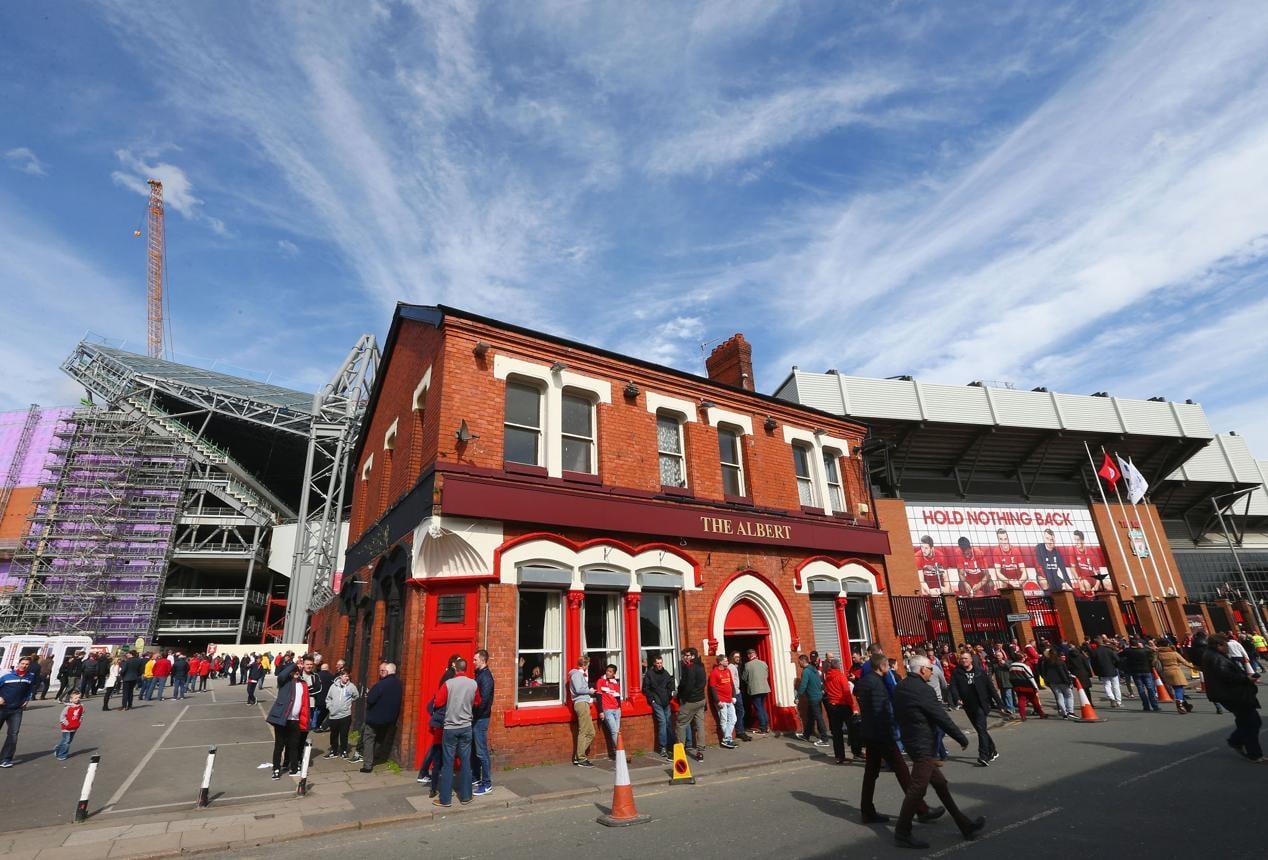
The Albert stands on Walton Breck Road practically in the Kop's shadow, and it is the Anfield ritual in its purest form: scarves and flags across the walls and ceiling, the anthems already being sung a couple of hours before kickoff, and a crowd that treats the pub as the first half of the match. Reviewers who go once tend to use the word "essential" and then go again.
It is not refined and does not want to be. You come here to stand in the noise and feel the day build; if you want to actually analyse a match on a screen in peace, this is the wrong room, gloriously. Home supporters, almost exclusively — visiting fans are pointed, by long custom and by the club guides alike, down the road to the Arkles.
The Arkles
Anfield Road — Watch the match · Supporters' gathering place (away)
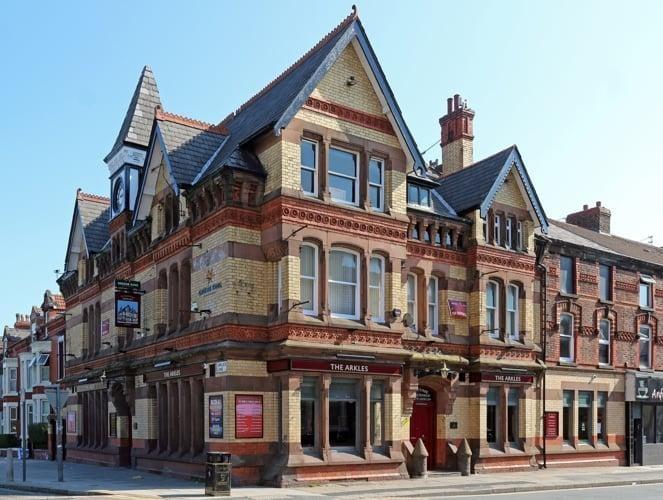
Every ground needs one pub where the away fans go, and Anfield's is the Arkles, a Greene King house on Anfield Road a few minutes from the away end. It has been the designated away supporters' pub for years, endorsed by visiting supporter clubs, and it runs a genuinely mixed room — home and away fans, food, actual seats, and live sport on the screens.
The caveats are the usual ones, applied kindly: it fills from a couple of hours before kickoff, on higher-risk fixtures away colours may have to stay under a coat, and on the very biggest days you may be asked for a ticket. For a neutral who wants to watch the Anfield crowd rather than be inside it, this is also the shrewdest seat in the neighbourhood.
The Bramley Moore
Regent Road, opposite Hill Dickinson Stadium — Supporters' gathering place
The strangest and best story in Liverpool football pubs: a small dockers' pub on Regent Road that stood for decades facing a derelict dock, and woke up in 2025 facing a stadium. The Bramley Moore sits directly opposite Hill Dickinson Stadium, close enough that the walk is measured in seconds, and it has become the de facto headquarters of the new matchday — Everton memorabilia on the walls, two small bars, no food, and a crowd that arrives early because everyone has already worked out that it fills.
Around it, a strip is assembling itself in real time: the Bluehouse and the Terrace a few doors along, with big screens and a fan-park feel, and fan zones on the old timber yards. It is not yet Anfield's century-deep culture and does not pretend to be. But if you are going to the derby on Sunday, this is where the new Everton matchday actually lives, and the pub that waited longest for it deserves the first pint.
Fliers Indoor Golf
27 Vandries Street, on the waterfront — Watch the match
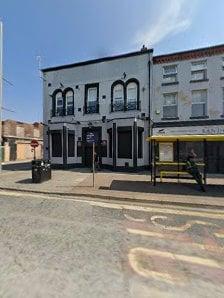
If the Bramley Moore is the romantic answer at the dock, Fliers is the practical one — and on a derby morning, practical has its own charm. It is an indoor golf simulator bar on Vandries Street, about ten minutes' walk from the stadium, that runs as a full match-day bar on Everton home games: big screens across the bar, a proper licence, cold pints, and doors open from 10am, every day, matchdays included.
Nobody will tell you it carries a century of history, because it doesn't. What it offers is the thing the older rooms cannot always promise: a screen you can actually see, room to stand, and a pint in hand well before kickoff — the bar takes walk-ins, no booking needed. For a visitor whose first priority is simply to watch the derby properly, ten minutes from the ground, it may be the least stressful plan in this guide.
The Denbigh Castle
Hackins Hey, off Dale Street — Watch the match
Down a cobbled lane off Dale Street — one of Liverpool's original seven streets — the Denbigh Castle has been pouring since at least 1815. It closed, drifted, and was reopened under its original name in 2020, and it is now the connoisseur's city-centre football pub: German lagers, cask and craft beers, big matches on the screens, and a traditional wet-led room that feels like the city before football was an industry.
Its regulars lean Evertonian — it is a known pre- and post-match haunt for Blues heading to and from the dock, five minutes from Moorfields station — but it welcomes both loyalties and is proud of doing so. For a visitor, it may be the best room in this guide: historic, central, serious about beer, and showing the match. One honest caveat for a noon Sunday kickoff: the Denbigh's published Sunday hours start at 12pm, which is precisely when this derby kicks off. It may well open early for the occasion — pubs do — but check first, and if it is opening at noon, be at the door at noon.
Camp and Furnace
Greenland Street, Baltic Triangle — Big-screen event
At the other end of the scale entirely: a converted factory in the Baltic Triangle that turns itself into a Fan Park for the matches that matter — giant screens, festival sound, street food — and bills itself, with some justice, as the home of big-screen sport in Liverpool. The biggest fixtures are ticketed events rather than walk-ins, and the crowd is the whole city at once: red, blue and neither, watching together in a warehouse.
This is not where you go for a quiet pint and the team news. It is where you go when the match is an occasion — a final, a title race Sunday, a derby you could not get into — and you want two thousand people to feel it with. Check what's on before you build a night around it; on a quiet midweek it is, as its fans admit, a very large shed.
This is the section where naming a single bar would be a disservice.
Walton Breck Road and Anfield Road, the two streets that wrap the ground, function on a matchday as one continuous venue. The Park stands opposite the Albert; Taggy's brings a beer garden on Anfield Road; the Flat Iron gathers a mixed crowd further down; and Homebaked, the community bakery on Oakfield Road, feeds the queue that the pubs can't. The rooms blur into the street, the street into the stadium.
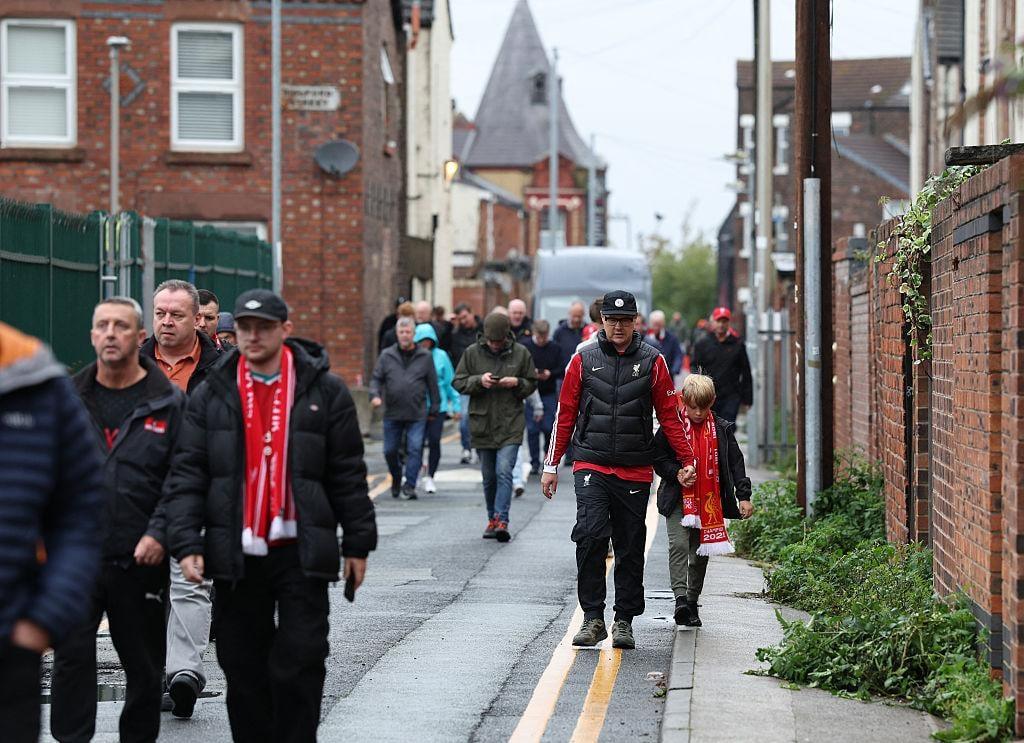
Practically, this means the advice for Anfield is different from the advice anywhere else in this guide. Do not over-plan a specific address. Get the bus up from the centre ninety minutes before kickoff, walk the strip, and choose your room by looking through the door. On a Liverpool matchday, the match is the strip's whole business — and there is no chance whatsoever of being confused about whose neighbourhood you are standing in.
You cannot simply turn up — to the grounds, at least. Neither club sells Premier League tickets on general sale. Anfield seats move through All Red membership, a credits system built on past attendance, and ballots, with returned seats appearing on the official Ticket Exchange for eligible members at face value; Everton's new ground runs the same way in blue — season ticket holders hold most of it, Forever Blue+ members enter a ballot first, remaining seats go to members, and the club's Official Resale is the legitimate second chance. Sunday's derby is already sold out by these routes, and official hospitality, sold by the clubs directly, is the honest route left for a one-off visitor.
Treat any other offer with suspicion. Unauthorised resale of football tickets is an offence in England and Wales, and both clubs warn that tickets from unofficial sources can be refused at the turnstile — and the dock stadium is digital-only and cashless besides. Which is, in the end, the argument for this entire guide: in Liverpool, being locked out of the ground still leaves you in some of the best football rooms in the country.
Kickoff times. Liverpool plays on UK time. The standard Premier League slots are Saturday at 12:30 PM, 3:00 PM and 5:30 PM, Sunday at 2:00 PM and 4:30 PM, and Friday or Monday at 8:00 PM; Champions League nights run at 5:45 PM and 8:00 PM. This Sunday's derby kicks off at noon — an early start that suits the pubs, which around both grounds fill from two to three hours before the whistle whenever the match is played.
Colors. The Merseyside derby is famously the one where the colours mix, and in the city centre they genuinely do. Around the grounds, read the room: the Anfield pubs are home-fan rooms that can ask for a home ticket on big days, the Arkles is the away fans' pub, and the Bramley Moore on a matchday is Everton's. Wear what you like in town; near the grounds, let the street tell you.
Verify before travelling. Ticketing windows, ballot dates and resale rules change by fixture, and pubs' matchday entry policies change with the opposition. Confirm the current arrangements on the clubs' official sites, and check a venue's own channels before you plan a day around it — especially for the derby, where everything in this guide will be busier than described.