Somewhere a phone is going off at twenty to three in the morning.
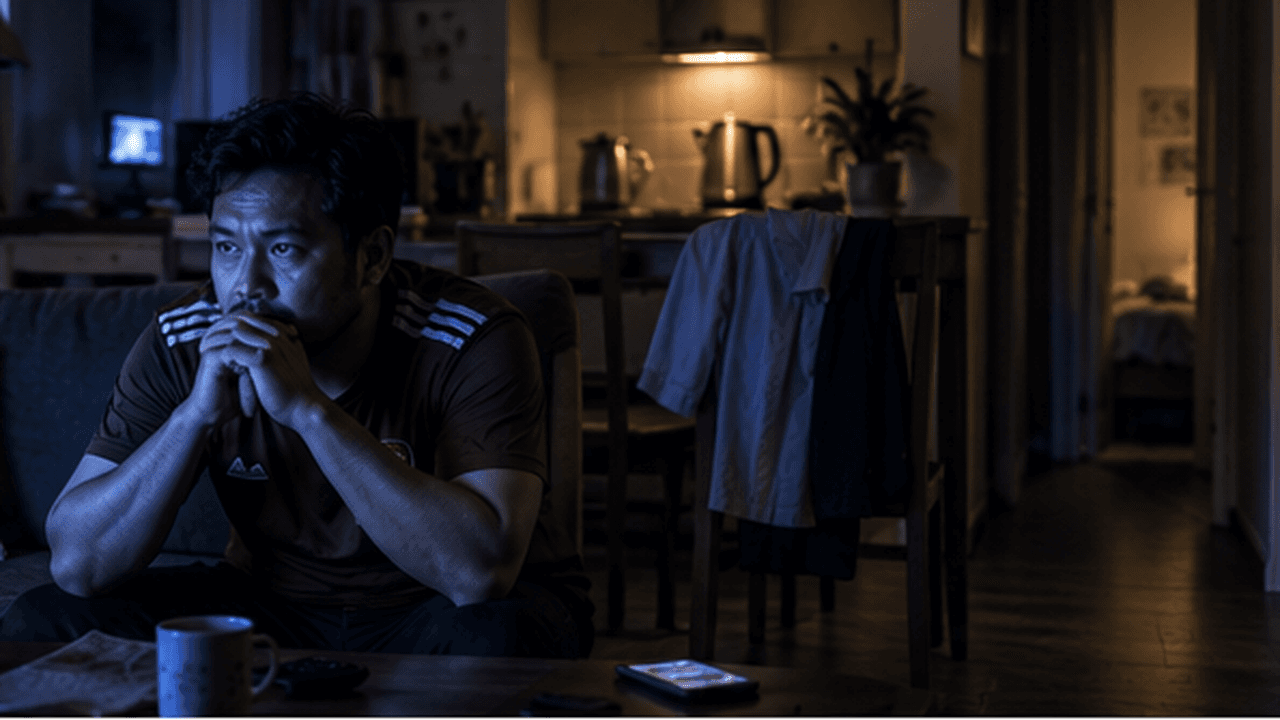
The man it belongs to set it himself, the night before, knowing exactly what he was doing. He has laid his work clothes over the back of the chair so he will not have to open the wardrobe at six. He gets up in the dark and goes and sits in front of a screen to watch twenty-two men he will never meet play a game in a city he has never visited, in a country he may never see, for a club that has no idea he exists.

The kettle is louder at that hour than it is in daylight. When the goal comes he celebrates it with his mouth open and no sound coming out, both arms up, alone, because there are children asleep down the hall. Somewhere around the seventieth minute the light starts arriving at the edges of the curtains, which always feels like being caught at something.

Then he goes to work.
This happens in Jakarta and Kuala Lumpur and Nairobi and a hundred cities like them, every week of the season, in numbers nobody has properly counted. It is one of the least discussed and most demanding forms of football support there is, and the people who do it are routinely patronized by people who have never had to do anything harder than walk to a ground.
The arithmetic
Why three in the morning, and how often
Start with the mechanics, because the mechanics are the whole thing.
English football schedules itself for English evenings and English Saturday afternoons, as it always has and as it commercially must. Jakarta is seven hours ahead of London. Kuala Lumpur is eight. So a Saturday three o'clock becomes a ten o'clock at night, which is survivable. The late Saturday kickoff becomes half past midnight. A Champions League tie beginning at eight in the evening in Europe begins at three in the morning in Indonesia and finishes at five, which is roughly when the call to prayer goes up, and about ninety minutes before a working day starts.
This is not a curiosity. Guinness Malaysia, the league's official beer there, described the situation earlier this year in the flat language of market research: kickoffs now fall regularly after midnight, sometimes as late as three, and following a team had become a "late-night commitment."
Do the sums over a season. Thirty-eight league games, plus cups, plus Europe. Call it fifty fixtures. Enough of them fall after midnight that across a season the lost sleep stops looking incidental, and across a supporting lifetime it accumulates into something a man would certainly notice if you handed it to him all at once.
Not a handful of eccentrics
The scale of the thing
It would be easier to dismiss if it were rare. It is not remotely rare.
Arsenal Indonesia Supporters was formed in 2004 and has since built a hundred regional branches across the country, with eleven thousand registered members. Their annual national gathering draws six hundred people. Every major English club has an equivalent, and Arsenal are not even the largest of them.
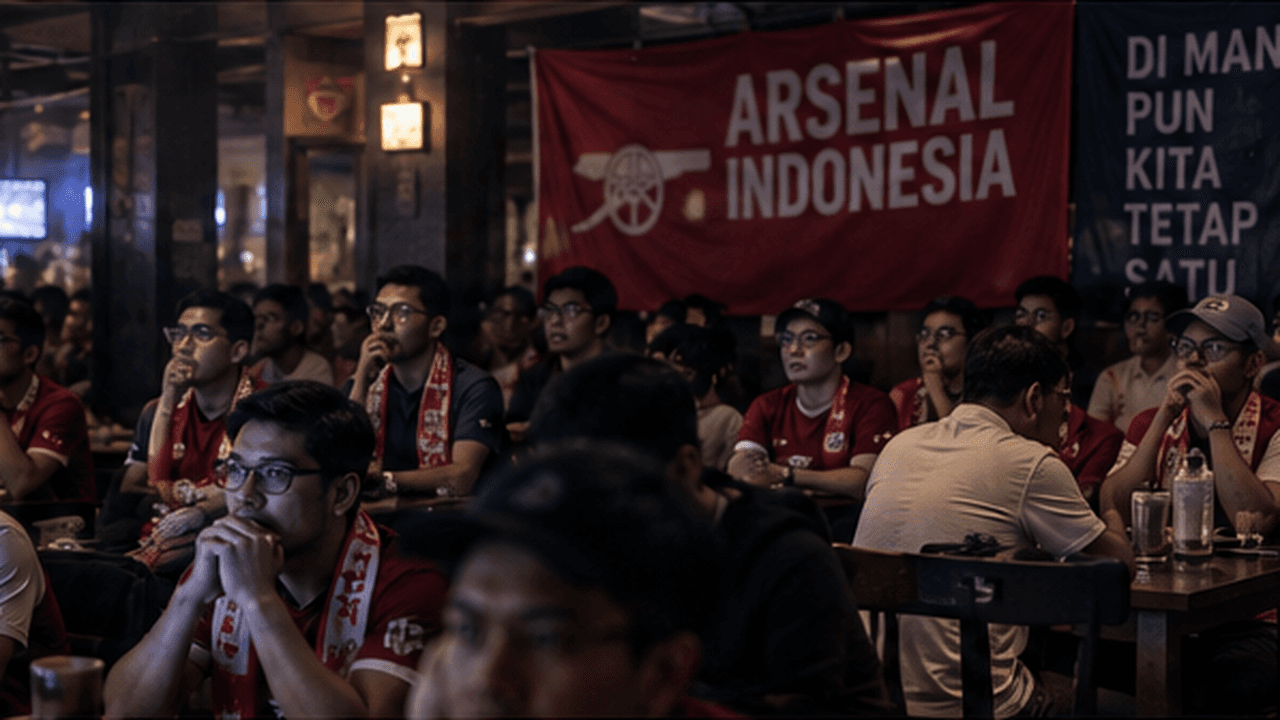
These are formal organizations with committees and regional secretaries and membership rolls. They run screenings. They do charity work. When Arsenal won the league in May, six hundred of them gathered in Jakarta to watch the final match and the coronation that followed, and somebody posted a photograph of it with a caption I have not been able to shake: North London Forever, even though we're thousands of miles away.
That is not a joke at their own expense. It is a statement of position.
What it costs, and what that proves
The one currency nobody can fake
Here is the thing I keep circling.
We have a settled hierarchy of footballing authenticity in this country, and it runs roughly: match-going season-ticket holder at the top, then the fan who goes when he can, then the armchair supporter, and then — somewhere near the bottom, spoken of with real condescension — the foreign fan who picked a club off the television. The assumption underneath it is that proximity equals legitimacy. That the further you are from the ground, the less it can possibly mean.
But look at what the hierarchy is actually measuring. If you were born in Islington to a family of Arsenal supporters, the original allegiance cost you no decision. It was ambient. You inherited it the way you inherited a surname and an accent, and the going is easy: the ground is a bus ride away, the match is on at a civilized hour, and every person you grew up with is doing the same thing. None of that is a criticism — that is how most support in the world works, it produces the deepest attachments there are, and over a lifetime it will cost a man a great deal in money and time and Saturdays. But the allegiance itself did not begin as a decision.
Set an alarm for twenty to three and it is nothing but decision. Nobody drifts into a three a.m. kickoff. There is no inertia carrying you there, no crowd, no habit of geography, nothing ambient about it whatsoever. You are choosing, individually, in the dark, to be tired tomorrow. And then choosing it again the following week.
Sometimes the alarm goes off and he turns it off. Sometimes he means to get up and does not, and finds the score on his phone at seven with a feeling he would struggle to justify to anyone, because nothing whatsoever depended on his being awake and he knows it. The guilt is absurd and entirely real.

Money can be inherited and geography is an accident.
Sleep is the one currency nobody can be born holding.
The permanent away end
What they will never have
I do not want to make this sound like a straightforward victory, because it plainly is not.
What those men and women have bought with all that sleep is a relationship that is, in one important respect, incomplete. They will almost certainly never stand in the ground. They will never do the thing the English fan does without thinking — the walk from the station, the same seat, the bloke behind who has been shouting the same thing since 1994. They know the club entirely through a screen, which means they know it as a broadcast product, edited and scored and sold to them by the same people who sold it to everybody else.
They are, in the sense this series takes its name from, permanently in the away end. Outnumbered, a long way from home, watching from the wrong side of something. Except that the away end at least eventually goes home, and these rooms never do.
Twenty to three
The choosing
None of that is the fault of a man with an alarm clock.
He did not design the fixture list or the broadcast rights or the seven-hour gap between his bed and the pitch. He was handed a version of caring that takes place against sleep and work and the clock, and he decided to care about it anyway, and then he kept deciding, week after week, for years, with no possibility of ever being thanked for it and no realistic prospect of ever seeing the thing in person.
There is a particular kind of English football conversation in which somebody says of a supporter overseas that he has never been to the ground, as though that settles it.
It settles something. Just not the thing the speaker thinks.

The phone goes off at twenty to three. There is no crowd to join, no station to walk from, no atmosphere doing any of the work. There is a dark room, a screen, and a man who has to get up in five hours making the same decision he made last week and will make again next week.
Nobody has ever had to talk him into it.
Also in The Away End: Strange Meeting — on the pubs and third places football has built everywhere else, and Games in Memory — on yards in Gaborone, where there was often no match to watch at all.