Four clubs remain in the 2025-26 Champions League. Arsenal face Atletico Madrid; Bayern Munich face PSG. All four share a structural characteristic that their eliminated rivals do not: a pressing system installed and refined over at least three consecutive seasons under the same tactical philosophy.
Four clubs remain in the Champions League. That sentence, stated plainly, tells you very little. Here is what it does not tell you: that all four clubs have had the same head coach for at least two full seasons. That all four ran PPDA figures — Passes Allowed Per Defensive Action, the cleanest proxy for pressing intensity — below 9.5 in the league phase. That the clubs who ranked first and second in pressing metrics during the league phase are both in the semi-finals. And that every club who installed a new manager last summer is watching from their sofa.
The clubs dominating Europe's knockout rounds share one thing: pressing intensity built over three or more seasons. Not one summer transfer window.
This is not coincidence. This is structure.
What We Mean When We Say Pressing
Pressing, in the way it is deployed by the game's best clubs, is not a tactic. It is a culture. The distinction is important and frequently confused.
A tactic can be installed in a week. You can tell a player where to stand, when to move, which trigger to react to. You can drill a high press in pre-season, run the shape until it looks correct in training, and produce something that resembles the thing you're trying to build. For roughly forty-five minutes of competitive football, it might even hold.
What you cannot install in a week — or a summer — is the decision-making underneath the tactic. The moment a defender receives the ball in his own third and the forward has to decide, without looking, whether his winger has begun a press or is holding, and whether the press will succeed or whether he should drop into a mid-block before the ball is played out — that decision happens in fractions of seconds and is made correctly only when the players involved have been making it together, repeatedly, for years.
Pressing requires shared understanding at the speed of competitive football. And shared understanding, at that speed, cannot be purchased. It has to be earned, repeatedly, in competitive matches, until it becomes muscle memory.
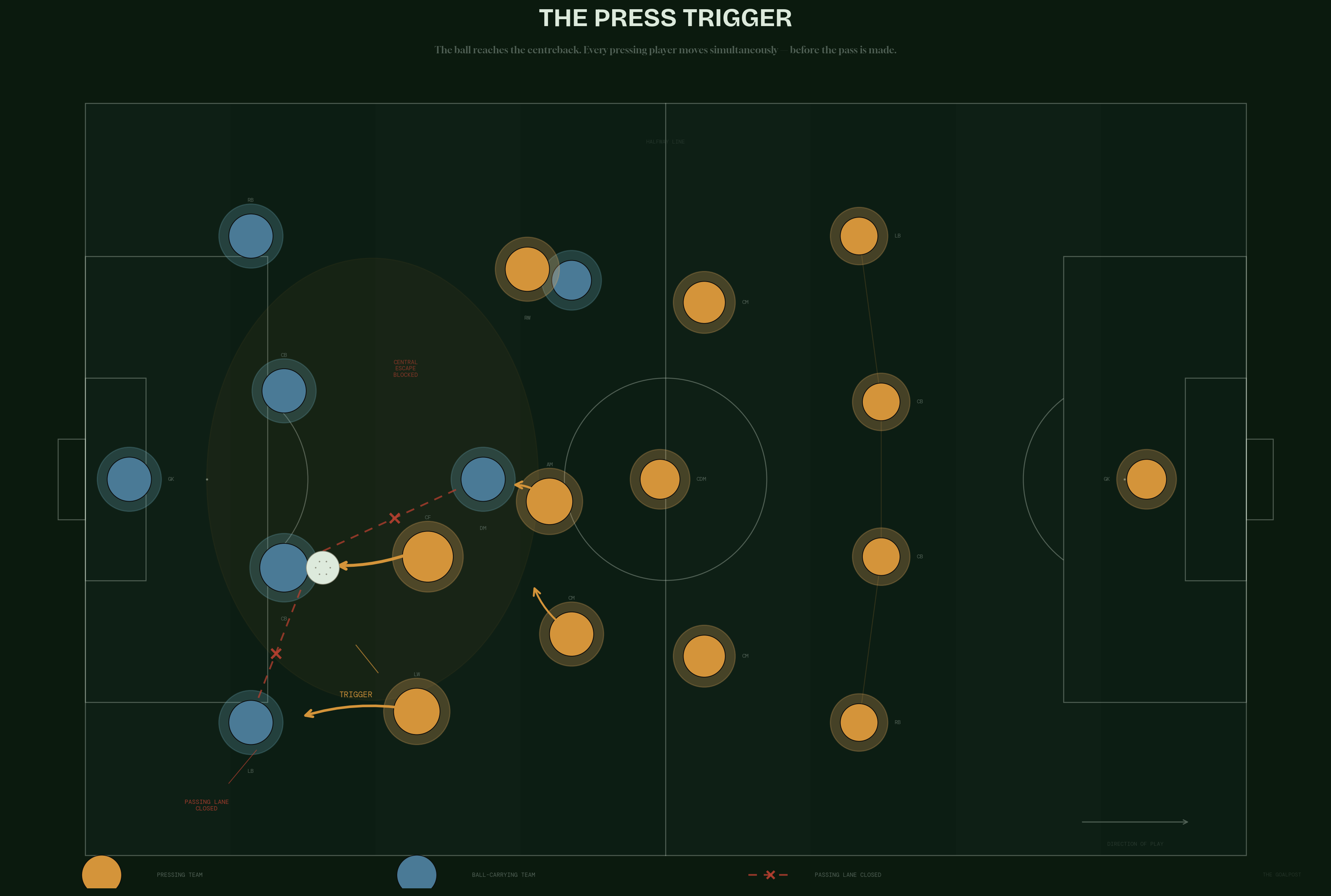
The press trigger. Every player moves simultaneously — before the pass is made.
The Numbers
PPDA displayed as raw values ×10 for visual comparison. Lower is more aggressive. Arsenal lead the competition at 7.2 raw; Atletico's mid-block-first approach explains their higher figure — this is deliberate system design, not passivity.
Several things are worth noting. Arsenal's press success rate — 38% of pressing sequences ending in a turnover — is the highest in the competition. Bayern's counterpressing data, specifically wins in the first fifteen seconds after possession loss, is exceptional. Atletico's PPDA sits higher than the other three, but their counterpressing wins per ninety — second best of the group — reflect a system built around winning the ball back in dangerous transition zones rather than forcing mistakes in the opponent's build-up.
And PSG. Their numbers are the least eye-catching of the four. They are also the most remarkable, given where they have come from.
Arsenal: Four Seasons of Installation
Mikel Arteta arrived at Arsenal in December 2019 with a philosophy and no margin for error. The press he wanted to play was, in his first season, visibly incomplete. Players were triggering at the wrong moments, leaving channels exposed, recovering poorly. You could see the idea. You could not yet see the execution.
Season two: the shape became recognisable. The triggers — a backpass to the goalkeeper, a centreback receiving under pressure from the near winger — became consistent. The press didn't always win the ball but it disrupted rhythm.
Season three: the pressing became directional. Rather than pressing everywhere at all times, Arsenal learned to press to one side, funnelling opponents toward a touchline, cutting off the easy escape. The results were immediate. They led the Premier League in PPDA by January.
Season four onward: it became automatic. Press success rate climbed each year not because the players changed — in many cases they didn't — but because the shared understanding deepened. Saka and Martinelli no longer needed to look at each other to synchronise a press trigger. Rice and Ødegaard no longer needed to communicate verbally to decide whether to hold or release. The decisions became embedded.
The press didn't change. The players' understanding of the press changed. That is a completely different thing, and it takes much longer.
That is four seasons. Most clubs are not willing to give a manager four seasons. The ones that aren't tend not to reach semi-finals.
Atletico: Fifteen Seasons and Still Evolving
Diego Simeone is now in his fifteenth season at Atletico Madrid. He is the argument that outlasts every argument against him.
The early Simeone system was purely reactive: two compact lines of four, space compressed through the centre, transition moments exploited with devastating precision. Critics — and there were many, some of them correct — said it was anti-football. They said it could not survive at the highest level. They said it was only effective against sides that wanted to play rather than grind.
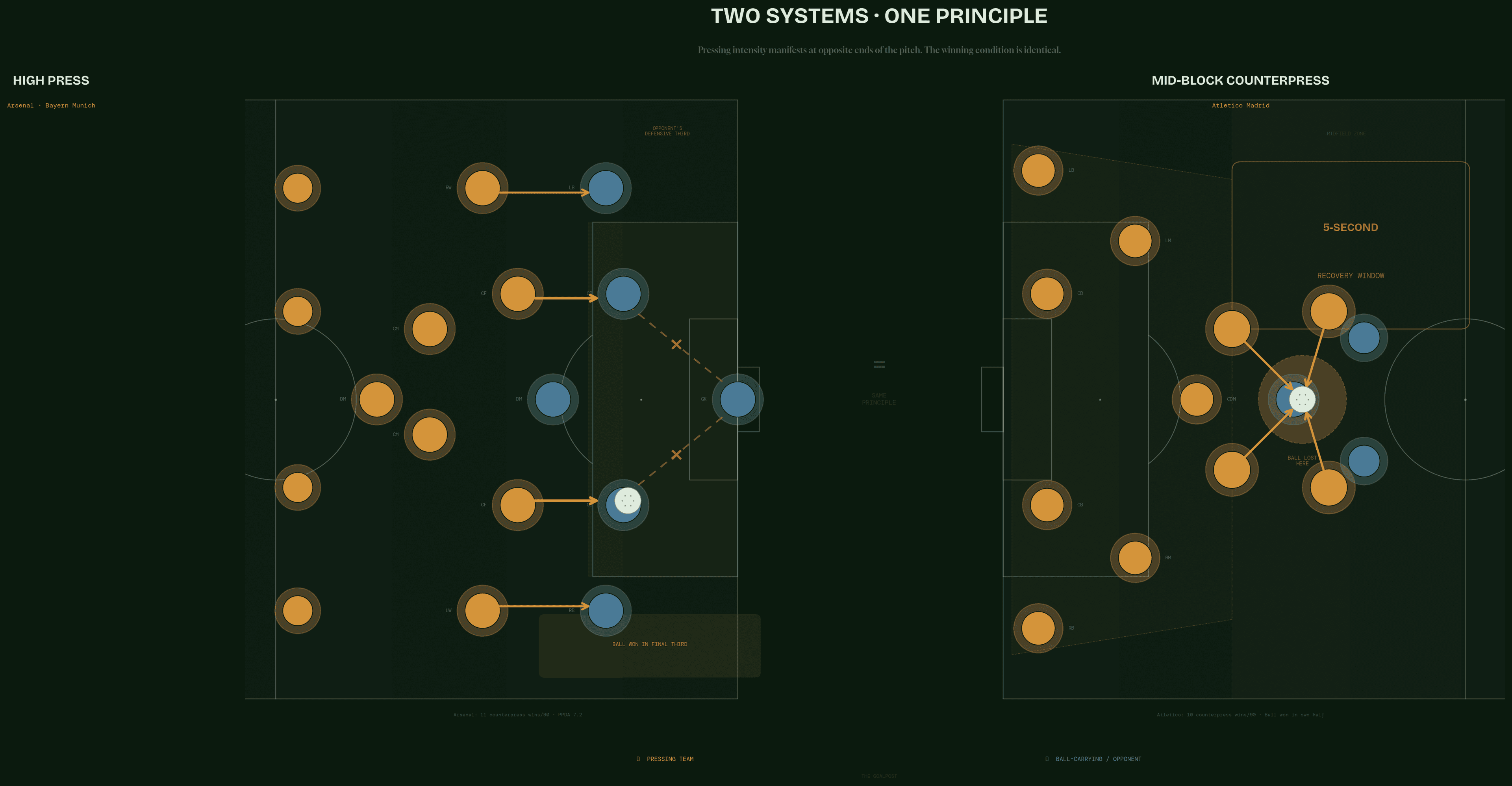
What those critics missed was the press within the low block. Atletico under Simeone do not press high in the conventional sense. But their counterpressing — the intensity of their effort to win the ball back within five seconds of losing it — has always been elite. The data now supports what the eye test showed for years: Atletico's ten counterpressing wins per ninety is second only to Arsenal in this competition.
The system has also evolved. The 2020s Atletico presses higher in specific zones than the 2013 version ever did — particularly when the opponent's wide defenders receive a backpass under time pressure. Simeone has refined rather than replaced. Fifteen seasons of the same core philosophy, continuously updated.
That is not stubbornness. That is institutional knowledge.
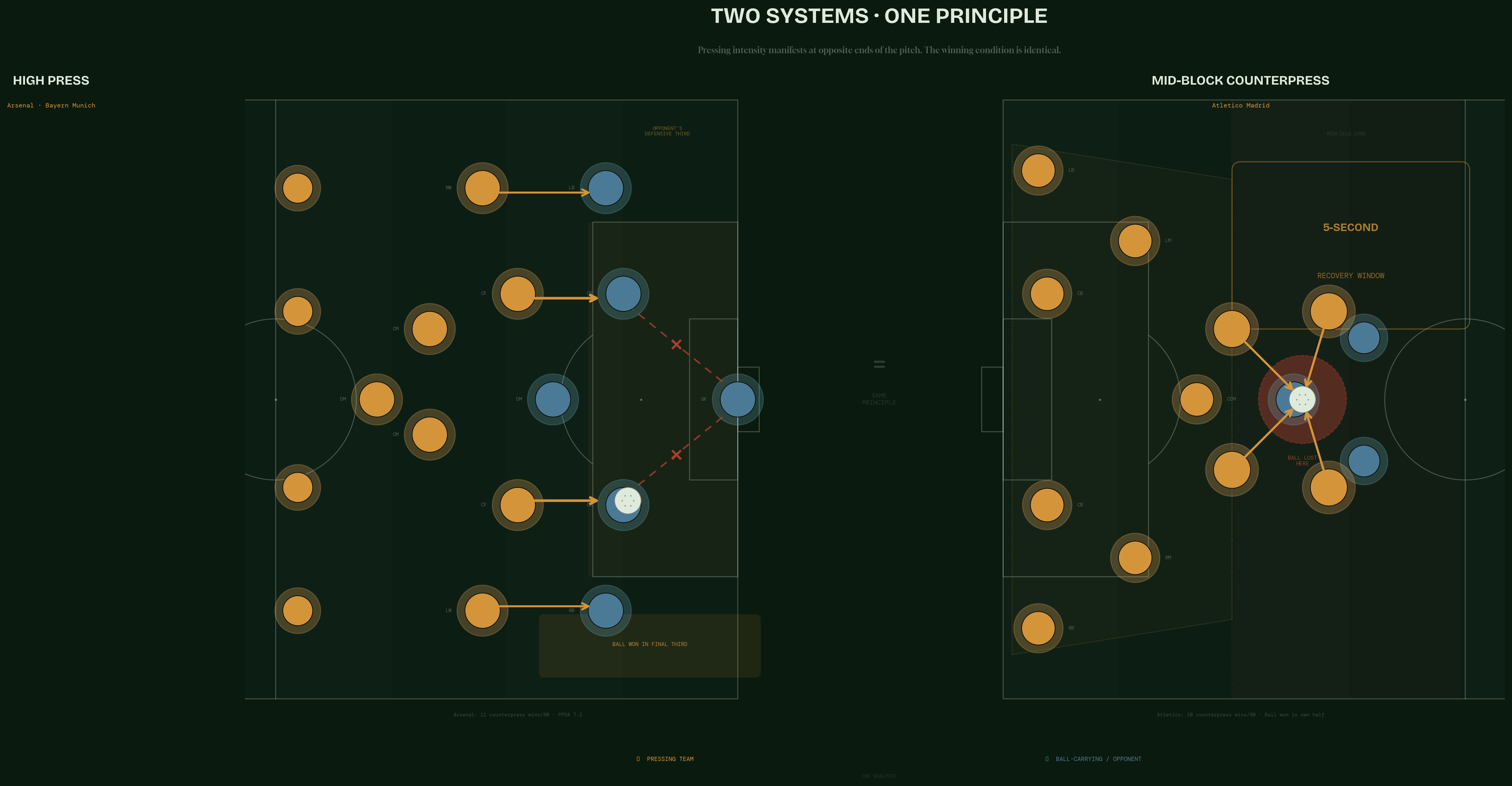
Two systems, one principle. Arsenal and Bayern press at source; Atletico compress space and win the ball back within five seconds. The winning condition is identical.
Bayern: Rebuilding Through Chaos
Bayern's path to the semi-finals is the most turbulent. The Nagelsmann era ended in confusion. Tuchel was a false start. Vincent Kompany was appointed in the summer of 2024 with minimal top-level coaching experience and a mandate that was, charitably, unclear.
What Kompany had was a pressing philosophy that was not merely decorative. At Burnley, in the Championship, he built one of the most aggressive pressing systems in English football. The squad wasn't built for it at Premier League intensity — they were relegated — but the system itself was coherent. Kompany knew exactly what he was trying to build and why.
At Bayern, the first six months were difficult. A squad built for Tuchel's system — deeper, more reactive — had to be relearned entirely. The pressing triggers were different. The recovery runs were different. Bayern conceded seventeen Bundesliga goals before Christmas, which by their standards is catastrophic.
But Kompany kept the squad largely intact and the philosophy completely intact. By February, the press was functioning. By March, Bayern were top of the Bundesliga and through to the quarter-finals. They are now in the semi-finals, with counterpressing data that leads the competition.
Two seasons. Not one. The patience required was real, and not every board would have provided it.
PSG: The Most Expensive Lesson in European Football
PSG are the most instructive case of all four — not because their pressing system is the most refined, but because of what they had to give up to build it.
Between 2011 and 2022, Paris Saint-Germain spent approximately one billion euros on transfer fees. They won Ligue 1 ten times. They reached one Champions League final. Their pressing metrics in that period ranged from inconsistent to non-existent depending on the manager — and there were five of them.
The problem was structural. PSG assembled players whose individual brilliance was beyond question and whose collective coherence was almost entirely absent. You cannot press with Neymar and Mbappe if neither player understands the triggering mechanism. You cannot counterpress if the defensive recovery positions are different every week because the manager changed in January.
What changed, in the end, was the acceptance that individual star power was insufficient. That five players capable of destroying any opponent in a single moment of individual quality do not constitute a pressing system, and that without a pressing system, those five players will eventually face an opponent sufficiently organised to neutralise them — which is what every organised opponent in a knockout tournament did, repeatedly.
The current PSG setup is the result of three seasons under the same manager, working with a squad that was gradually shaped to fit a specific system rather than assembled on the basis of individual brilliance. Their PPDA of 9.1 is not elite by the standards of this competition. It is, however, the best PSG have produced in eleven years of Champions League football.
PSG used to buy players. Now they build systems. The distinction is why they are in the semi-finals for the second consecutive season.
That is the lesson at its bluntest. A club that spent more than any other in European football, that assembled the most individually talented squads the modern game has seen, discovered that none of it was sufficient without the unglamorous, unremarkable, deeply unsexy work of installing and repeating a pressing philosophy until it became instinct.
The Cautionary Tale
The clubs eliminated at the round of sixteen and quarter-finals this season read like a list of expensive impatience.
Chelsea, with their sixth manager in four years, played a press that changed shape every three months and coherently executed none of them. Their PPDA improved and collapsed and improved again with each appointment — the shape of a programme that was being continuously reset rather than built upon.
Barcelona, post-Xavi, attempted to install a high-pressing system on a squad built for positional play. The result was neither: too passive to press effectively, too vertically disorganised to hold possession. They were eliminated in the round of sixteen, at home, by an Atlético side who pressed harder for longer despite being a third of Barcelona's wage bill.
Napoli. The lesson from Napoli is perhaps the starkest of all. Under Spalletti, they won Serie A in 2022-23 playing some of the most coherent, high-intensity pressing football in Europe — 6.8 PPDA for the season, better than any club in the Champions League this year. They replaced Spalletti with four managers in two years. Their PPDA is currently 11.4. Their Champions League campaign ended in December.
The press was not in the players. It was in the system. And the system left when Spalletti did.
Why This Matters Beyond the Semi-Finals
The Champions League semi-finalists are an argument. They are an argument that the sport, at its highest level, is beginning to reward patience and punish the illusion that intensity can be acquired.
The illusion is expensive. It costs managers their jobs, players their confidence, and clubs hundreds of millions in pursuit of something that cannot be bought. PSG are the proof of concept, the exhibit that makes the argument undeniable: if the club with the largest transfer budget in European football history had to give up buying and start building before they could reach a semi-final, then the lesson is probably universal.
The press is a philosophy. It takes seasons to install. It takes seasons to refine. And when you get it right — when you have a group of players who understand each other's movement so deeply that they defend as a single organism — you reach the semi-finals of the Champions League and you deserve to be there.
The four clubs in these semi-finals deserve to be there.
The rest are paying the price for believing otherwise.