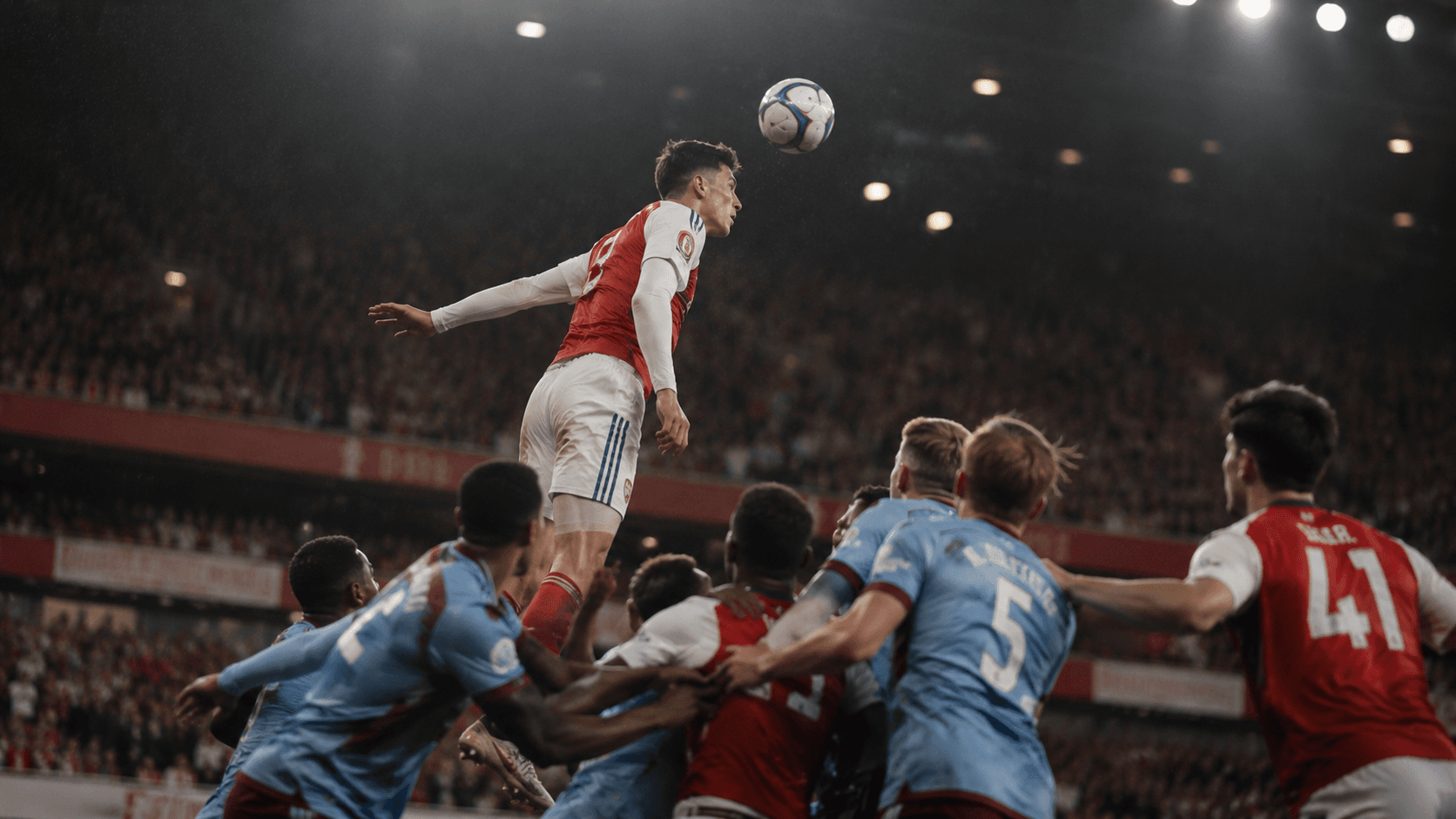
Callum Wilson scored in the 95th minute at the London Stadium on Sunday. He turned away celebrating. His teammates mobbed him. For the better part of a minute — before the review was called, before the clock was stopped, before the picture on the screen at the stadium changed — West Ham had equalized against Arsenal.
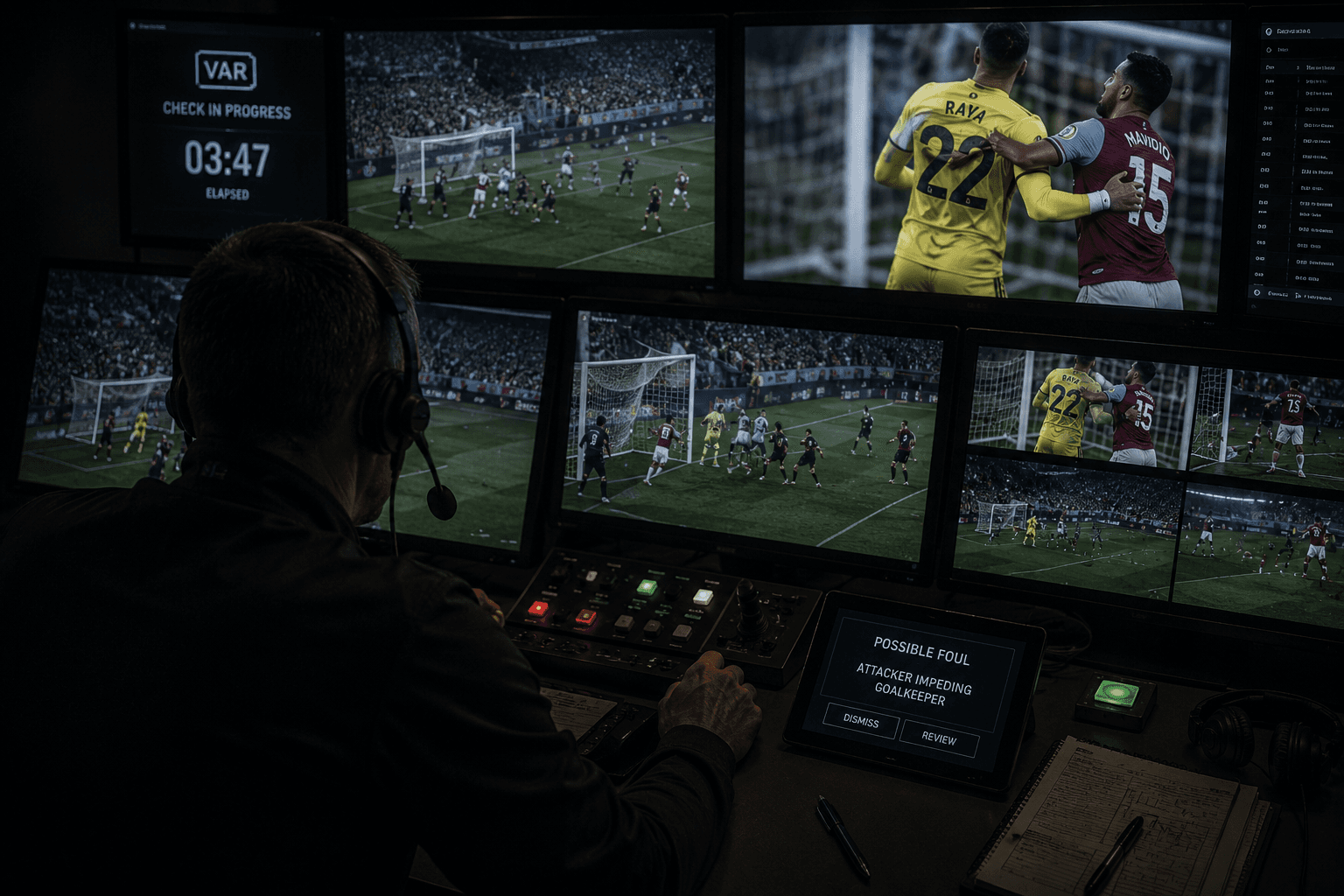
Then came four minutes and seventeen seconds. Seventeen replays. VAR official Darren England working through the footage at Stockley Park, identifying the arm of West Ham's Pablo across the chest of David Raya, concluding that it had impeded the goalkeeper's ability to move. Referee Chris Kavanagh went to the pitchside monitor. He agreed. The goal was disallowed.
Gary Neville called it "the biggest moment in VAR history." He may not be wrong.
The decision was correct. This matters, and it should be said clearly before anything else. Pablo's arm was in an unnecessary position across Raya's chest. It stopped the goalkeeper from catching the ball cleanly. Ian Wright: "without doubt." Jamie Redknapp: "brave, but the right one." Even the ESPN VAR analysis — conducted separately from the match officials — concluded the same. England identified the infringement early and took his time to be sure. The system, on this occasion, functioned exactly as designed.
West Ham manager Nuno Espirito Santo offered something more honest than outrage. "Due to the recent seasons, it has been happening," he said. "Even the referees don't know what is a foul and what is not a foul, it creates doubt."
That sentence is where the real conversation begins.
Arsenal are not unfamiliar with the other side of this. Last season, in the first leg of their Champions League semifinal against PSG at the Emirates, Mikel Merino headed in a Declan Rice free kick just after half-time to seemingly make it 1-1. An agonisingly long VAR check followed. The goal was ruled out for offside. Arsenal lost the first leg 1-0. PSG knocked them out and went on to win the competition.
Merino afterwards: "It was tough, but those are the margins that we manage in these kinds of games. This is elite football, and a few centimetres can determine your future."
A year later, Arsenal are in the Champions League final — and potentially on the verge of a league title that VAR helped preserve on Sunday. The technology that denied them last May now works in their favor. This is not an argument that the decisions were equivalent in correctness. It is an argument that the experience of VAR is inseparable from which side of the decision you happen to be standing on. The club that loses a goal to a VAR check and the club that keeps a lead because of one are not having the same relationship with the technology, even when both decisions are right.
That is the problem.
West Ham captain Jarrod Bowen put it plainly: "Goalkeepers are protected more than outfield players and there is a lot of holding inside the box. Are you going to look at those every time? That is the only way that is the right way to do it."
He is correct. After the disallowed Wilson goal, social media filled within minutes with footage of near-identical incidents from earlier this season — arms across goalkeepers in set-piece situations, goals allowed to stand, VAR silent. The standard applied on Sunday afternoon is not the standard that has been applied consistently. It was the right call. It was also, viewed against the body of decisions across the season, a selective call.
This is what erodes trust faster than any individual wrong decision: not the errors themselves, but the inability to know in advance which errors will be corrected and which will be permitted to stand. The "clear and obvious error" threshold — the bar that VAR must clear before intervening — is a phrase that sounds definitive and functions as anything but. What is clear to one official is ambiguous to another. What is obvious in one half is overlooked in the next.
The camera angle problem compounds this further. VAR is only as powerful as the footage it has access to. When the available replays are inconclusive — certain angles supporting one interpretation, others supporting the opposite — the protocol defaults to the on-field decision. Per IFAB rules, the VAR selects the best angle and speed; the referee can request others. But if the definitive angle doesn't exist, or hasn't been identified, or hasn't been shared with the on-field official, the intervention doesn't happen.
Chelsea against Crystal Palace this season: Pedro Neto went down in the box under a challenge. The referee didn't give the penalty, VAR backed it. Some angles supported Chelsea's claim, others did not. Inconclusive evidence, on-field decision stands. Whether the right call was made is genuinely unknowable because the footage didn't resolve it. Japan's winning goal against Spain at the 2022 World Cup — scored by Ao Tanaka in the 51st minute — is the most famous illustration of what happens when VAR has access to an angle nobody else can see. In the build-up, Kaoru Mitoma chased the ball to the byline and hooked it back across the face of goal. To virtually every viewer watching on broadcast television, the ball had already rolled out of play before Mitoma touched it — a clear strip of green grass was visible between the base of the ball and the touchline. The assistant referee flagged it out. After a lengthy VAR review, the goal stood.
The reason: under IFAB Law 9, the ball is only out of play when its entire circumference has completely crossed the boundary line. A ball is a sphere. Its physical base had crossed the line, but its overhanging outer curvature still hovered above it. FIFA later released overhead goal-line camera footage confirming that roughly one millimetre of the ball still intersected the vertical plane of the touchline. VAR found that angle. Broadcast cameras hadn't shown it. The goal was correct by the laws. It was also a decision that millions of people watching — including, reportedly, those inside the stadium — could not see the evidence for.
The result sent Japan through to the knockout rounds and eliminated Germany from the group stage. It was decided by a millimetre that only one camera in the stadium could prove.
The most egregious illustration of VAR's human dependency came in September 2023. Liverpool's Luis Díaz scored a perfectly legal goal against Tottenham Hotspur, only for it to be disallowed due to a miscommunication between VAR officials and the on-field referee — a goal flagged offside when it wasn't. The Professional Game Match Officials Limited acknowledged a "significant human error." The VAR official on duty, Darren England, was stood down from subsequent matches. The same Darren England who, on Sunday, correctly identified Pablo's arm across Raya's chest and was widely praised for doing so. The machine is only as good as the person operating it — and the person operating it is the same person, capable of getting it catastrophically wrong in one match and precisely right in another.
The numbers do show improvement. The Premier League's Key Match Incidents Panel logged 28 on-field errors in 2024-25, compared to 33 in 2023-24. This season, there have been between 12 and 15 errors that VAR missed entirely — down from higher figures in earlier years. The system is getting better. Incrementally. At a cost measured in disrupted goals, halted celebrations, and four minutes and seventeen seconds of collective uncertainty that no fan of any club fully accepts.
What the numbers also show is that errors have not been distributed evenly. This season, Chelsea have benefited most from VAR mistakes — seven decisions in their favor. Liverpool and Manchester United have each suffered eight errors against them, though in United's case the net points impact is zero, with four errors also going in their favour across the season. Arsenal, who could win the Premier League title before the season ends, would still be top without VAR — but their lead would be one point rather than five. Brighton, meanwhile, have been the silent victims: seven points lost to VAR errors, enough to move them from seventh to fourth in the adjusted table. Across the division, right calls and wrong calls have accumulated into a table that reflects official intervention as much as it reflects football.
This is not unique to England. The conversation about VAR's limitations runs across the continent, and every league tells a version of the same story. Serie A was among the first to adopt VAR — introduced in the 2017-18 season alongside the Bundesliga, a year before Spain's La Liga followed — and Italy opened the world's first VAR training center in 2018. Having lived with the technology longest, Serie A has also had the longest time to confront its inadequacies. They are now experimenting with referees explaining decisions in real time, adding transparency to a process that has consistently suffered from its opacity. La Liga is exploring a challenge system, allowing managers to request a review from the touchline. The Bundesliga has been fractionally more consistent. No league has solved it — because the problem is not implementation. The problem is that football's laws were written for a human referee making decisions at full speed, and slow-motion review systematically makes contact look more severe than it is. Penalty awards have increased in every league that adopted VAR. That is not a coincidence.
Here is what we are left with after Sunday.
West Ham will probably be relegated. They sit in the bottom three, two points behind Tottenham with the same number of games remaining and a significantly inferior goal difference. The Wilson goal — correctly disallowed — may prove to be the moment the season ended for them. Not because they were wronged. They were not. But because on another Sunday, with a different VAR official, the arm across the goalkeeper might not have been called. It might not even have been checked.
Before VAR, that goal would have stood. The referee awarded it. The ball crossed the line. West Ham would have had a point. Arsenal would have two fewer. The title race would look different. This is the version of events that existed for the brief moments on Sunday afternoon before Stockley Park intervened — before the review was called, before the clock stopped, before the picture on the screen changed.
Before VAR, plenty of things that shouldn't have stood, stood. That was the problem VAR was introduced to solve. It has solved some of them. It has introduced new ones. The miscommunication that cost Liverpool a perfectly legal Díaz goal. The inconclusive angles that leave decisions unresolvable. The selective application of thresholds that makes the same contact a foul in minute 95 and irrelevant in minute 45.
The question is not whether Sunday's decision was right. It was. The question is: the next time Pablo's arm is across a goalkeeper's chest — and there will be a next time, in the next match, in the next corner, in the next 95th minute — will the arm be called? Will VAR even intervene?
Nobody can tell you. Not with confidence. Not yet. And perhaps not ever, as long as the system is asking human beings to make consistent judgments about inherently inconsistent contact, in slow motion, under the weight of title races and relegation battles, in four minutes and seventeen seconds.
That is the problem VAR was supposed to fix. It is also the problem VAR has failed to fix. What it has done, in its place, is move the location of the doubt — from the referee on the pitch to the official in the booth, and from the moment of the incident to the long wait afterwards, when the stadium holds its breath and wonders which version of the rules will apply today.